

Stray Narratives is published when the market demands a closer look. Nothing in this publication constitutes investment advice. All views are those of the author. Please read our full disclaimer. If you enjoy this article, please Like & Share, it means the world to me!
Start with a desk.
Every computer has two places to put data, and they do completely different jobs.
The filing cabinet in the corner is the hard drive. It holds everything you own, cheaply, and it is painfully slow. You have to walk over and find the folder.
The desk in front of you is the memory. It holds only what you are working on right now. It costs vastly more per square inch, and it is instant.
The entire point of the desk is immediacy. When you buy memory, you are not buying storage. You are buying time.
For forty years the desk was the boring part of the technology industry. Then artificial intelligence arrived and demanded a desk the size of a football field.
Why AI is starving for memory
An AI model is not a search engine looking things up. It is a vast grid of numbers, hundreds of billions of them, which are the weights it learned during training. To answer a single question, the whole model has to be run through the processor.
This is the bottleneck almost everyone missed. The entire model has to be sitting on the desk at once. Not in the filing cabinet. Every single time anyone asks it anything.
A data centre packed with the fastest processors on earth is useless if there is nowhere to put the numbers those processors need. The industry spent three years working out that the binding shortage was not the graphics chips. It was the desk space next to them.
The answer is High Bandwidth Memory, or HBM: ordinary memory chips stacked twelve or sixteen layers high, drilled through, bonded, and placed hard against the processor. Data travels millimetres instead of centimetres. It is extremely difficult to manufacture, and it is now the single component holding up the global AI build.
The catch: an oligopoly that has never stopped overbuilding
Only three companies make HBM at scale: Samsung, SK Hynix and Micron. SK Hynix is currently the best at the hardest part of it.
In any normal industry, three suppliers controlling a bottleneck for a generational technology would mean you buy the shares, close your eyes, and collect the rent.
Memory has never been a normal industry. It has been a ruthless commodity:
Buyers choose on price. Historically there has been no software lock-in and no ecosystem loyalty.
When memory is scarce, prices triple and the makers print money.
When it is plentiful, prices collapse and they lose money on every chip.
And here is the flaw that has defined the industry for four decades: they have never once stopped themselves from overbuilding. They do not even need new factories to flood the market. They convert existing lines and shrink the circuitry on the chips they already make. Samsung raised its output of memory by about 40% in a year, measured in bits rather than chips, and spent almost nothing extra doing it. Supply arrives without anyone having to fund it. That is why the good times end faster here than in copper, oil or shipping.
So the question is not whether AI needs memory. It plainly does. The question is whether this time the industry finally behaves differently.
There is now real evidence that it is, and that is what most of the market is still not pricing.
Why the demand panic is wrong
SK Hynix shares peaked at 2,987,000 won on 25 June and closed at 1,504,000. They are down 49.6% in seven weeks. The market is pricing the end of the AI build. The evidence does not support it.
1. Customers are paying up, and saying so out loud.
Amazon raised its 2026 capital spending from $200bn to $220bn and its chief executive named rising memory prices as the reason. In the same results it disclosed a contracted cloud backlog of $496bn, up $132bn in one quarter, and said it will not have enough capacity to meet demand in 2026 or 2027. A customer who raises his budget to meet your price is not a customer with weakening demand.
2. The product is now genuinely contracted, and this is new.
On 28 July the company said it has concluded long-term agreements with around ten customers, including its key customers, with further discussions running. On the same call it set out the terms. They run normally around five years. They carry long-term volume commitments. And they carry deposits, which the company says are there “to support contract fulfillment and enhance visibility” of demand. Pricing is deliberately not fixed: the company uses “a range of pricing mechanisms that can better respond to price volatility.”
Read what that structure actually is. The volume is committed and the price is not. For thirty years this industry sold neither. A business with contracted volumes and open pricing is not a commodity producer, it is a toll. That is the single most important change in this company’s history and it happened three weeks ago.
And the deposits matter more than they sound. A customer who puts cash down in advance is part-funding the capacity that will serve him. The oldest question to ask of any supplier is who pays for the next factory. When the answer is the customer, the supplier keeps the rent. That answer has never been available in memory before.
3. It is not just the frontier labs.
The loudest bear case is that the big model labs run out of money. But Microsoft has disclosed that about 90% of Microsoft Cloud revenue comes from ordinary corporate computing rather than frontier AI. That measure includes Office 365 and LinkedIn, so treat it as a direction rather than a precise number, but the direction is clear and it is growing on its own.
4. The supplier is not releasing supply. It is contracting it.
Conventional DRAM wafer capacity is flat in 2026 and shrinks 4.0% in 2027. The share of wafers going to AI memory is forecast to rise from 18% at the end of 2025 to 22% in 2026 and 30% in 2027. Nobody is flooding anything.
Management describes its expansion in terms this industry has never used. Equipment investment and production ramps will run “in phases while considering demand visibility, investment efficiency”, staying ”flexible in alignment with confirmed customer demand.” The historical failure was building against forecasts. This is building against orders.
5. Prices have not turned.
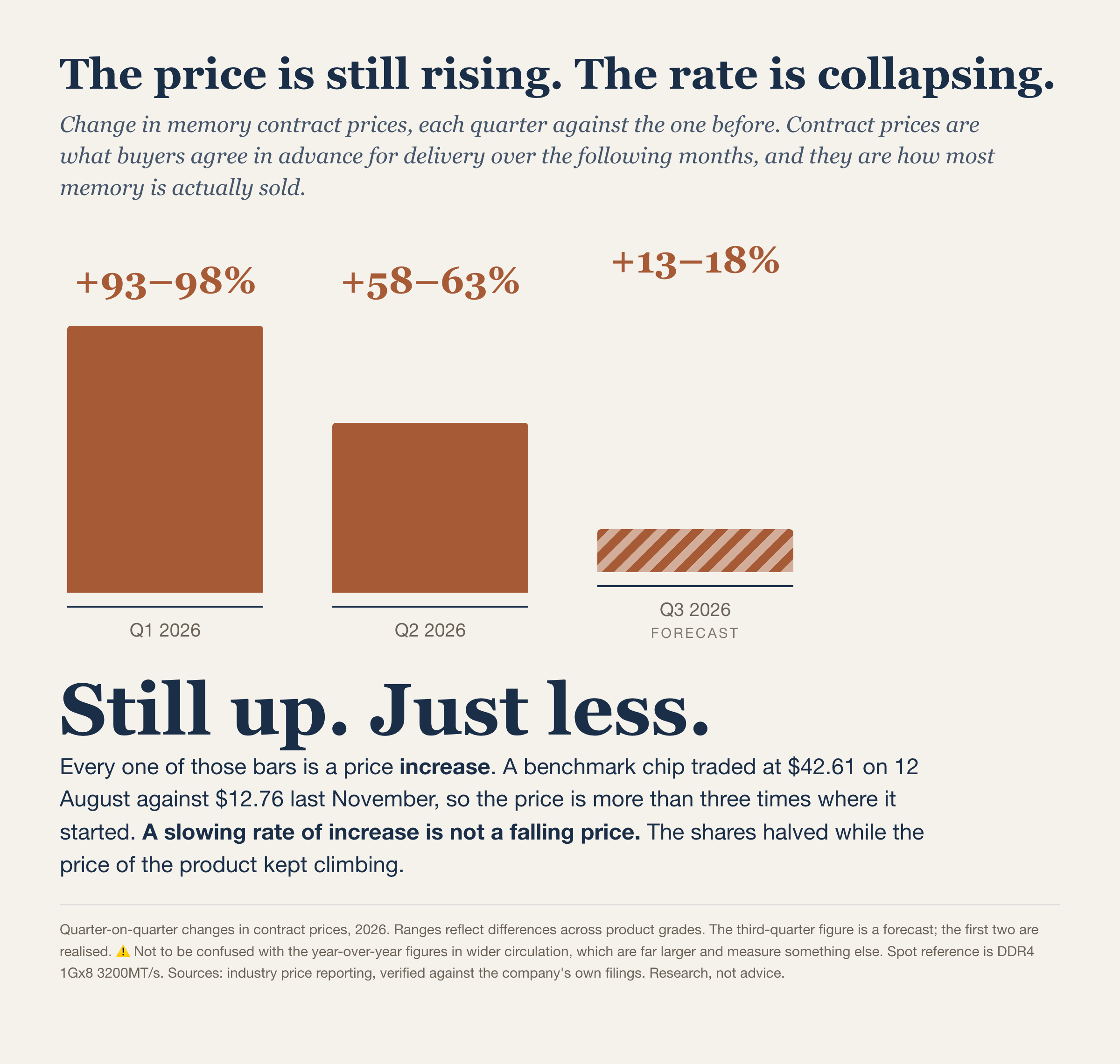
A benchmark chip traded at $42.61 on 12 August, having risen from $12.76 last November. Contract prices rose 93% to 98% in the first quarter and 58% to 63% in the second, with 13% to 18% forecast for the third. The rate of increase is collapsing. A slowing rate of increase is not a falling price.
6. Even the bears’ best evidence points the other way.
Nvidia cut the memory in its Rubin Ultra design from about 1TB to 192-256GB, which was widely read as weak demand. The industry’s own price reporters state the cause directly: the 2027 shortage means suppliers cannot deliver the volume. That is a buyer rationing itself in a shortage, not a buyer that needs less.
So why did the shares halve? A single fund running about $45bn, heavily concentrated in exactly these names, took margin calls at the end of July and was forced to sell most of its public book to Citadel, ending with roughly $10bn. The KOSPI fell about 33% from its June peak. That is a positioning event, not a demand event.
The real pressure point, and how it actually resolves
There is one genuine mechanism that could break this, and it deserves to be understood properly rather than waved at.
A memory factory makes both kinds of chip from the same silicon wafers. Ordinary memory and stacked AI memory. Same buildings, same wafers, a choice about what to run. AI memory yields roughly a third as many gigabytes per wafer because it is so much harder to make.
So AI memory has to sell at a large enough premium to justify giving up the ordinary memory those wafers could have made. For two years that was easy, which is exactly why ordinary memory went short and its price tripled. Not because anyone stopped wanting ordinary memory, but because the wafers that would have made it were making something else.
And the premium has been closing, because ordinary memory has risen far faster than AI memory. If it closes far enough, the wafers should flow back, ordinary supply would rise, and the price of the product that earns most of the profit would fall.
How violent would that be? The industry’s own history gives exact answers, and they are brutal:
1.38 points of surplus was enough to turn the price.
5.8 points of surplus broke it.
One to two points of shortage is what tripled it.
Small moves in volume, violent moves in price. That is the whole industry in three numbers.
But the mechanism has now been tested in public for nine months and has not fired. The price reporters flagged it last October and reported capacity beginning to shift two months later. Since then the share of wafers going to AI memory has gone up, not down. Ordinary memory set a record price. Nobody blinked.
Here is why, and it is the part the bears have wrong:
Leaving AI memory is easy. Coming back is not. Ordinary memory needs a wafer and nothing else. AI memory needs a wafer plus a second step that happens somewhere else: stacking, drilling, bonding, and a control chip bought in from TSMC. The wafers are shared between the two products. That stacking capacity is not, and it had to be built on purpose.
So a maker who moves wafers out to chase today’s ordinary price may not get them back in when it matters, and would surrender its position in the most important hardware of the decade to do it.
And the shortage itself is now the brake. The expected 2027 shortage limits how much capacity can go to AI memory at all, because ordinary memory is too short and too profitable to starve any further.
Which leaves one resolution, and it is the bullish one. If the premium is too thin and no wafers can move, then the premium has to widen from the other end. The industry’s price reporters expect exactly that: AI memory contract prices rising several-fold in 2027. The gap closes by AI memory repricing upward, not by ordinary memory collapsing. Nobody has to switch, and the shortage holds.
That is the reasonable base case, and the market is not paying for it.
What management actually did, and what it does not mean
In July SK Hynix sold $26.5bn of new shares on the American market. Within twenty-four days it approved roughly $41bn of new factory building.
This is usually presented as a warning sign. Read the actual filing and it is mostly not.
The prospectus states what the money is for, and it is specific: 45.5 trillion won for Fab 1 at the Yongin complex and the P&T7 advanced packaging plant at Cheongju, both completing at the end of 2030, plus 11.9 trillion won of EUV lithography scanners for delivery by December 2027.
And it says the raise does not cover it. That is a 57.4 trillion won programme against net proceeds of about 26.2 billion dollars, roughly 37 trillion won. The company writes that it expects to fund the difference from operating cash flow, borrowings and debt. So the common claim that they did not need the money is simply wrong on their own document. It is also worth knowing that quarterly free cash flow is about $12.5bn, not the $40bn of quarterly operating profit that gets quoted as though it were cash.
There are four reasons on the record, and three of them are ordinary:
1. A Nasdaq listing requires a primary raise. This was the largest first-time US share sale by a foreign company ever, seven times oversubscribed, priced at $149, up 13% on debut. You cannot list without selling something.
2. There is a published building programme, and the money does not cover it.
3. Washington is applying pressure. The US Commerce Secretary has been openly lobbying both Korean makers to build American fabs, at the same moment the two of them pledged over $550bn to Korean plants. A US listing and a US shareholder base is a cheap opening move.
4. Management may have thought the price was good. This is the fourth answer, not the best one.
But there is one genuinely interesting fact in the sequence, and it is not the raise. The prospectus filed on 10 July names Fab 1 and P&T7 and nothing else. The terms “M17” and “Fab 2” do not appear in it once. Eighteen days later the company’s own results release named M17, a second Yongin phase, and a new cluster. So they raised against one program and then approved a larger and different one almost immediately.
That is a company responding to demand it did not have visibility on three weeks earlier. It is not a company calling the top.
Valuation: pricing the cycle
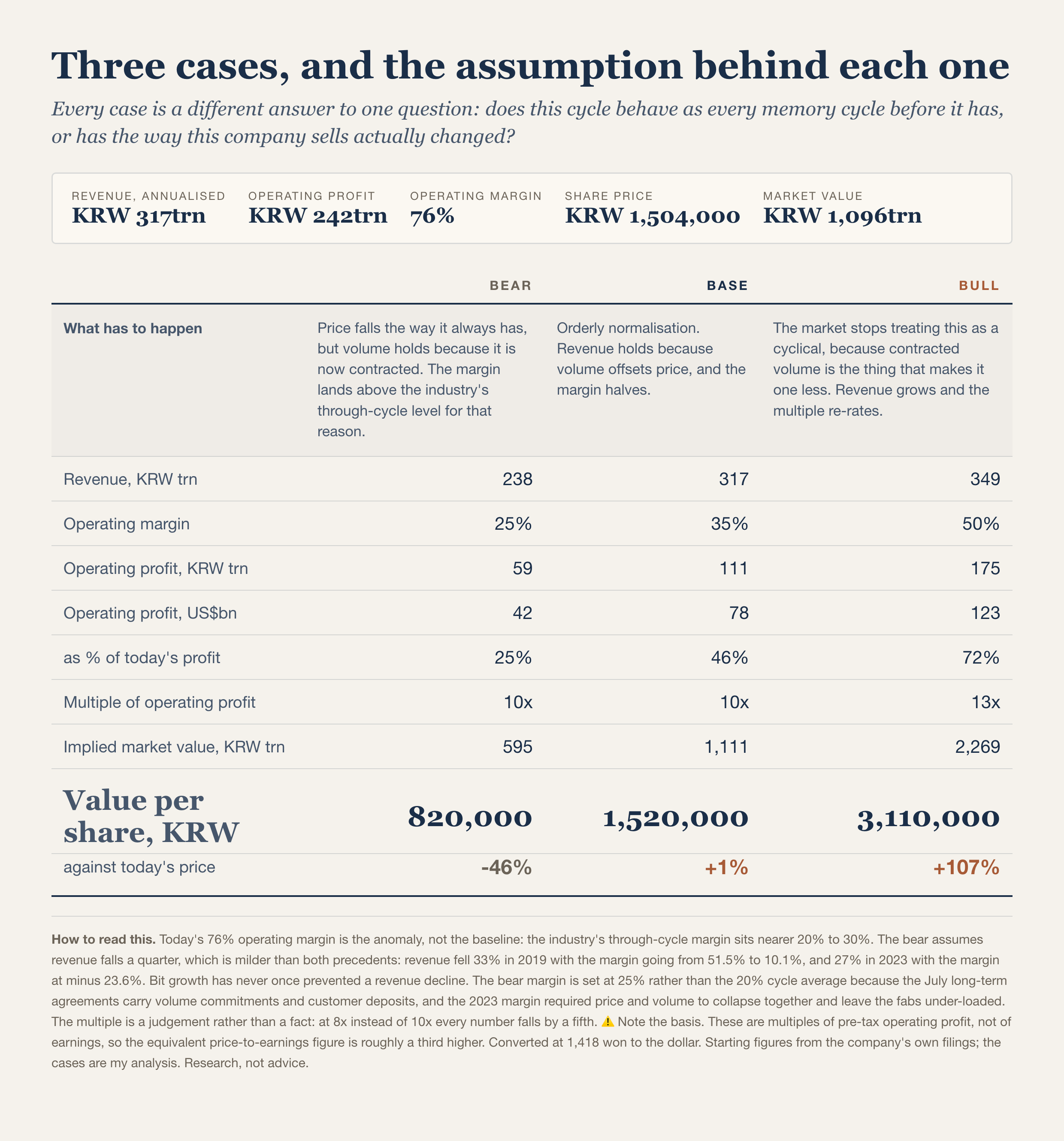
Last quarter the company earned 60.5 trillion won of operating profit on 79.3 trillion won of revenue. At 1,418 won to the dollar, that annualises to about $224bn of revenue and $171bn of operating profit, on a 76% margin, against a company worth about $773bn.
So the whole company costs about 4.5 times one year of current operating profit. That is not a cheap business. It is a peak one. And note the basis: that is a multiple of pre-tax operating profit, not earnings, so the true price-to-earnings figure is roughly a third higher again.
One number has to be set aside, and it is not the one usually named. Last quarter’s bottom-line profit was 93.9 trillion won, half as much again as the 60.5 trillion the factories earned. The difference was not made by making memory. Most of it is a gain on the company’s convertible bond in the Bain-led vehicle that owns Kioxia, the Japanese memory maker, which converts into a stake in that vehicle rather than into Kioxia shares directly. Only about a third of the holding was actually sold. The rest is carried at what the market says it is worth, and Kioxia’s share price roughly halved in July. Every number in this piece uses the factory profit and ignores that gain entirely.
The three cases
How each case is built:
The bear respects the company’s own history. Revenue fell 33% in 2019, with the margin going from 51.5% to 10.1%. It fell 27% in 2023, with the margin at minus 23.6%. Volume growth has never once prevented a revenue decline. A 25% fall is therefore milder than both precedents, deliberately.
The bear margin is 25% rather than the 20% the industry averages through a cycle, and the contracts are the reason. The catastrophic margins of 2023 happened because price *and* volume collapsed together and the fabs ran half empty. Committed volumes with deposits are precisely what prevents that. A price-only downturn does far less damage than a price-and-volume one.
The base assumes today’s 76% margin is the anomaly it obviously is and halves it, while volume growth offsets falling prices to hold revenue flat.
The bull needs the multiple to change, and now has a reason. Thirteen times instead of ten is what you pay for a business with contracted volumes rather than a pure cyclical. Before those agreements existed that was a hope. It is now a mechanism.
The multiple is a judgement, not a fact. At 8x instead of 10x, every number falls by a fifth.
The risk that trades at nothing
Two of the company’s plants sit in China: Wuxi, which makes legacy DRAM, and Dalian, the former Intel NAND plant. Their US export waivers were revoked at the end of 2025 and replaced by an annual site-license review. The company’s access to American equipment for a meaningful part of its capacity is now renewed once a year, at Washington’s discretion. That is currently priced at nothing.
The bottom line
Demand for high bandwidth memory is not weakening, and the 50% fall was a forced seller in a crowded trade rather than a change in the business. What has changed, and what the market has not absorbed, is that this company now sells contracted volume at open prices. That is a different business from the one whose forty-year range everyone is quoting at it. The pressure point on wafers is real, and on the evidence it resolves through AI memory repricing upward rather than through ordinary memory collapsing.
I am treating this as a tactical position with a rerating case attached rather than a buy-and-forget.
Wrong if:
1. The share of wafers going to AI memory starts falling while prices hold. That would mean the supply response of the past forty years is finally arriving.
2. The long-term agreements turn out to carry no deposits and no real volume commitment. The structure is the whole rerating case. If the terms are soft, the case is soft.
3. A benchmark contract price prints a quarter-on-quarter fall. Not a slower rise. A fall.
Status:
On its last filed accounts, 99.87% of 2025 revenue and 99.94% of first-quarter revenue was recognised at a point in time, with no backlog and no take-or-pay. The agreements announced on 28 July are not yet in any filing.
The share of wafers going to AI memory is still rising, not falling.
The most recent benchmark spot price is a new high, not a fall.
None of the three conditions is met.
References
1. SK hynix Inc., Prospectus (Form 424B4), filed 10 July 2026. SEC CIK 0002120882, accession 0001193125-26-299963. Use of proceeds, capital expenditure table, revenue recognition by timing, and China facility risk factors.
2. SK hynix Inc., “SK hynix Announces 2Q26 Financial Results”, 28 July 2026. Revenue, operating profit, net profit, long-term agreements, and mid-to-long-term investment plans including P&T7 and M17.
3. Amazon.com Inc., second-quarter 2026 results and earnings call, 30 July 2026. Capital expenditure guidance and AWS backlog.
4. Microsoft Corporation, quarterly disclosure of Microsoft Cloud revenue composition.
5. TrendForce, Memory Spot Price Update, weekly, November 2025 to August 2026. DDR4 1Gx8 3200MT/s spot prices.
6. TrendForce, DRAM contract price forecasts, quarter on quarter, 2026, published 3 July 2026.
7. TrendForce, “DRAM Supply to Remain Tight in 2027, Prompting NVIDIA to Lower HBM Configurations for Rubin Ultra”, 4 August 2026.
8. TrendForce, HBM wafer allocation and 2027 contract price outlook, 2 June 2026.
9. US Bureau of Industry and Security, “Revocation of Validated End-User Authorizations in the People’s Republic of China”, Federal Register, 2 September 2025, effective 31 December 2025.
10. EODHD market data. SK hynix (000660.KO) closing prices and USD/KRW, to 12 August 2026.