

Stray Narratives is published when the market demands a closer look. Nothing in this publication constitutes investment advice. All views are those of the author. Please read our full disclaimer. If you enjoy this article, please Like & Share, it means the world to us.
We are opening a position in a Dutch company that builds the largest man-made objects that move, parks them in the deep ocean, and then does the single most boring, most profitable thing in energy: it collects the rent. The company is SBM Offshore. It trades in Amsterdam, most professional investors have never opened its filings, and it is the closest thing the oil industry has to a toll booth — sold to us, right now, at the price of a cyclical.
Let us start with the machine, because the machine is the whole story and hardly anyone outside the industry has seen one.
Imagine an oil tanker. Now imagine that instead of a hold full of crude, its deck carries a chemical plant — separators, compressors, gas-treatment trains, a power station, accommodation for a couple of hundred people — the entire apparatus of an onshore refinery, welded onto a hull the length of three football pitches and moored in two kilometres of water a hundred miles from land. Pipes run down to wells on the seabed. The raw mixture of oil, gas and water comes up, gets separated on deck, the oil is stored in the hull, and every week or so a shuttle tanker pulls alongside and carries it away. It is called an FPSO — Floating Production, Storage and Offloading vessel — and it is how the world now produces oil in places too deep for a pipeline to shore: offshore Brazil, offshore Guyana, off West Africa. One of these things can cost three to five billion dollars and will sit on station, pumping, for twenty years.
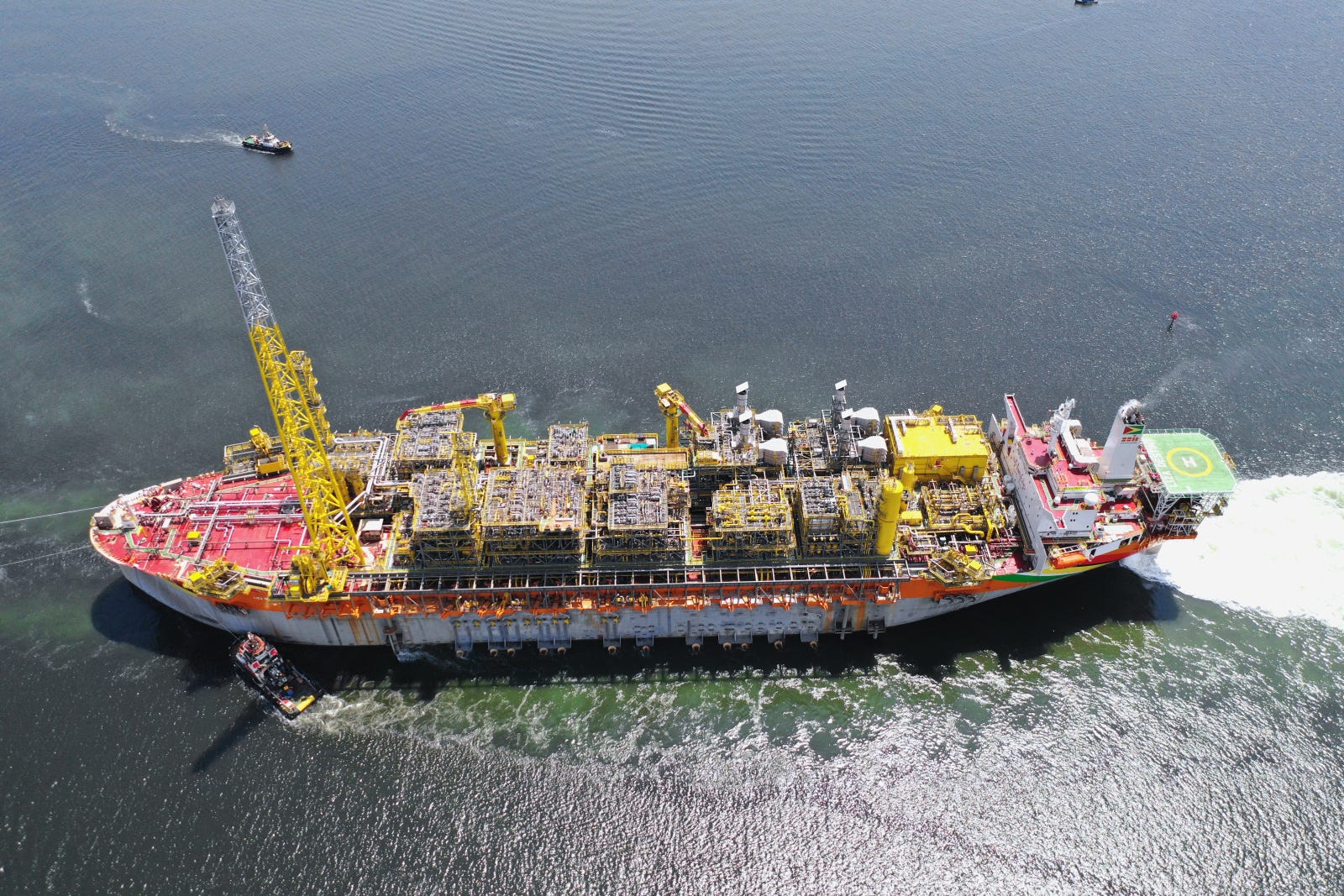
Source: SBM Offshore
https://media.sbmoffshore.com/en/asset-details-page/3328:image:3dc3e75dafc34c08b263d44f8251a982#/search-id=1784027290282_107140893/
Here is the part that matters. The oil major — Petrobras, ExxonMobil — does not, as a rule, want to own the machine. It wants the oil. Owning a floating factory is a headache: you have to build it, finance it, crew it, maintain it, keep it running through hurricanes and equipment failures for two decades. So the major does what any sensible company does with an expensive, specialised asset it needs but would rather not run. It rents.
That is SBM’s business. It builds the FPSO, and then it leases and operates it for the field’s life — ten, fifteen, twenty years — for a contracted day-rate, paid whether the oil price is forty dollars or a hundred. The major is contractually obliged to pay for the machine to be available, in the same way you pay your mortgage whether or not you enjoyed living in the house that month. SBM is not selling oil. It is selling uptime. It is a landlord.
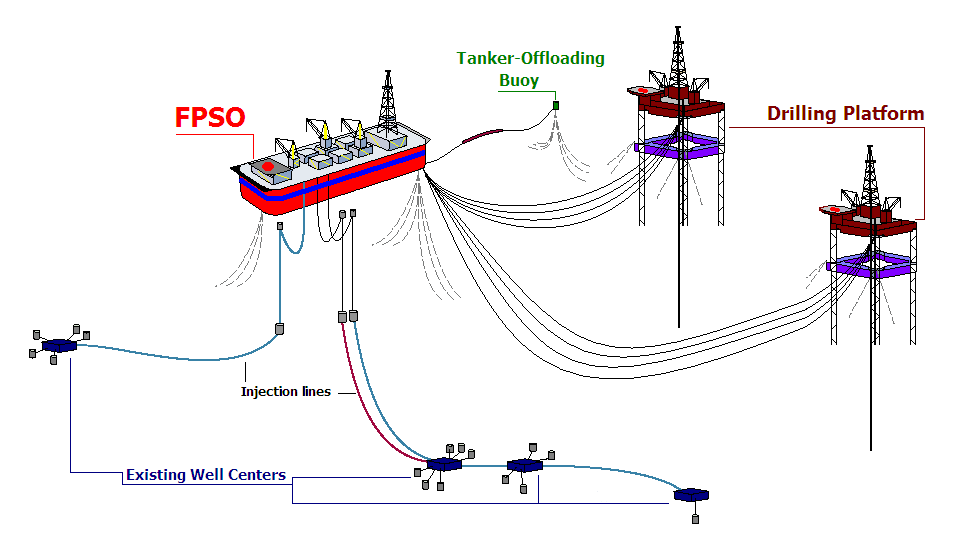
By User:WikiDon - From en: Ther uploaded with GFDL- licence by User:WikiDon, CC BY-SA 3.0,
https://commons.wikimedia.org/w/index.php?curid=696897
The magic trick everyone watches instead
The reason nobody talks about the landlord is that offshore energy is a genuinely thrilling casino, and the landlord is the one person in the building not gambling.
When investors say “offshore is back” — and it is; deepwater now breaks even around forty-three dollars a barrel, which is marginally cheaper than American shale at forty-five, a quiet reversal of the last decade’s received wisdom [6] — they reach for the exciting names. They buy the drillers: Transocean, Valaris, the companies that own the rigs that drill the wells. These are magnificent, terrifying instruments. A drillship is rented by the day, and the day-rate swings from a hundred and fifty thousand dollars at the bottom of the cycle to six hundred thousand at the top and back again, tracking the oil price like a needle on a seismograph. Own one at the right moment and you triple your money; own one at the wrong moment and you go through Chapter 11, which most of them did in 2020. It is a wonderful trade and a terrible annuity.
Or they buy the plumbers: TechnipFMC, Subsea7, Saipem — the engineering firms that lay the pipe and install the hardware on the seabed. Better businesses, real backlogs, and right now the market’s darling: TechnipFMC trades at roughly fifteen times EBITDA, near an all-time high, because it is the quality name in a hot sector. There is even a merger to gossip about — Subsea7 and Saipem are combining into a contractor with a backlog north of forty billion euros, antitrust regulators permitting, which is its own soap opera.
So the whole room is watching the drillers gamble and the plumbers merge. And in the corner, unwatched, is the one company that already signed the twenty-year lease and is simply collecting.
A toll, not a bet
This is the distinction the market is not pricing, and it is the entire idea: a day-rate is a bet on the oil cycle; a twenty-year lease is a toll on production. The driller gets re-priced every few months by the crude curve. SBM’s tenant is locked in until the 2040s at a rate agreed before the first barrel flowed.
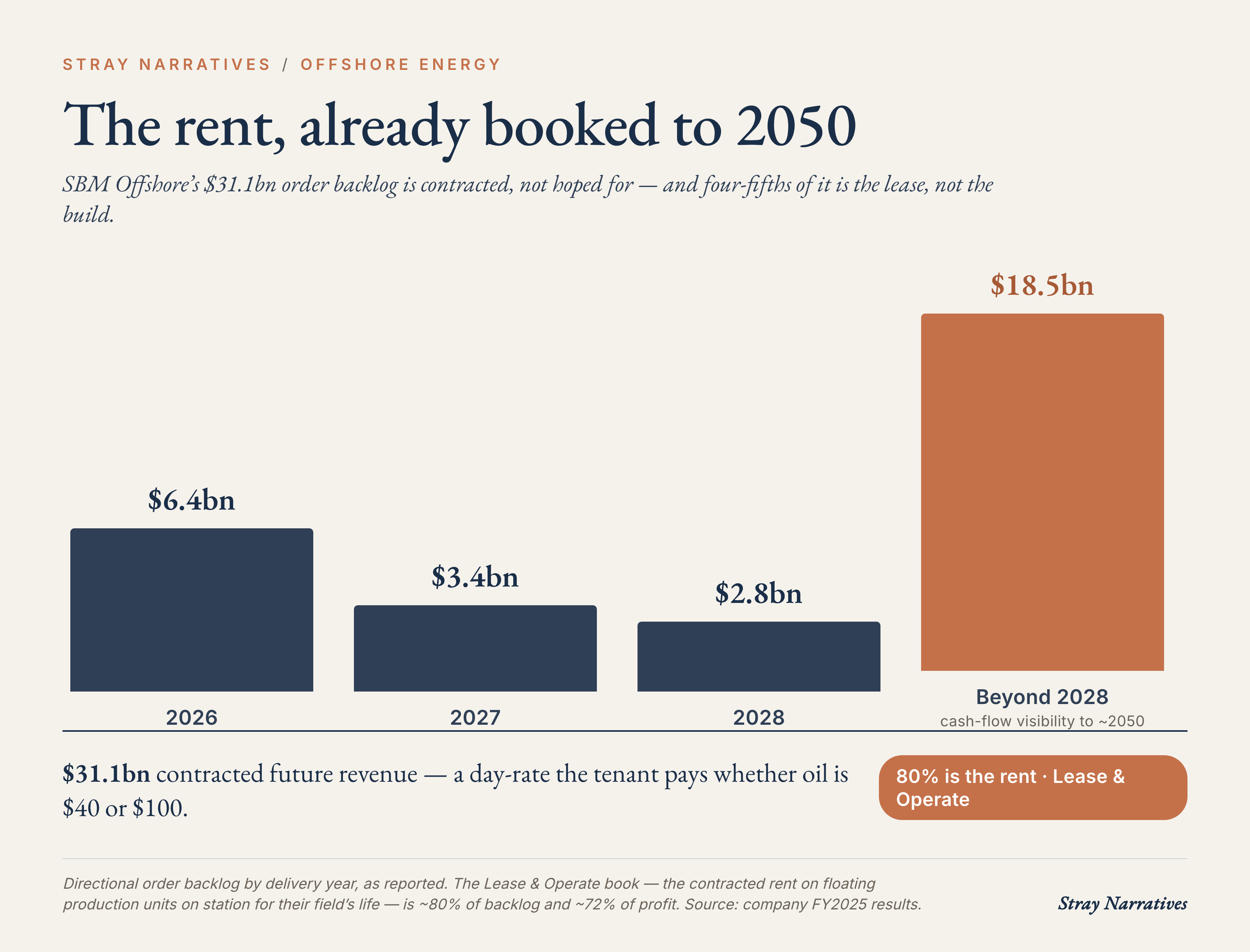
Put a number on it. SBM’s order backlog — the contracted, already-signed future revenue — is $31 billion, with cash-flow visibility running to 2050. Eighty per cent of that backlog, and roughly seventy per cent of the profit, is the lease-and-operate book: the rent. Not the oil price. The rent. The margin on that rent is fifty-four per cent, because once the machine is built and paid for, keeping it running is cheap and the cheque arrives every month regardless.
And the obvious objection — that a twenty-year fixed cheque is not an annuity but a bond, quietly halved by two decades of inflation — is one the company has already answered. The backlog is, in SBM’s own words, “backed by firm contracts from premium clients with inflation protection” [5]. The rent escalates. The landlord thought of it first.
We have spent a good deal of this publication's ink on the difference between businesses paid on volume and businesses paid on price — the toll booth versus the commodity. SBM is the cleanest toll in the entire energy complex, and it is hiding in the one corner of the market everyone has decided is a pure commodity play.
“But look at the debt”
Here is where the professional investor, glancing at the screen for the first time, recoils. SBM carries around eight billion dollars of net debt on the IFRS measure, against a market value near six. For a company that gambles, that is a death sentence. It is the reason the stock screens as a scary levered cyclical and gets a scary levered-cyclical multiple.
It is also the wrong number — and this is the crux of the trade.
There are two debt figures here, and the gap between them is the entire argument. The IFRS measure consolidates every financed vessel in full. The company’s own preferred measure, Directional, tracks what the parent is actually on the hook for, and it stands at US$3.2 billion. Most of the difference is non-recourse project finance. It does not sit at the parent. It sits inside each individual floating factory, secured against — and repaid by — that specific lease. The bank lent against the contracted cash flow of one machine and can only ever look to that machine. The debt is a mortgage on a building, and the building comes with a tenant who has signed for twenty years and cannot leave.
You do not have to take our word for it, because SBM ran the experiment for us. In February it sold one FPSO — a unit called ONE GUYANA — to ExxonMobil Guyana for about US$2.32 billion in cash, and used the proceeds to repay, in full, the US$1.74 billion of project financing secured against that vessel [2]. Read that again: one machine, sold for a third more than the debt tied to it. The mortgage was not a millstone. It was comfortably covered by the asset it was lent against. Directional net debt is now US$3.2 billion, down forty-three per cent year on year, primarily on that sale [3]. And the landlord did not even lose the tenant — SBM continues to operate and maintain the vessel until 2035 [2]. It sold the building and kept the management contract.
A levered cyclical cannot do that. A portfolio of financed annuities can, because the leverage was never fragility. It was the plumbing of the toll.
The price
So what does the market charge for the cleanest annuity in energy, run by a company that just proved its debt is a mortgage and not a millstone?
The whole enterprise — equity and debt together — costs about five times forward EBITDA: earnings before interest, tax, depreciation and amortisation. For context, the plumbers you are being encouraged to buy instead trade at six to fifteen times the same measure, with more oil-price exposure and more project risk. On the crude price-to-earnings line the stock looks like value-trap wallpaper — roughly seven times — but the sharper figure is the cash it hands back. SBM returned $440 million to shareholders last year, up fifty-seven per cent, a mix of dividend and buyback worth about seven per cent of the market value, and it has committed to a minimum of $2.1 billion of returns over the next six years. You are paid roughly seven per cent a year, in cash, to wait — while a book of twenty-year leases quietly amortises the debt for you and a deleveraging balance sheet does the re-rating in the background. The analysts who cover it — the few who do — carry an average target around thirty-five per cent above today’s price.
Where we could be wrong
We try never to fall in love, so here is the case against, stated as strongly as we can make it.
First, SBM is a hybrid, not a pure landlord — and the impure half is not a half. The Turnkey division, which builds the machines, booked US$2.9 billion of first-quarter revenue against Lease & Operate’s US$0.6 billion. Turnkey is most of the revenue and little of the profit; the rent is little of the revenue and most of the profit. That asymmetry is the company — and it means the construction arm can hurt you long before the annuity does.
Second, this is a concentrated toll, not a diversified perpetuity. Strip the backlog down and it is overwhelmingly two counterparties: Petrobras in Brazil, and ExxonMobil in Guyana. A Brazilian political lurch or a Guyanese disruption would hit the “annuity” harder than the word annuity implies. Two tenants is not a bond ladder.
Third, the rent roll does not grow in a straight line. The backlog actually fell by four billion dollars last year, because new mega-contracts are lumpy — a handful of awards drive the whole book — and the pace of new leases still rides the deepwater sanctioning cycle. If oil sags into the fifties and the majors defer their next round of projects, the existing rent keeps arriving on schedule, but the growth stalls and the stock waits longer for its re-rating.
Notice, though, what none of those objections touch: the cash flow already contracted to 2050. The bear case is an argument about SBM’s growth and its construction arm. It is not an argument against the rent. You are being asked to underwrite whether the landlord finds new tenants, not whether the current ones pay — and while you wait for the answer, you collect seven per cent.
The trade
We are adding SBM Offshore to our list of positions, and we are underwriting it over three years.
The shape of the return is unusually legible for an energy name. In the sour case, growth stalls and the multiple sits where it is, and we are left clipping a seven-per-cent yield for something in the low teens a year — a poor outcome that is still a positive one. In the base case, the backlog replenishes, the balance sheet keeps shedding debt as the leases amortise, the stock drifts toward the analysts’ thirty-five-per-cent-higher target, and the yield rides on top, for high teens to low twenties a year. In the good case, the market finally notices that a twenty-five-year contracted cash-flow stream is an infrastructure asset and not an oilfield-services stock, re-rates it toward the multiple that pipelines and toll roads command rather than the one that drillers get, and the number has a three in front of it — a year.
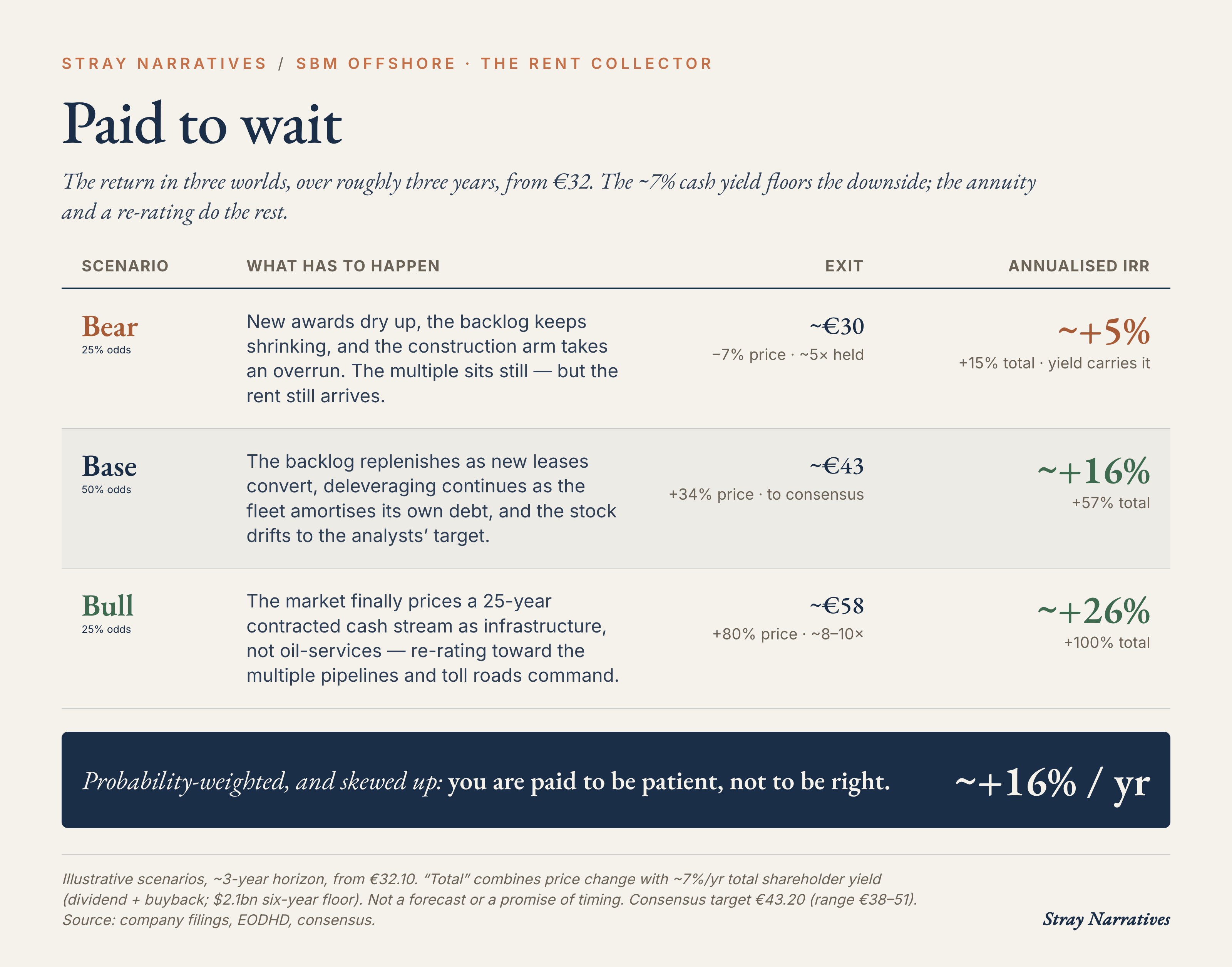
The market is paying fifteen times for the company that installs the plumbing, and five times for the company that owns the factory and collects the rent until 2050 — and it calls the second one risky because it appears to have debt, when the debt is simply the mortgage on a building that someone else is contractually obliged to pay off.
We will happily be the landlord.
References
[1] SBM Offshore — Full-Year 2025 Earnings and Annual Report. Directional backlog US$31.1bn with cash-flow visibility to 2050; Lease & Operate backlog US$25.0bn of US$31.1bn (~80%); Lease & Operate Directional EBITDA US$1,235m of US$1,709m total (~72%) on revenue of US$2,295m (~54% margin); the ~US$4bn year-on-year backlog decline; IFRS net debt US$8.1bn; Directional net debt US$5,651m at 31 December 2025; capital returns US$440m (+57%) and the US$2.1bn six-year minimum distribution commitment.
[2] SBM Offshore — FPSO ONE GUYANA purchase by ExxonMobil Guyana completed (4 February 2026). Total cash consideration of c. US$2.32 billion; the net cash proceeds primarily used for the full repayment of the US$1.74 billion project financing; SBM Offshore continues to operate and maintain the FPSO up to 2035.
[3] SBM Offshore — First Quarter 2026 Trading Update. Directional net debt US$3.2 billion at 1Q 2026, a 43% decrease year on year, primarily reflecting the ONE GUYANA sale.
[4] TechnipFMC, Subsea7 and Saipem — company filings and the Subsea7/Saipem merger announcement. Comparator EV/EBITDA multiples (~6–15×) and the combined entity’s backlog.
[5] SBM Offshore — First Quarter 2025 Trading Update: “Our pro-forma Directional backlog … is backed by firm contracts from premium clients with inflation protection.”
[6] Rystad Energy — published upstream breakeven analysis: deepwater breakeven ~US$43/bbl against North American shale ~US$45/bbl.
[7] EODHD. Share prices, forward EV/EBITDA (~5×) and P/E (~7×), and the sell-side consensus target (€43.20, ~+35%).