Stray Narratives is published when the market demands a closer look. Nothing in this publication constitutes investment advice. All views are those of the author. Please read our full disclaimer. If you enjoy this article, please Like & Share, it means the world to me.
When I wrote about Magnum back in May, I left one big question open. I called it the load-bearing one: does the listed company structure put a permanent ceiling on Magnum’s margin compared to what Froneri can reach?
Froneri is the Nestlé and PAI joint venture making ice cream in the exact same countries, buying the exact same dairy, cocoa, and packaging. Everyone uses them as the yardstick so I did too.
But as I do for every name I discuss here, I went back to dig more through Froneri’s accounts and made a few interesting discoveries.
How Bad Math Becomes Gospel
The number floating around every trading desk is that Froneri earns 26%. Against Magnum’s mid-teens, so what is Magnum doing wrong? Add in the fact that Froneri owns Häagen-Dazs outright in North America, bought for cash a quarter of a century ago and royalty-free until 2110, which is a setup Magnum cannot replicate.
But Froneri’s audited accounts show 21.5%, and 21.6% the following year. The year before that, they earned 18.3% and actually lost money before tax. Even the rating agencies covering their debt only forecast a peak in the low twenties.
So where does the 26% come from? It is worth understanding, because this mechanism is incredibly common and it is exactly how garbage numbers travel around.
Somebody took a press-reported enterprise value, divided it by a press-reported transaction multiple to back out an EBITDA figure, and then divided that by revenue to get a margin. The multiple and the margin are the exact same data point and that phantom EBITDA sitting in the middle is a heavily adjusted figure prepared for a debt syndication pitch, running about a fifth higher than the audited number. The leverage statistic everyone blindly quotes for Froneri comes from that exact same denominator and understates the real debt load by more than a full turn.
The Math Works
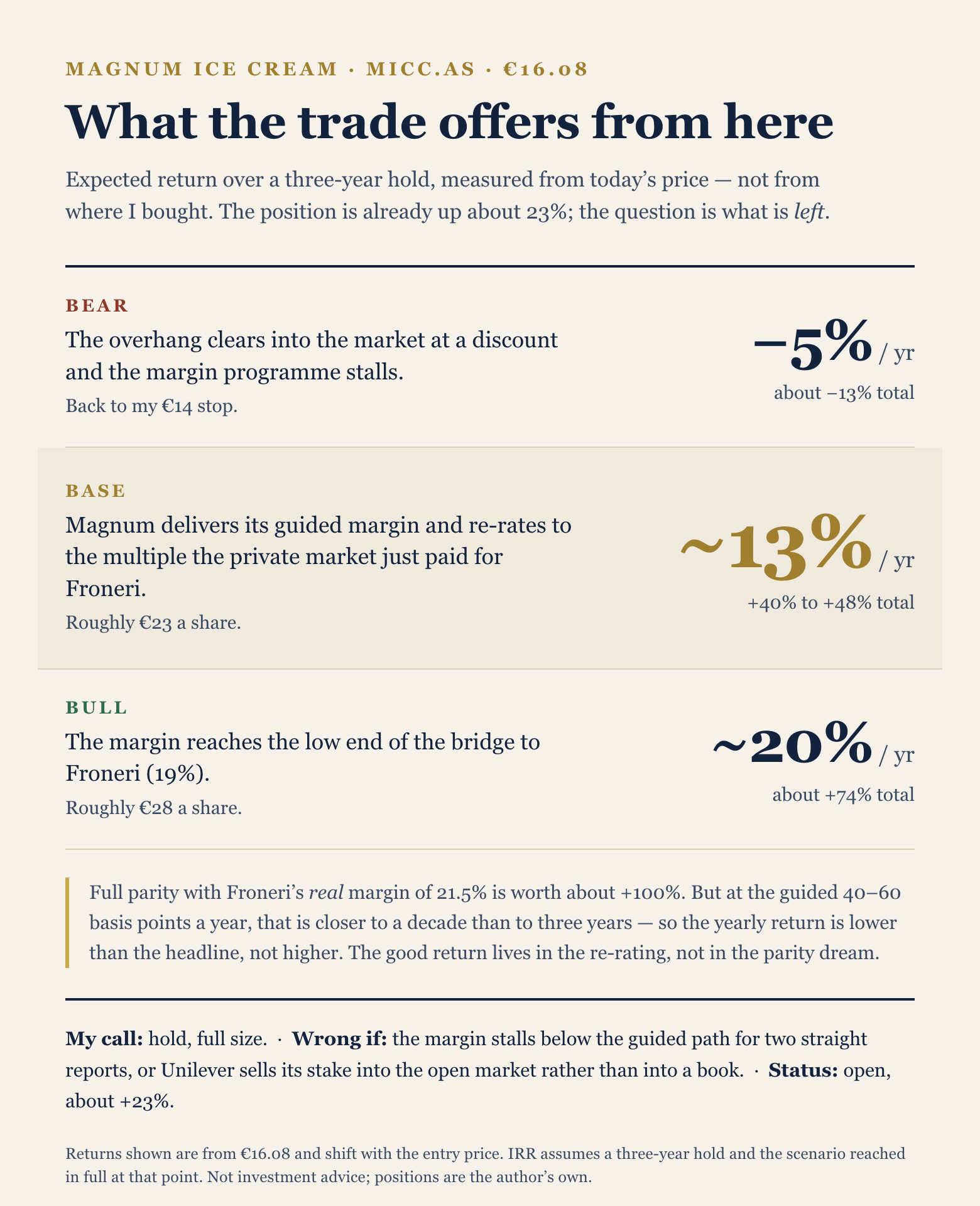
So the open question I had in May has an answer and it is not the one implied. Magnum’s reachable range is 19% to 22% so the cap I could not rule out looks like it is not even actually there.
I want to be careful about what this does and does not settle. It does not make the cost-cutting program easy. Management is guiding to forty to sixty basis points a year, which is a glacial pace, and slow corporate turnarounds fail regularly. It also does not make Froneri a weak operator. Pulling 21.5% is a very strong margin in this category, and Magnum still has a steep hill to climb.
What it removes is the arithmetic impossibility of catching them.
Taking the ‘L’ on the Overhang
There is one other thing I have changed my mind about, and this one cuts the other way.
In May, I described Unilever’s remaining stake as coming to market on an orderly, scheduled basis. That is not what the filings say.
Unilever still holds essentially all of it. There are absolutely no lock-up arrangements, and the whole position has been registered for an at-will sale since before I even bought the stock. We are talking about a block equivalent to roughly a quarter of the free float, just sitting there undated. The optimist stance is that Unilever trusts the business and wants to remain invested, the pessimist stance is that the can dump that stock at any time.
The Bottom Line
Despite the overhang, the position is up around 23% and I am keeping it at full size. It is still trading below the multiple its private peer commands so I will continue holding it as long as the margin continues to trend towards that number.