

Stray Narratives is published when the market demands a closer look. Nothing in this publication constitutes investment advice. All views are those of the author. Please read our full disclaimer. If you enjoy this article, please Like & Share, it means the world to us.
Four months ago we drew a map of the rates market. It held where it mattered and failed where we warned it might. Today we close the book: one large win, two small losses.
“The Wrong Map” went out in March on one admission, we did not know which tail would arrive, so we built three legs that would pay across different states of the world. Looking back, thank god we did not venture in predicting how the Hormuz crisis would evolve!
The scorecard
The tanker win dwarfs the two rates losses, and the premiums were small by design, so the book closes comfortably ahead.
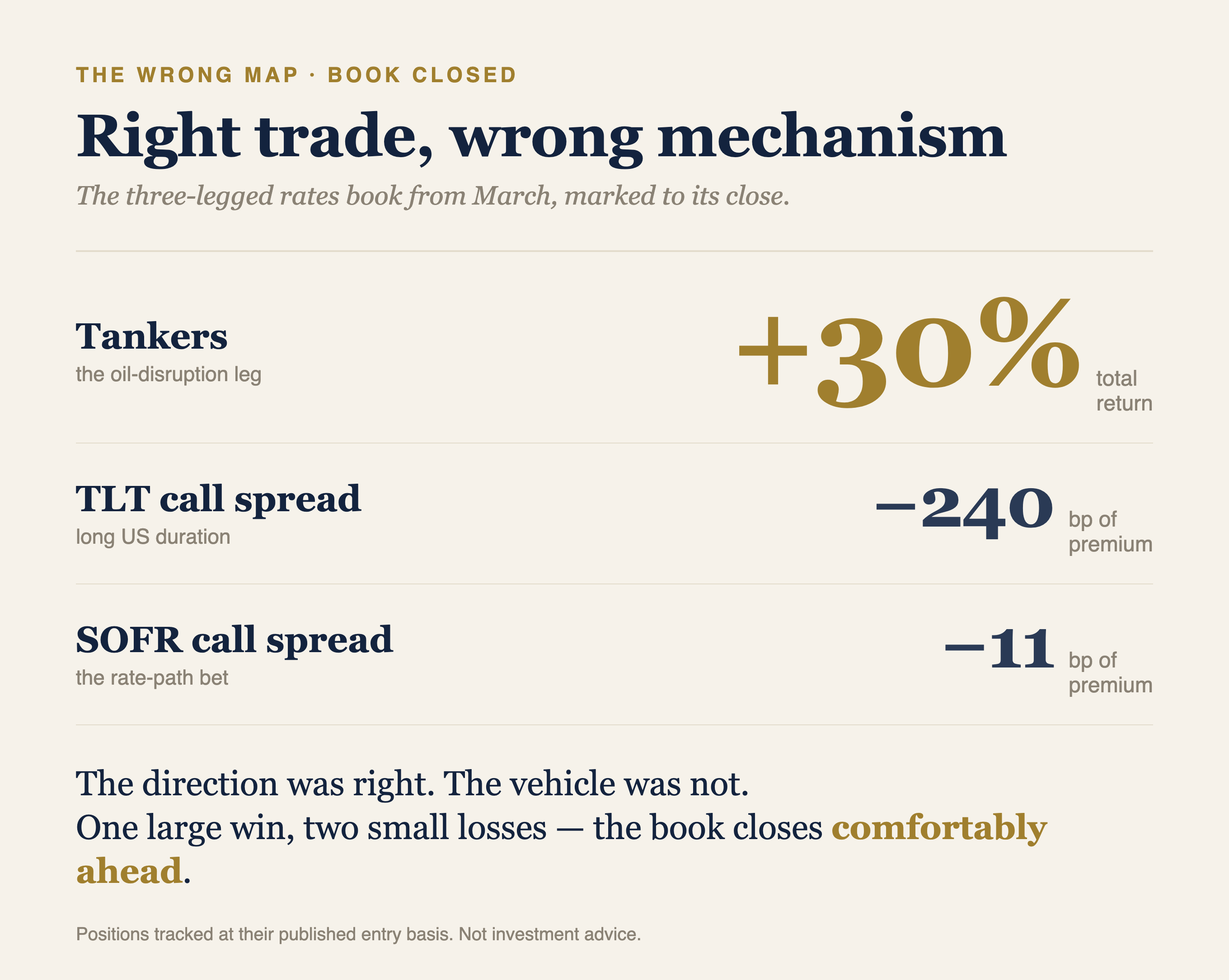
Right direction, wrong vehicle
The risk we identified in that issue was a painful middle with oil high enough to keep core inflation sticky, not high enough to break growth. That is exactly what happened: the Fed held at 3.50 to 3.75%, the 10-year sits near 4.6%, and the disruption that froze our rates legs is the one that detonated the tankers.
Then the June reaction complicated the trade even more. US core inflation printed flat on the month, the friendliest bond number of the year and Treasuries shrugged. When the perfect input produces no move, it’s clear you are missing something: the private sector spending (i.e. AI infrastructure spending) is stronger than anticipated, and our read on the near-term path is unlikely to resolve in the timeframe of these options. Two multi-year theses, wrapped in early-2027 options, are not going to fly. So we close both and step back, rather than roll a decaying option into a view we can no longer fund with conviction.
We are not done with US rates
We will likely express a view on US rates in the coming quarters. The scenario we fear is an AI-capex unwind: risk assets down, credit wider, the Fed cutting hard, capital stampeding into long Treasuries. Against that, a long bond hedges the entire portfolio. But if the hedge has a negative carry you can’t risk being way too early. The tells are not on the tape, and a hedge bought early is theta paid to wait, the exact bill we are settling today.
The trade moves to Britain
The surviving view goes where the mispricing is cleaner and needs no American recession, the front of the UK curve. And the case is not just that the Bank is mispriced. The economy underneath it is weak enough to force the cut.
Britain is not America here. Its mortgages do not lock away for thirty years; they refix every two to five. So the rate the Bank set in 2023 is still biting, household by household, as cheap pandemic fixes roll off and reset several points higher, a slow tightening still under way, long after the last hike. To a British homeowner the policy rate is not a screen abstraction; it is a bigger number on next month’s direct debit. It shows. Households have pushed their saving rate to nearly 9% of income, against about 6% before the pandemic with a straight subtraction from demand. And the labour market is loosening the way that leads disinflation, not lags it: vacancies a tenth below pre-pandemic, and pay, which trails the labour market by about a year, already down to 2.9%, its weakest since 2020. The second-round wage spiral the Bank keeps invoking is nowhere in the wage data.
Yet the market is braced the other way. Bank Rate is 3.75%; in June two members voted to hike and none to cut; Britain now carries the highest 10-year yield in the G7, on the weakest growth in it.
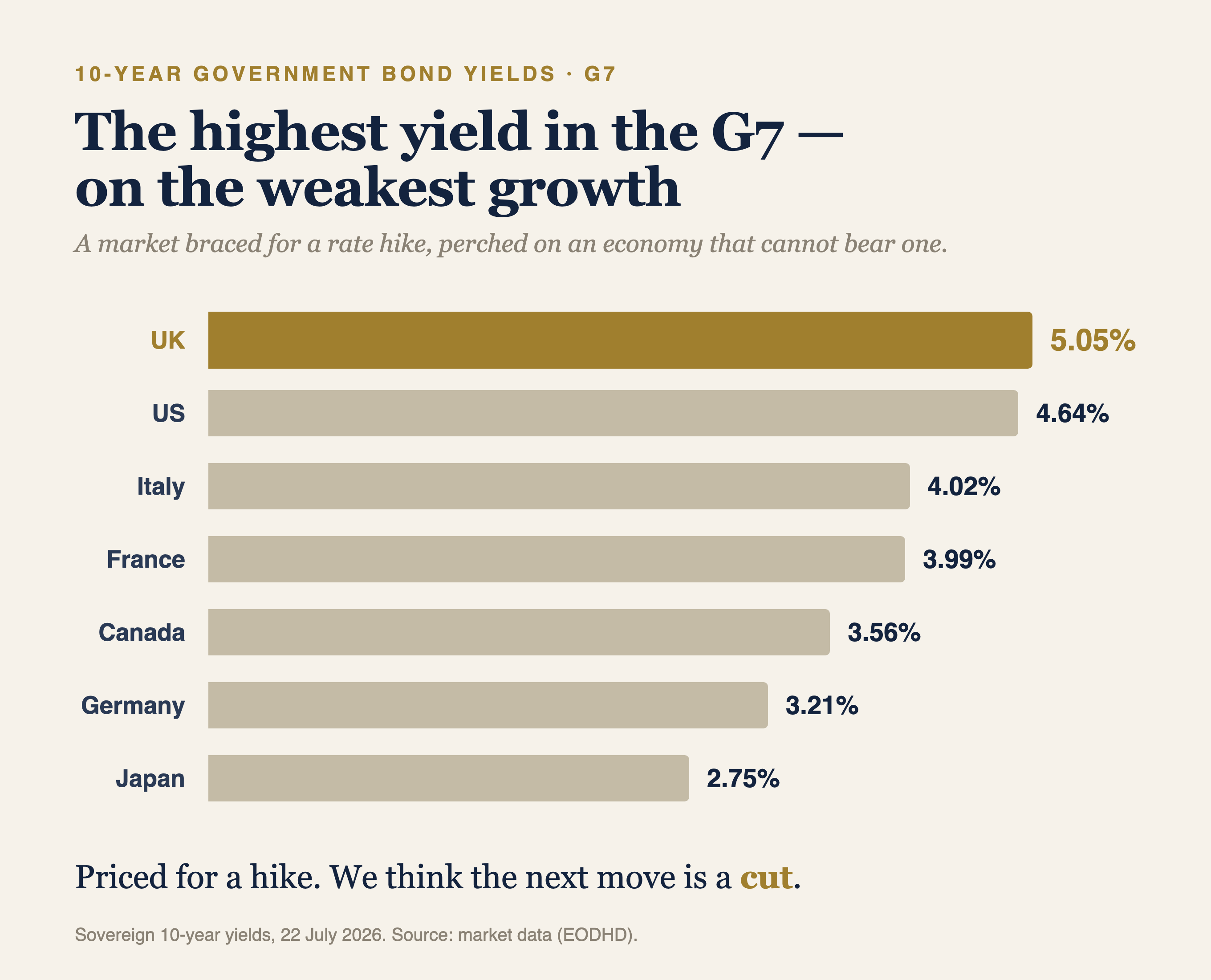
The vehicle, and the risk in it
We are long the front of the gilt curve through the short-gilt future. It fixes the flaw that just cost us, no premium bleeding while we wait and hands us another: a leveraged future can be stopped out before the thesis pays. So we are starting with a small position and a stop loss.
The stop is a weekly close above 4.577%, the 2-year’s 2026 high, the line “The Wrong Map” has fought since March, barely 10 basis points higher than now. That stop is not very far and that’s what we like it because the front end is not the safe end of the curve. In 2022 the 2-year sold off hardest of all, and the Bank’s rescue bought long gilts, not short. We own the 2-year because it is the cleanest expression of a cut, not because it protects us from a fiscal scare. That risk we manage with a small sized position and the stop loss.
We started at half size, and may add after the Bank meets on 30 July. Half, because the case is not clean yet with core still stuck at 2.6%, and July’s 13% jump in the energy cap will lift headline over the next prints.
The shape is convex. Base case, the 2-year drifts to 3.75–4% as the Bank cuts late. Growth scare, it rallies hard as the hawkish curve unwinds. Core stays hot, the stop caps it. Gilts and sterling break together, the co-selloff pulls us out. Downside known; upside not.
Our call: the UK front end is priced for a hike an economy this weak cannot sustain; the next Bank move is a cut, and 2-year gilts rally.
Wrong if: core and services stay hot through the energy-cap pass-through and the Bank holds or hikes; or gilts and sterling sell off together, the fiscal tail the front end is most exposed to.
Status: long UK 2-year via the short-gilt future, half size from 23rd of July; hard stop on a weekly close above 4.577%; may add after the 30th of July meeting.
References
[1] UK June CPI — Office for National Statistics: headline 2.6%, services 3.6%, core 2.6%. Private-sector regular pay growth 2.9% (3 months to May, lowest since 2020, ONS AWE); job vacancies 707,000, 10.4% below the pre-pandemic Jan–Mar 2020 level (ONS Vacancy Survey); household saving ratio 8.9% in Q1 2026 versus ~6% in 2019 (ONS series DGD8). Ofgem default tariff cap +13% to £1,862 from 1 July (Ofgem). UK mortgages predominantly short fixed-rate terms that refix every 2–5 years, versus the US 30-year fix; sub-3% pandemic fixes are rolling onto materially higher rates through 2028 (Bank of England, July 2026 Financial Stability Report; UK Finance).
[2] Bank of England — Bank Rate 3.75%; June MPC vote 7-2, two members preferring a hike, none a cut (Monetary Policy Summary). UK 10-year yield the highest in the G7 (sovereign yields, market data). OIS-implied policy path is market pricing, not a Bank forecast.
[3] The 2022 UK gilt-market episode, in which the 2-year yield rose furthest across the curve and Bank of England intervention purchased long-dated gilts (Bank of England; market data). For context, UK whole-economy investment was the lowest in the G7 at 18.6% of GDP in Q3 2025 (ONS).
[4] US rates context — FOMC target 3.50–3.75%; US 10-year ~4.6% (Federal Reserve H.15); June US core inflation flat on the month (BLS). Position marks and the tanker close are our tracked book; the tanker basket closed at roughly +30% total return in Issue 17 (22 June).
[5] “The Wrong Map,” Stray Narratives Issue 03 (23 March 2026) — the painful-middle call and the argument that a Gulf disruption is borne by Europe and Asia, not the US.