

Stray Narratives is published when the market demands a closer look. Nothing in this publication constitutes investment advice. All views are those of the author. Please read our full disclaimer. If you enjoy this article, please Like & Share, sharing really helps this remain free!
The Trade in 30 Seconds:
The Flaw: America’s trillion-dollar deficit is funded by foreign portfolio capital. This is financial Airbnb, not a thirty-year mortgage.
The Trap: When the stock market crashes, that foreign capital will dump US equities and sell dollars to go home. The dollar will drop right alongside the S&P 500. Good luck hiding there.
The Fix: I am buying the Japanese yen against the Swiss franc. It is the rare crash hedge that actually pays you a yield while you wait for the sky to fall.
Quick trade update first: I am taking profit at the open on my SK Hynix position. It is up by over 15% in less than a month and as I mentioned in the article, it was a tactical trade, not a strategic position.
Now to this month article which is a very strong long term conviction of mine.
Months after the United States finally cut the dollar loose from gold in 1971, Treasury Secretary John Connally reportedly told his foreign counterparts that the dollar was America’s currency but their problem.
He was absurdly right for half a century but I think that sentence is starting to point in the opposite direction and the bill is finally arriving. I went long the Japanese yen and short the Swiss franc, added to the book at the open today.
This is the first in a series of hedges I will be layering into the portfolio over the coming months. As I have started describing in my new series on where I think we stand in this bull market, I don’t have the pretension of trying to forecast the market top but I think we can, with humility, better understand where we stand in this cycle. Valuations are stretched, market concentration is historic, and retail euphoria is palpable. When the music finally stops, you want your insurance policies signed. Too late to buy insurance when volatility is rising. This yen trade is policy number one.
The core claim here is narrow. It is a bet on market plumbing rather than American decline. I am not saying the dollar is finished.
For forty years, the market reflex was completely automatic: when panic hits, you buy dollars. I believe that reflex is now conditional, and that specific condition is currently failing.
The Problem With Rented Money
The entire argument sits in the accounting.
When a country imports more than it exports, it runs a current account deficit. Someone abroad has to fund that gap. That funding generally arrives in one of two forms. The first is direct investment and is a foreign company building a manufacturing plant, buying a domestic business, or putting something in the ground they intend to keep. The second is portfolio flow. This is foreigners buying stocks and bonds.
Direct investment is patient capital. It moves in and it stays. Portfolio flow is a tourist. It is money that can be sold on a Tuesday and wired back home on a Wednesday.
The US current account deficit is currently running near 3% of GDP on a four-quarter basis, which translates to just under a trillion dollars a year. The issue is not the sheer size of the deficit. It has been large before. The vulnerability lies in what is financing it.
Direct investment finances essentially none of it, and never has. The deficit is covered by the world buying American securities. According to the Federal Reserve’s own flow-of-funds data, foreigners now hold roughly $19.4 trillion of US equities and around $15.9 trillion of US debt. What has grown is not a willingness to build infrastructure in America, but the actual stock of America that the world is invested in. And who would blame us? There aren’t that many markets that have annualized over 20% per year for the past 10 years like the Nasdaq 100 has!
A Broken Reflex
Here is how the trap actually springs.
When a national deficit is funded by patient direct investment, the currency and the domestic stock market are only loosely linked. The money financing the country is fundamentally different from the money trading in the index.
But when that exact same deficit is funded by portfolio flows, they become the exact same money. The foreign capital covering the American external deficit is the foreign capital propping up the S&P 500.
In a serious US equity drawdown, that capital does not simply accept the markdown, hold hands, and sing Kumbaya. A significant portion of it goes home and to go home, they have to sell their dollars.
So the currency and the stock market fall together. The dollar turns pro-cyclical. It weakens in the exact risk-off scenario where it is historically supposed to strengthen, because the capital outflow crushing equities is the exact same capital outflow crushing the currency. It looks a lot like the late 1960s, right before Connally had his famous meeting.
If this reading is correct, the standard market crash hedge will fail right when you need it most. The risk-off bid will not magically vanish during a crash, it will migrate and flow to the countries that run surpluses and are owed money by the world.
Japan is standing at the very front of that queue.
Why the Yen Broke (And What Snaps It Back)
For three years, trading the yen was idiot-proof. You just tracked the gap between American and Japanese ten-year yields. A wider gap meant a weaker yen. It was entirely mechanical. Through 2022, the correlation was a flawless 0.88. If you knew the spread, you knew the currency.
That relationship is dead. Through 2025, it decayed to zero, and this year it violently inverted to negative 0.56. The single best historical indicator for the yen now points in the exact opposite direction.
Today, the yen sits near ¥156 to the dollar, hovering around a forty-year low. It has become the world’s favorite ATM: borrow yen at zero, buy absolutely anything with a pulse that yields, and pocket the difference. The entire financial world is crowded on one side of this boat. Speculative positioning is as aggressively short the yen as it has been in a decade.
The immediate assumption from the peanut gallery is that the yen is weak because Japan is a walking fiscal time bomb carrying the largest government debt in the developed world.
The accounting violently disagrees. Japan actually runs a massive current account surplus of roughly 4.9% of GDP. Its private sector saves more than enough to fund both private investment and the government’s deficit. On the IMF’s Fiscal Monitor, Japanese net public debt has actually fallen from a peak near 161% of GDP in 2020 to about 137%. Japan's external assets also exceed its liabilities by roughly 79% of GDP. A country the world owes money to is not the same thing as a country about to have a debt crisis. The yen is not weak because Japan is broke.
It is weak because the Bank of Japan is running negative real interest rates directly into rising wages and expanding credit. That is a textbook recipe for overheating an economy. Because the central bank is visibly behind the curve, rising Japanese inflation expectations are currently making the yen weaker, not stronger. A central bank that sleeps through its own inflation problem is not defending its currency; it is quietly devaluing it.
The politics have moved too. Through the summer the government tolerated a weak yen. It no longer does. The Takaichi administration now says it can live with higher rates and a firmer currency. The reason is domestic. Inflation imported through a weak yen is the kind Japanese households hate most. The Bank of Japan has less independence than the Fed or the ECB, and it does not tighten against a government that wants low rates. A government that wants a stronger yen removes the last excuse.
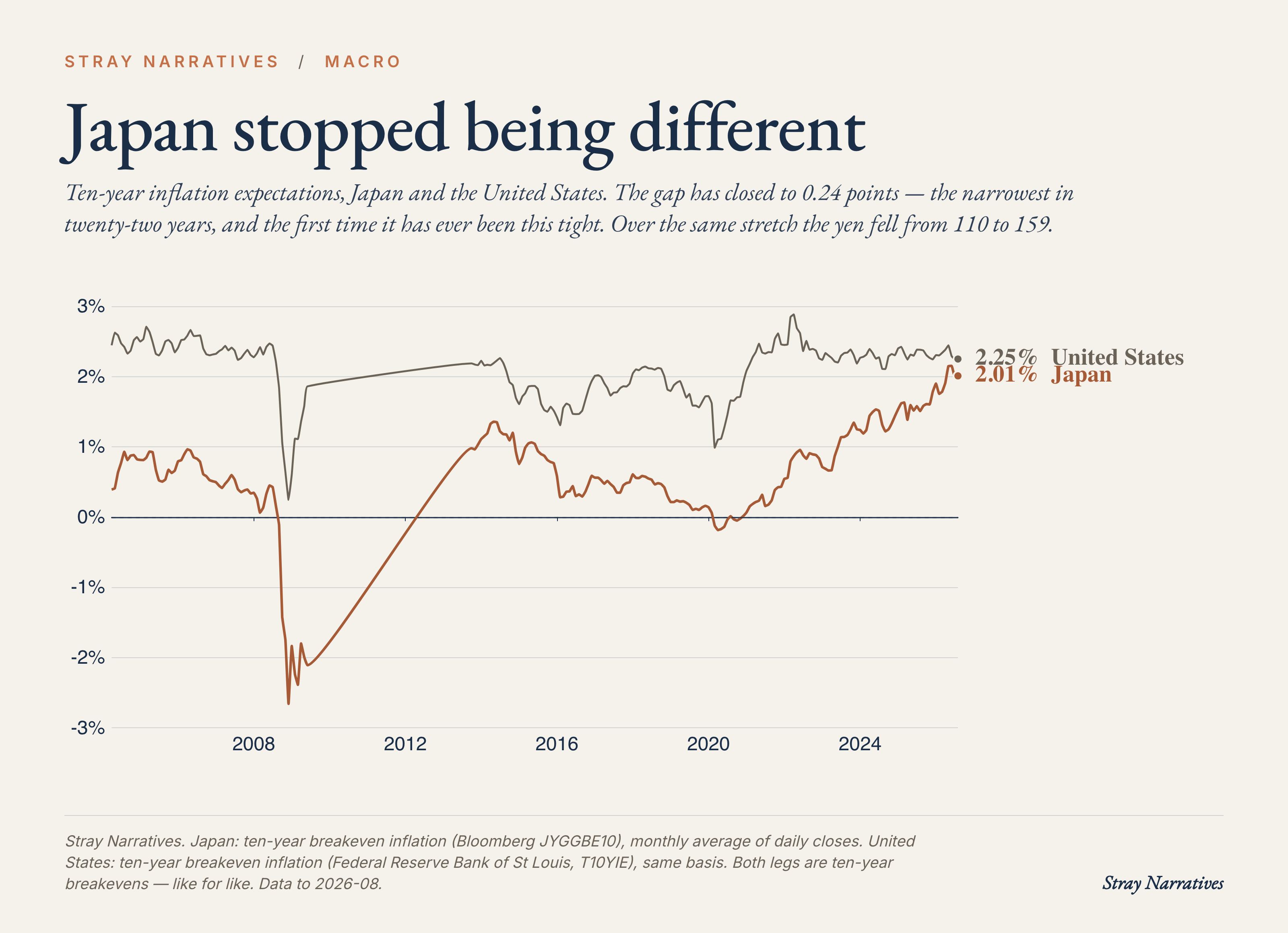
But every month the BOJ waits, the gap between where rates are and where inflation says they should be gets wider. This ends in a violent snapback. The yen is weak for reasons that can all rapidly reverse, and I only need one of these three roads to play out:
1. The American Crash. As described above, in a portfolio-led bust, the dollar falls and the safe-haven bid immediately moves to the surplus bloc. The yen is the deepest, most liquid expression of that exact trade. It pays out exactly when the rest of your portfolio is bleeding.
2. The Hawkish Capitulation. The inflation I was waiting for has started to print. Trimmed-mean inflation is back at 2%. Core inflation is running above 3% on a three-month annualised basis. Services producer prices, which lead services inflation, are up 3.6%. Nominal wages are up 3.6% and real wages 1.9%. Manufacturers' output-price expectations in the Tankan are the highest in five decades. A central bank at a 1% policy rate with core inflation above 3% is not tight. It is loose, and it knows it. At some point the BOJ stops being able to look away and is forced to hike directly into a massively crowded short position. That point has a date. The Bank of Japan meets on 18 September. A hike at that meeting is priced as near certain. The hike is not the question. The guidance is. If the Bank says it will keep raising rates roughly once a quarter until inflation settles, the yen stops being a funding currency. If the Bank calls September enough, the yen gives back ground and the curve steepens again. The carry pays me while the Bank makes up its mind. The guidance, not the 25 basis points, is what I am waiting to read.
3. The Great Repatriation. Japan’s public pension system holds roughly $1.2 trillion abroad, essentially unhedged. The weak yen handed these funds a massive translation gain, but that process runs in reverse the moment the currency turns. Japanese life insurers have already started dumping foreign bonds because hedging costs and new solvency regimes made them too expensive to hold. While this repatriation is traditionally a slow structural tailwind rather than a sudden trigger, it represents a massive wall of domestic money waiting to come home. There is a second flow behind the pension money, and it is annual rather than one-off. Japan earns income on its foreign assets worth about 6.3% of GDP a year. The Ministry of Finance publishes the primary-income line every month. For years that income stayed abroad, because bringing it home into a falling currency looked like throwing money away. A credible central bank changes that sum. Hedging works the same way. The 79% of GDP I mentioned above is mostly unhedged. When the yen turns, the rational response is to hedge, and hedging a foreign asset means buying yen. The income comes home first. The hedges follow. The pension money is the slowest and largest layer, and a leveraged carry unwind is what speeds all of it up when volatility rises.
It is also worth noting that on the OECD’s purchasing power parity estimate, fair value for the yen sits near ¥97 to the dollar. That metric does not tell you the exact timing, but looking at a rubber band stretched that far is incredibly persuasive.
Why the Swiss Franc?
The natural instinct here is to buy the yen against the dollar. That is a trap, and it is the exact mistake that has drowned every yen bull for the last decade.
Against the dollar, you pay the interest rate differential every single day you wait. You are taking a direct, bleeding bet on the exact timing of the American turn. Nobody ever gets that timing perfectly right.
But against the Swiss franc, the arithmetic changes in three beautiful ways.
I get paid to wait. The Bank of Japan is at 1% and climbing. The Swiss National Bank is at zero. That spread gives me positive carry of roughly one percent a year. On a macro trade where the biggest historical risk is the cost of holding it long enough to be proven right, flipping the carry from paying to collecting is everything.
I am shorting the reluctant haven. The franc is the only real rival to the yen as a panic currency, but the Swiss National Bank actively despises a strong franc. They lean against it heavily through direct market intervention. The asymmetry here is brilliant. Capping your own currency is something a central bank can do forever because it just requires printing your own money, and the SNB has plenty of ink. Holding a currency up requires spending foreign reserves, which are finite. I will gladly bet against the guys with the unlimited printing press who actively want to lose.
I keep the convexity. We just had a live rehearsal of this. At the end of July 2024, the BOJ raised rates and the yen spiked 14% against the dollar in five weeks, unwinding massive amounts of carry trade leverage and crushing global equities. Against the franc, the yen rose far less because the franc rallied alongside it as a fellow haven. So by shorting the franc, I capture roughly half the yen’s flight-to-safety surge, plus the daily positive carry, plus whatever rate hikes the BOJ delivers that the Swiss cannot match.
A partial hedge that pays you to hold it always beats a full hedge that bleeds you dry while your broker sends you polite margin call emails.
Intellectual Honesty: What Breaks This Trade
I have spent more time trying to destroy this thesis than build it. Some of the risks are not just theoretical; they are playing out on the tape right now. There is a reason there is something called the “Japan widow-maker trade”. For over two decades hedge funds and macro traders have repeatedly tried to make money betting against Japan. None of the strategies have ever worked, so who am I to try?
The Oil Shock. Japan imports its energy. A supply-driven crude spike creates a risk-off environment where the yen can actually fall because their terms of trade get crushed at the exact wrong moment. Crude spiked more than 50% in July on the escalation with Iran and the Hormuz disruptions, and the yen weakened straight into it, printing a fresh forty-year low. Brent has since settled back near $92 with the strait still contested, and the yen has recovered around three per cent off that low. This hedge is built for a demand-led deflationary bust and it has just been stress-tested by a supply-led inflationary one. It survived. That is not the same as being vindicated. This hedge is built for a demand-led deflationary bust, but it is currently staring down a supply-led inflationary shock. I am actively leaning into that headwind.
The Dirty Entry. Japanese authorities are suspected to have intervened heavily to support the yen on July 30, and again in the first days of September. So the level I am buying at is artificial. My entire argument for shorting the franc is that holding a currency down is infinite, while holding one up requires finite reserves. Japan is currently burning finite reserves to prop up the yen, and the arithmetic is not kind. Japan holds about $1.3 trillion of reserves. Each round of yen buying costs something between $50 billion and $75 billion. Those are a macro research house’s estimates; the Ministry of Finance publishes reserves monthly and intervention totals at each month-end, with daily detail each quarter. A finite reserve against a repeated bill is a bluff the market will eventually call. The yen also tends to weaken in the weeks after an intervention, as traders test how serious the authorities are, so the tape may move against me before the Bank meets. I am ignoring the official support because it only smooths the speed of a move, not its direction. I hold the position for the Bank, not for the Ministry.
The Fiscal Trap. The objection I hear most is that Japan cannot afford to raise rates. The arithmetic runs the other way. The government pays about ¥10.3 trillion of interest a year and receives about ¥9.2 trillion, so the net interest bill is near ¥1.1 trillion, roughly 4% of revenue. The Ministry of Finance budget documents carry the primaries. What matters is which part of the curve each side answers to. Payments follow Japan’s long yields, because that is where the debt is issued. Receipts mostly follow short yields abroad, because the biggest asset is $1.3 trillion of reserves sitting in short-dated dollar paper. So a steepening Japanese curve hurts the public finances on the only side Tokyo controls. A hike that flattens the curve helps them. The Japanese 30-year to 2-year spread flattened by about 44 basis points this summer on hawkish speeches alone, and the Ministry of Finance publishes the daily yield curve if you want to check. The cost of the debt is a long-end problem, and a credible central bank is what brings the long end down. That is why I do not treat the debt as a reason the BOJ stays on hold.
Finally, dollar bears have been early for so long that being early is functionally indistinguishable from being wrong. If the US deficit adjusts the normal way through a standard economic slowdown, the dollar will likely rally just as it has in most post-war downturns. I have been actually been rather bullish the dollar all year so much the positioning against it was one sided.
The Playbook
I added long yen and short Swiss franc to the book at the open today, at 192.70. I am sizing it big, as big as my conviction level on this one. It is large enough to matter when the carry trade unwinds over the next few quarters/years, but small enough that I can comfortably sit through a longer wait.
Base Case: The BOJ is forced to tighten through the winter. The cross grinds from roughly 193 toward the 175 to 180 area over the next year, and I collect a point of carry while it happens. We continue on that path every year ultimately settling around 150.
Bull Case: The US equity market cracks. The global carry trade unwinds violently, the yen vastly outruns the franc as capital flees, and the cross slices through 150 in 2027.
Bear Case: The BOJ hikes on 18 September and calls it enough. The yen gives the summer’s gains back and settles at the level the authorities appear to defend. Or the US slowdown closes the trade gap normally and the dollar rallies, or the current oil shock deepens dramatically. The cross drifts back toward 200 and the position bleeds slowly against the carry I am earning.
The Call: Long yen, short Swiss franc. It is the rare crash hedge that actually pays you a yield while you wait for the storm.
Wrong If: The yen fails to appreciate against the dollar during the next sustained US equity drawdown. That correlation is the empirical bedrock of this entire trade. If the US market crashes and the dollar still rallies, the thesis is fundamentally broken. My stop loss is at the all time high a few months ago, 204.