

Stray Narratives is published when the market demands a closer look. Nothing in this publication constitutes investment advice. All views are those of the author. Please read our full disclaimer. As always, please share this post if you enjoy it, that’s how it stays free!
I bought Xunlei (NASDAQ: XNET) in May at $6.33, anchoring the thesis on an 80% discount to its net asset value. That value was built around a 7.8% stake in Arashi Vision, the maker of Insta360 cameras.
In July, I set a tripwire: a decisive break below 130 yuan on Insta360 would force me to reassess the trade. It broke that level and Xunlei shares are now trading around $5, down over 20% from entry. Insta360 has halved, falling roughly 6 times further than the STAR 50 index it trades against.
What remains is a bet on a single document, a specific date, and the price of management’s willingness to act.
The number that has not moved
Cash and short-term investments, less bank debt, come to $220.4 million, or $3.46 per ADS [4]. At the time of this writing, the Insta360 stake is worth $509.6 million, or $7.99 per ADS converted at that day’s exchange rate [3][4]. Then there is the operating business, which lost money in the second quarter. Take the $4.90 price, subtract the $3.46 of net cash and what is left is the $1.44 per ADS that the market is paying for the stake and the operating business together. Now let’s assume the operating business is worth nothing. The whole $1.44 becomes the price of the stake, against $7.99 of Insta360 shares, that is 18 cents on the dollar. When I opened the position, that number was 17 cents on the dollar.
There are two different reasons the market might only give partial credit for the stake:
Reason one: the market thinks Insta360’s Shanghai price is too high, and is quietly betting it’s worth less.
Reason two: the market doesn’t have an independent view on Insta360 at all. It’s just applying a fixed haircut to whatever the stake is quoted at, because the real question isn’t “is Insta360 cheap or dear” but “will Xunlei’s management ever actually sell it and hand you the cash.”
The fact that the stock has kept a fixed hair cut means its reason 2.
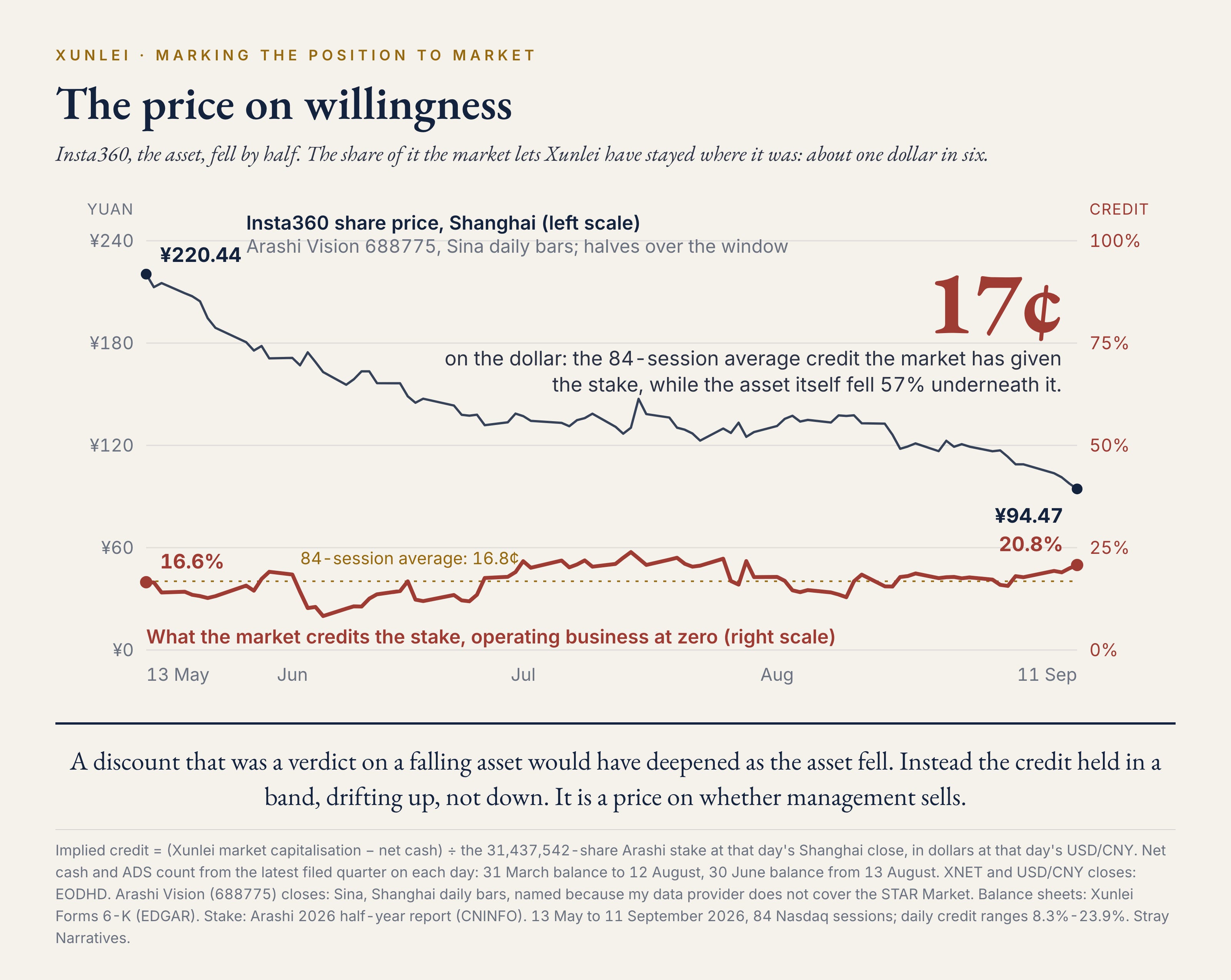
A Deteriorating Collateral and a Broken Stub
Insta360 halved on more than just sentiment. First-half profits collapsed to a loss of 90.1 million yuan. Gross margins fell to 38.3% from 51.2% a year earlier. Operating cash flow plunged into negative territory as the company spent aggressively to stockpile chips. Inventory doubled. Short-term borrowing rose eight-fold [6].
This is not the same business trading at a lower multiple; this is a business changing shape under the pressure of a margin-crushing price war.
Xunlei’s own operating business, which I called a “cheap stub” in July, is no longer a bargain either. It posted a GAAP operating loss of $4.8 million in the second quarter [5]. If you price the Insta360 stake at its Shanghai value, the market is valuing Xunlei’s operating business at roughly minus $420 million.
The Illusion of the Clock
The case for a forced sale rested on the Investment Company Act. It is the US statute that can classify a company as an investment company once too much of its balance sheet sits in securities of other companies. Past that threshold, a company is no longer treated as an operating business. I wrote in July that this "still points in one direction" and that roughly $446 million of selling was required to reach management's stated 45% ceiling [2].
That statutory obligation is looking increasingly like a management option.
The 45% figure and the line “we never intend to be an investment company” are not in Xunlei’s most recent annual filing. They are earnings-call language, said twice this year, both times preceded by “if needed” [7]. The filing itself, made two weeks before I bought the stock, says something different. Even if the statutory test is met, the company believes it can rely on a separate exclusion. That exclusion is available to a business “primarily engaged” in an operating trade, its cloud and consumer services, rather than in holding investments [8]. On the August call, the company’s own words were “going through certain procedures to get ready to reduce our stake.” In the same answer: “we have no specific plans for the share disposal for the time being” [7].
Read together, the obligation is not a statutory clock. It is a management option. Its writer has already told the regulator it does not think it has to exercise it. Selling the stake down would still cost tax on the gain. I published that tax at 10% in July. It should have been a range then too. The rate is zero if the Hong Kong holding entity qualifies under the cross-border tax treaty that applies below a 25% ownership threshold — Xunlei’s stake in Insta360 is 7.84%. It is 10% by default. It is 25% if the entity is treated as mainland-resident [9].
I Am Holding. Here is What Has to be True.
I am holding the position. The downside is heavily buffered by $3.46 per ADS in net cash, and the stake itself remains highly liquid. However, the expected return now relies entirely on management breaking their own stated inertia.
If nothing is filed and Insta360 keeps de-rating toward 50 yuan, the value in two years is around $3.33 per ADS — a loss of about 17% a year. Net cash alone today is $3.46, so this is close to a floor case, not a tail case. If a plan is filed around the November results, and Xunlei sells down to its stated ceiling through 2027 at prices that allow Insta360 to keep falling, the value is around $6.25. That is a gain of about 13% a year. If the sale happens on the same timetable and Insta360’s fortunes turn instead, the value is around $9.65, a gain of about 40% a year, on legs that are not yet in motion [4].
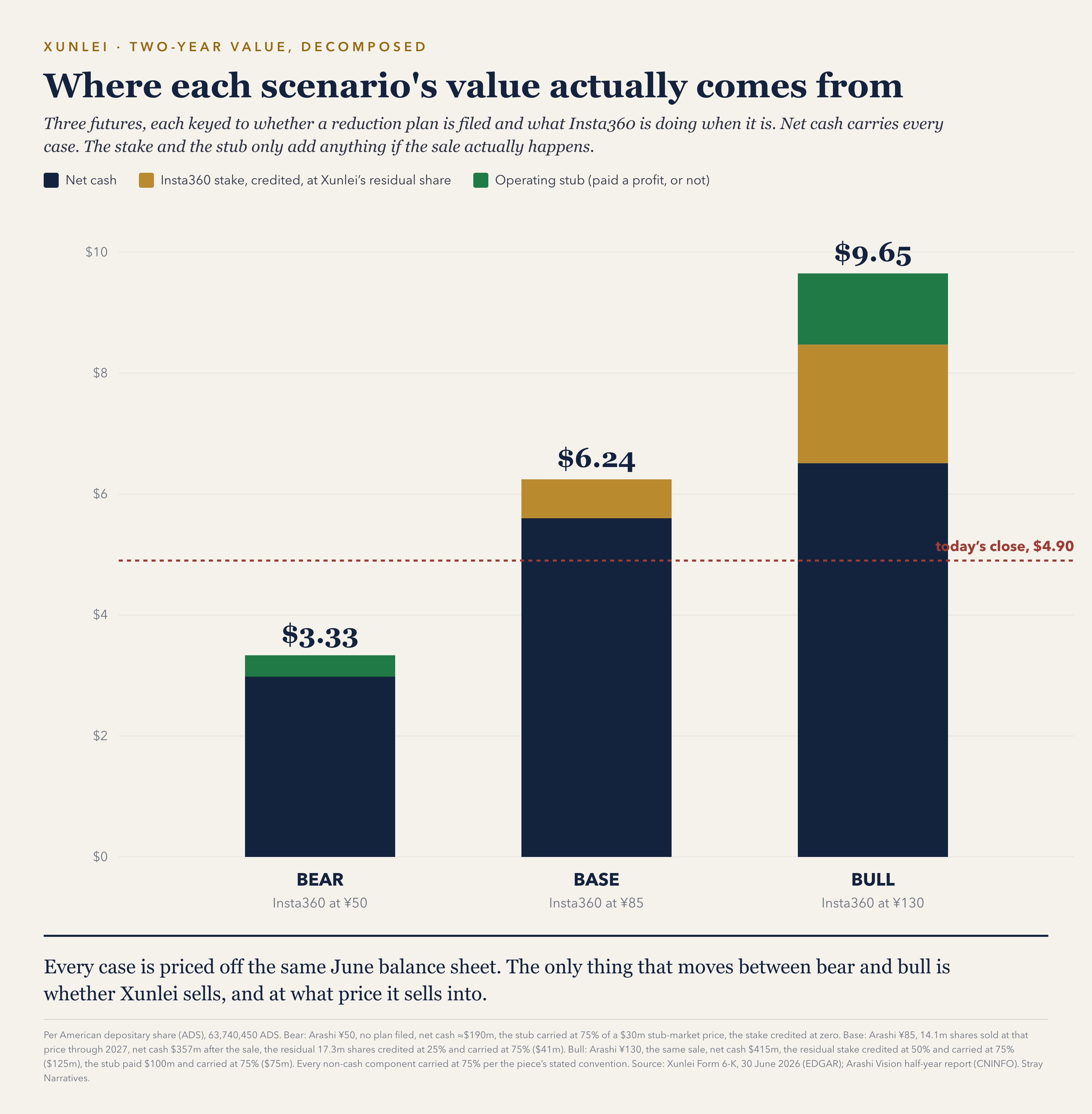
Let’s be honest, would I put on this position today? No. But the asymmetry is like an option so I am keeping it a little longer. That’s not a great argument by the way and my patience is running out.
Three specific events will invalidate this stance:
Upside Surprise: A reduction-plan pre-disclosure appears on the Shanghai exchange before Xunlei’s mid-November Q3 results. This is the only event that turns the discount into cash. If it prints, I was wrong about their timeline, and the market’s price was wrong.
Structural Failure: Insta360’s Q3 report (due late October) shows total net margins remaining negative, or gross margins staying below 35%. This proves the camera business is losing a structural fight, making a much lower valuation the new normal.
Market Capitulation: Xunlei’s shares close below net cash ($3.46). This would signal the market has begun pricing the operating business as a terminal liability.
References
[1] Stray Narratives Issue 11, An 80% Discount to NAV, Four Weeks to Close, published 14 May 2026. Entry $6.33; Insta360 stake, net cash, operating business as published there.
[2] Stray Narratives Issue 19, The Discount That Did Not Close, published 5 July 2026. Re-underwritten thesis, no clock, mechanical exit on an acquisition-shaped capital move, review tripwire at a decisive break below 130 yuan on Insta360.
[3] EODHD eod/XNET.US: $6.33 close 13 May 2026 (entry); $4.90 close 3 September 2026. Sina Shanghai daily bars, sh688775: ¥220.44 close 13 May 2026; ¥108.89 close 3 September 2026, the lowest close since Insta360 listed in June 2025; the STAR 50 index over the same window, −9.0%, from the same feed. EODHD carries no coverage of the Shanghai STAR Market.
[4] Xunlei Limited Form 6-K, Exhibit 99.1, unaudited results for the quarter ended 30 June 2026, filed 13 August 2026: cash $125.8m, short-term investments $151.0m, bank borrowings $56.5m, net cash $220.4m; 318,702,251 ordinary shares outstanding, 63,740,450 ADS at five ordinary shares per ADS. Insta360 stake: 31,437,542 shares (Arashi Vision Inc. 2026 half-year report, top-ten shareholder table, 30 June 2026) at ¥108.89, converted at EODHD’s 3 September USD/CNY close of 6.7181. Scenario arithmetic (bear/base/bull) per the same balance sheet, tax at 10% in the base case, a 25% discount applied to every non-cash component in all three scenarios.
[5] Xunlei Limited Form 6-K, Exhibit 99.1, quarter ended 30 June 2026: revenue $102.7m (+38.9% y/y); subscription revenue $44.5m (Q1 2026: $45.0m); gross margin 55.8% (Q2 2025: 63.0%); GAAP operating loss $4.8m.
[6] Arashi Vision Inc. (Insta360, Shanghai STAR Market: 688775), 2026 half-year report, disclosed on the Shanghai exchange’s disclosure site 27 August 2026 (unaudited): profit before tax −¥90.1m (H1 2025: +¥540.4m); second-quarter gross margin 38.3% (Q2 2025: 51.2%); operating cash flow −¥2,761m (H1 2025: +¥241m); inventory ¥6,212m (+112.8% in six months), 43.7% of total assets; short-term borrowings ¥1,061m (from ¥123m); bank facility ceiling raised from ¥6.5bn to ¥12.0bn (disclosure 27 August 2026); other non-current liabilities ¥1,795m (from ¥496m), an equity-repurchase obligation to minority investors in the company’s drone subsidiary, which raised ¥1,303m from those investors in the first half. Trailing earnings multiple 99x at the 3 September close (¥45.66bn market capitalisation), against roughly 57x at the mid-July check.
[7] Xunlei Limited, first-quarter 2026 earnings call (28 May 2026) and second-quarter 2026 earnings call (13 August 2026), management commentary (secondary transcripts; primary source is the call itself): “if needed, we will gradually seek to adjust our holdings so that Xunlei will hold investment securities with a value not exceeding 45% of the company’s total assets”; “we never intend to be an investment company”; “we are going through certain procedures to get ready to reduce our stake in the company. But at this time, we have no specific plans for the share disposal for the time being.”
[8] Xunlei Limited, Form 20-F for the fiscal year ended 31 December 2025, filed 28 April 2026: “We believe that, even if we were determined to be an investment company under Section 3(a)(1)(C), we are entitled to rely on the exclusion from investment company status afforded by Section 3(b)(1) of the Investment Company Act.” No “45%” self-declared target and no “never intend to be an investment company” language appears in this filing; both are earnings-call statements only.
[9] Cost basis for the Insta360 stake: $20.0m carrying amount at 31 December 2024 (Form 20-F, filed 28 April 2026), a book figure, not a confirmed tax basis. Tax treatment: Article 13(5) of the Mainland–Hong Kong tax arrangement taxes a share-sale gain in mainland China only where the seller held 25% or more of the underlying company’s capital in the prior twelve months; Xunlei’s holding entity holds 7.84% of Insta360. Withholding at 10% is the default rate for a non-resident enterprise absent treaty relief; 25% applies if the holding entity is deemed mainland-resident by place of effective management. Treaty-residency status of the holding entity is not established in the public record.