

As always, if you enjoy this article, please Like & Share, it means the world to me! Click here for : Part1 - Part 2 - This is Part 3

And here is the audio podcast version (done with Gemini Notebook):
Everyone is hunting for the crash in data centers. Or in the hardware stocks. Or the debt markets.
They are looking in the wrong place entirely.
Saying that AI is a bubble has become the standard consensus view across Wall Street. But in finance, the exact moment an observation becomes consensus is the exact moment it loses all utility. The question is never whether we are in a bubble. The question is which kind of bubble it is, and which layer of the stack gets slaughtered when it pops.
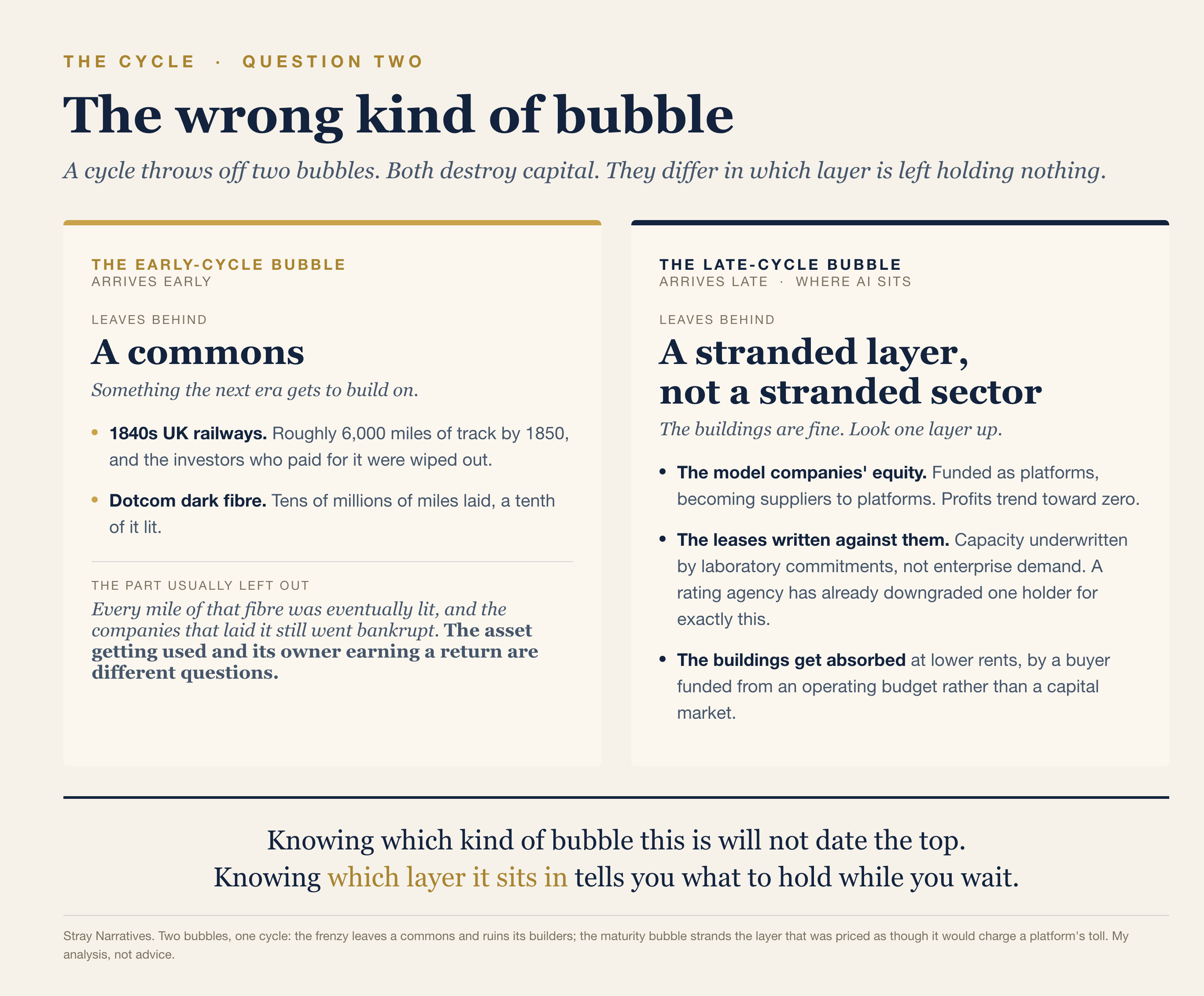
Infrastructure booms throw off two fundamentally different kinds of bubbles. They behave nothing alike and they reward opposite investors:
The Early-Cycle Bubble arrives early, as its name implies. It builds something magnificent that the next generation inherits for free. It crashes hard, but leaves the physical asset standing. Britain’s Railway Mania bankrupted its investors, but left six thousand miles of track. The dot-com buildout laid tens of millions of miles of fibre, lit barely ten percent of it, went bust, and quietly funded the next twenty years of the internet [1].
The Late-Cycle Bubble arrives late. The technology has obviously won. Financing turns aggressive, and the cycle’s cheap input gets wildly over-consumed until the economics break. It feels gentler on the way up because real earnings sit underneath it. It is far nastier on the way down, because what it leaves behind is not a public commons but stranded capital.
We are in the second kind of bubble. AI is not a new industrial platform; it is a late-cycle efficiency input.
Inputs like that do not keep their profit margins. But the money isn’t vanishing into thin air either. It is migrating to the two extreme ends of the pipe: to the platforms that control customer distribution at the top, and to the physical bottlenecks that supply energy and land at the bottom.
What gets stranded is the layer in the middle. So you have to own the ends and be terrified of the middle.
LLMs Are Memory Chips, Not Processors
The right historical reference point for Large Language Models is not the railway or the internet. It is the microprocessor [2].
The microprocessor made the entire global economy exponentially more productive while the price of computation itself plummeted relentlessly toward cost.
Some inputs manage to keep their margins. Intel held fat rents on x86 architecture for decades, and Nvidia does the same today with CUDA. Why? Because a massive wall of software was built specifically for their design and could not easily move.
An input keeps its rent only when it locks its users in.
Large language models do the exact opposite. They are accessed through near-identical interfaces and can be swapped out in an afternoon. They are not the processor; they are the memory chip, a pure commodity where whichever supplier is cheapest and good enough wins.
The tell that a technology has entered its late cycle is who adopts it first. New paradigms start on the fringe as crude toys that serious executives ignore. This generation of AI was seized instantly by incumbent megacaps, because the enterprise rails were already laid. When the breakthroughs come from multi-billion-dollar corporate research budgets rather than a garage, you are looking at a mature cycle, not a wild new frontier [3].
The Great Price Split
The headline narrative says the price of machine intelligence is falling across the board but the data says otherwise.
The price didn’t fall, it split:
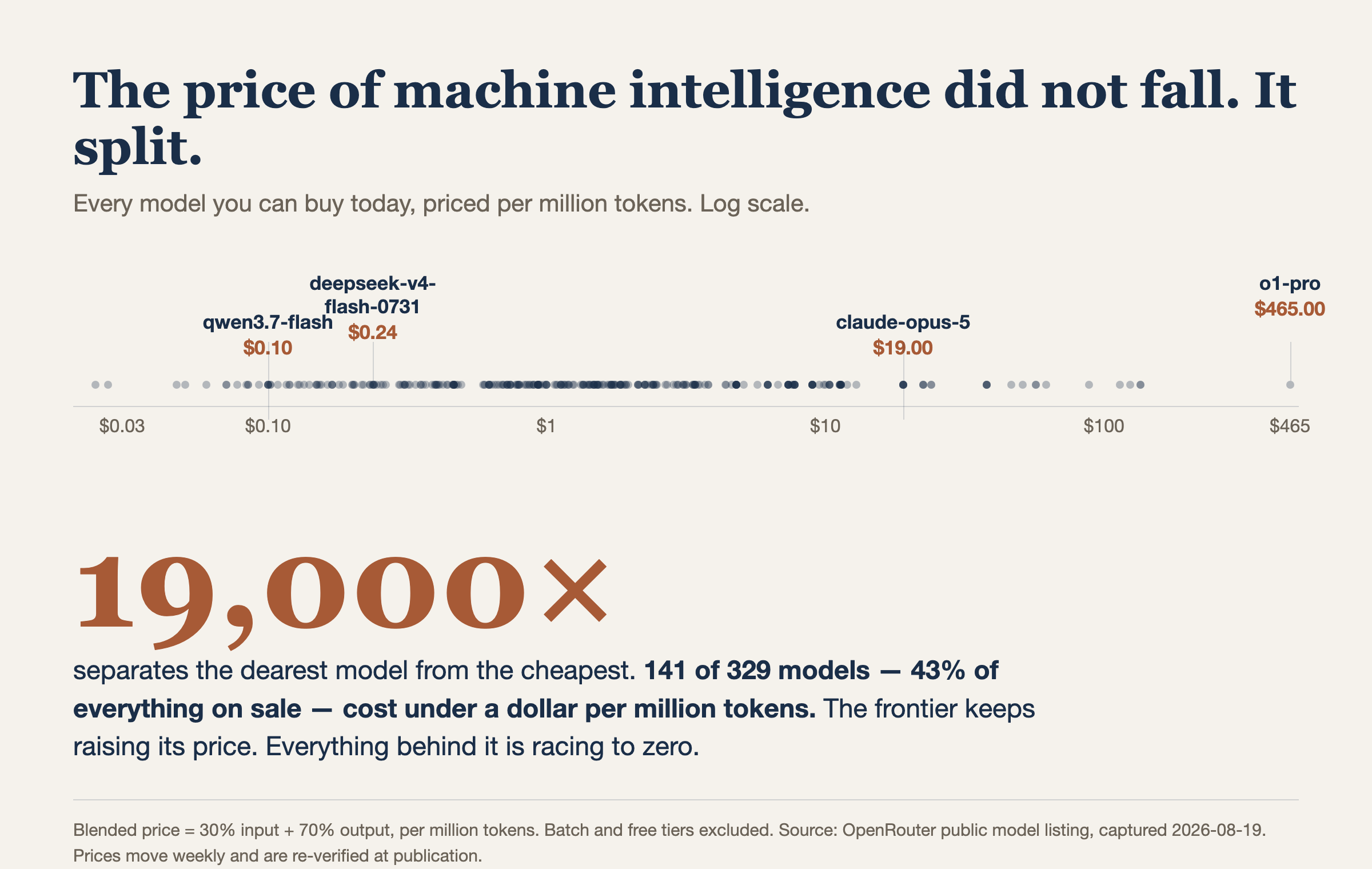
Since mid-2024, the cheapest capable models have anchored at roughly two and a half cents per million tokens. Meanwhile the most expensive flagship on the market today costs $465 per million tokens on a blend of 30% input and 70% output, against roughly $51 for the flagship of three years ago on the same blend [5]. The top of the market raised its prices roughly ninefold while the bottom collapsed to near-zero.
Today, roughly 43% of all available models cost under a dollar per million tokens. The gap between the most expensive and the cheapest is an absurd 19,000 times [5].
This structural split ruins the middle layer. A commodity layer has emerged at the bottom, where good-enough intelligence is practically free, while a hyper-specialised niche holds at the top. What is disappearing is the middle class of AI: the assumption that a very good proprietary model is a durable, broadly monetisable business.
And the proof keeps compounding. In July 2026 a Chinese open-weight model, Kimi K3, took the top spot on a public coding leaderboard ahead of every Western frontier model, and its creators released the weights for free download [4]. Days later, OpenAI cut prices on its smaller models, taking roughly 80% off the output price of one of them.
The repricing did not stop there. DeepSeek, the most watched of the budget providers, is reported to have raised its prices by roughly 205% over the same weeks. The reported gap between OpenAI’s cut model and DeepSeek’s flagship collapsed from 21 times to 1.4 times. The cheap end is no longer a race to zero; it is converging on a single commodity band.
A free or cheap model doesn’t need to defeat the frontier everywhere. It just needs to be good enough for ninety percent of daily tasks.
Data Centers Aren’t Warehouses of Obsolete Chips
If model prices are commoditising, doesn’t that mean the massive capital expenditure pouring into data centers is being incinerated?
Look at the operating numbers [6].
Azure crossed $100 billion in annual revenue in Microsoft’s fiscal 2026, growing 43% year on year in the June quarter.
Microsoft Cloud overall reached $214 billion.
Google Cloud’s operating margin expanded from 20.7% to 35.6% in twelve months.
These are widening operating margins, not collapsing ones.
Paper valuation gains. Much of Big Tech’s net income spike stems from markups on private stakes in AI labs. The scale of it is visible in the index: FactSet’s blended second-quarter earnings growth for the S&P 500 was 50.4%, but 32.0% excluding Alphabet and Amazon [7]. That is why I look at cloud operating margins rather than net earnings.
Cash burn. Alphabet’s quarterly free cash flow turned negative for the first time since it listed, a $5.9 billion outflow. Amazon’s June quarter was a $7.7 billion outflow. Meta’s fell 91% to $784 million. Only Microsoft stayed firmly positive, at $19.6 billion. Together, on the companies’ own definitions, the four generated roughly $6.9 billion while capital expenditure surged, and their credit spreads widened.
So how to reconcile booming cloud operating margins with tightening cash? By understanding the two-clock option structure of data center construction.
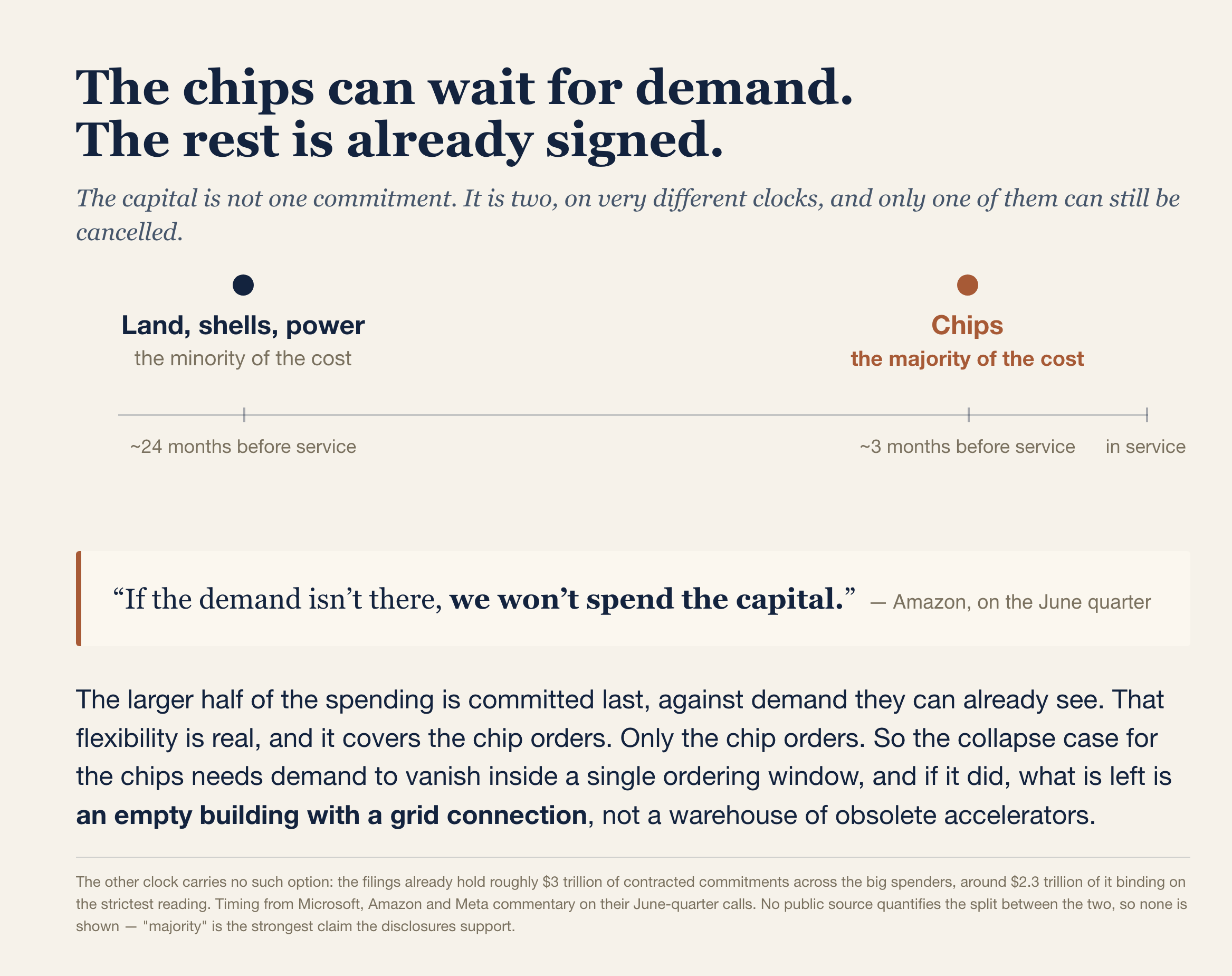
Land, buildings and power grid connections require a twenty-four-month lead time. But the actual chips and accelerators, which are the majority of total cost, are ordered just three months before installation, only after real customer demand is visible.
As Amazon put it bluntly: “If the demand isn’t there, we won’t spend the capital.”
That flexibility is real, and it covers the chip orders. Only the chip orders. For the chips to be stranded, demand must vanish inside a single ordering window, and even then what stands empty is a building with a massive power link, not a warehouse full of decaying chips.
The other clock carries no such option. The filings already hold roughly $3 trillion of contracted commitments across the big spenders, around $2.3 trillion of it binding on the strictest reading [9]. A later piece in this series follows those signatures.
The Model is an App, Not the App Store
Wall Street committed a fundamental classification error. It priced AI models like two-sided platforms, assets that gain network effects and pricing power as more users join.
The model is not the App Store. The model is just an app. The hyperscaler is the App Store.
Consider what a distribution platform actually does
It owns the end-customer relationship.
It processes all telemetry and billing.
It sees exactly which features get traction.
And when a third-party app gets big enough, the platform builds its own version and defaults it onto the customer’s screen.
This playbook is currently being executed in AI with Hyperscalers owning the corporate billing accounts. They see which models are being called and at what price and when a third-party model charges a premium, Microsoft or Google simply deploys its own internal or open-weight alternative directly into the stack.
The rents do not belong to the model. They belong to whoever owns customer distribution at the top, and whoever owns scarce power and grid access at the bottom.
The $217 Billion Exposure: Where the Real Risk Lives
The strongest counterargument to this thesis is circular financing.
A chipmaker invests in an AI lab, which uses the funds to buy chips. A cloud platform invests billions in a lab, which turns around and commits those billions back to the platform in compute contracts. It echoes the circular accounting that unravelled telecom firms during the 2001 crash.
If the model labs are funded by the very platforms selling to them, what happens if the labs go under?
Microsoft disclosed two crucial numbers on the same earnings call [6]:
Commercial contracted backlog grew +84% to $678 billion.
Excluding OpenAI, backlog grew +25%.
Do the arithmetic: OpenAI alone accounts for at least $217 billion of Microsoft’s forward book. That is just under a third of it at the strictest floor, and plausibly closer to half. That figure is a floor, not an estimate: it assumes OpenAI had no backlog whatsoever a year ago, and any starting value above zero makes the share larger.
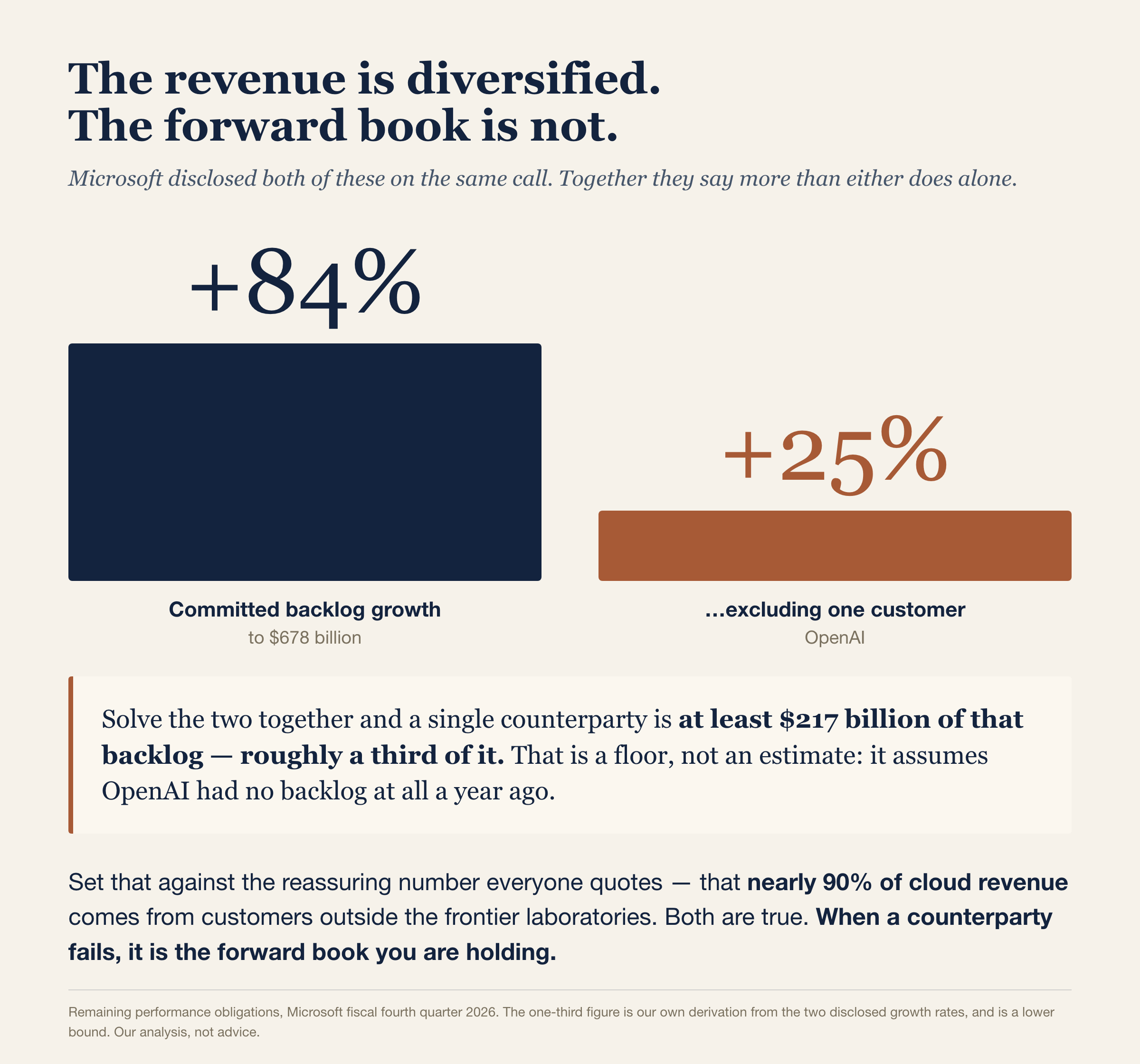
Current cloud revenue is highly diversified: nearly 90% of Microsoft Cloud revenue comes from customers outside the frontier laboratories. That measure also carries Office, LinkedIn and Dynamics, so the concentration inside the cloud infrastructure business alone is higher still. The forward contracted book is wildly concentrated.
If a laboratory fails to raise its next multi-billion-dollar equity round, it won’t trigger an immediate drop in today’s cloud computing usage. Instead it creates a severe credit and lease exposure on the forward books of the platforms. One rating agency has already acted on exactly this risk. In July 2026, S&P downgraded Oracle and wrote that “OpenAI remains a key credit risk”, estimating that OpenAI makes up “roughly half of the $638 billion” in Oracle’s contracted book [8]. Moody’s holds the same company on negative outlook, citing the counterparty risk of its largest AI infrastructure customer.
What Happens When the Buyer Changes?
If model laboratories stumble, won’t traditional enterprises and governments absorb the extra compute capacity?
Yes. But at a fraction of the price.
Every mile of dot-com fibre optic cable was eventually lit and used. But the equity owners who laid that fibre still went broke; the eventual returns went to distressed-asset buyers who bought the infrastructure for pennies on the dollar.
Why? Because the buyer changed:
Laboratory demand is funded by capital markets. It demands peak hardware and maximum memory bandwidth at almost any price, to win the intelligence race.
Enterprise demand is funded by corporate operating budgets. It demands good-enough inference performance at a cost that clears an internal committee.
When capital-market funding slows, the volume of compute demanded doesn’t disappear. What disappears is the buyer who would pay anything for the newest, most memory-dense configuration, replaced by one who will only pay for the cheapest arrangement that works.
Volume holds. Realised price per unit falls. That is the same bifurcation as the model-price chart, seen from the demand side.
Training wants maximum memory bandwidth per chip whatever it costs; inference wants the cheapest adequate configuration. So the memory content of each machine is not a constant. It is a function of the training-to-inference mix, and that mix is about to move.
The Investor’s Playbook
On its face this is not an absurd multiple bubble. Names like Nvidia, Broadcom and Meta trade at growth-adjusted multiples below 1.0. Keep in mind though that the earnings beneath those multiples carry the paper markups flagged above.
The risk is not that price-earnings multiples are crazy. The risk is that future earnings assumptions rely on middle-layer rents that cannot be sustained.
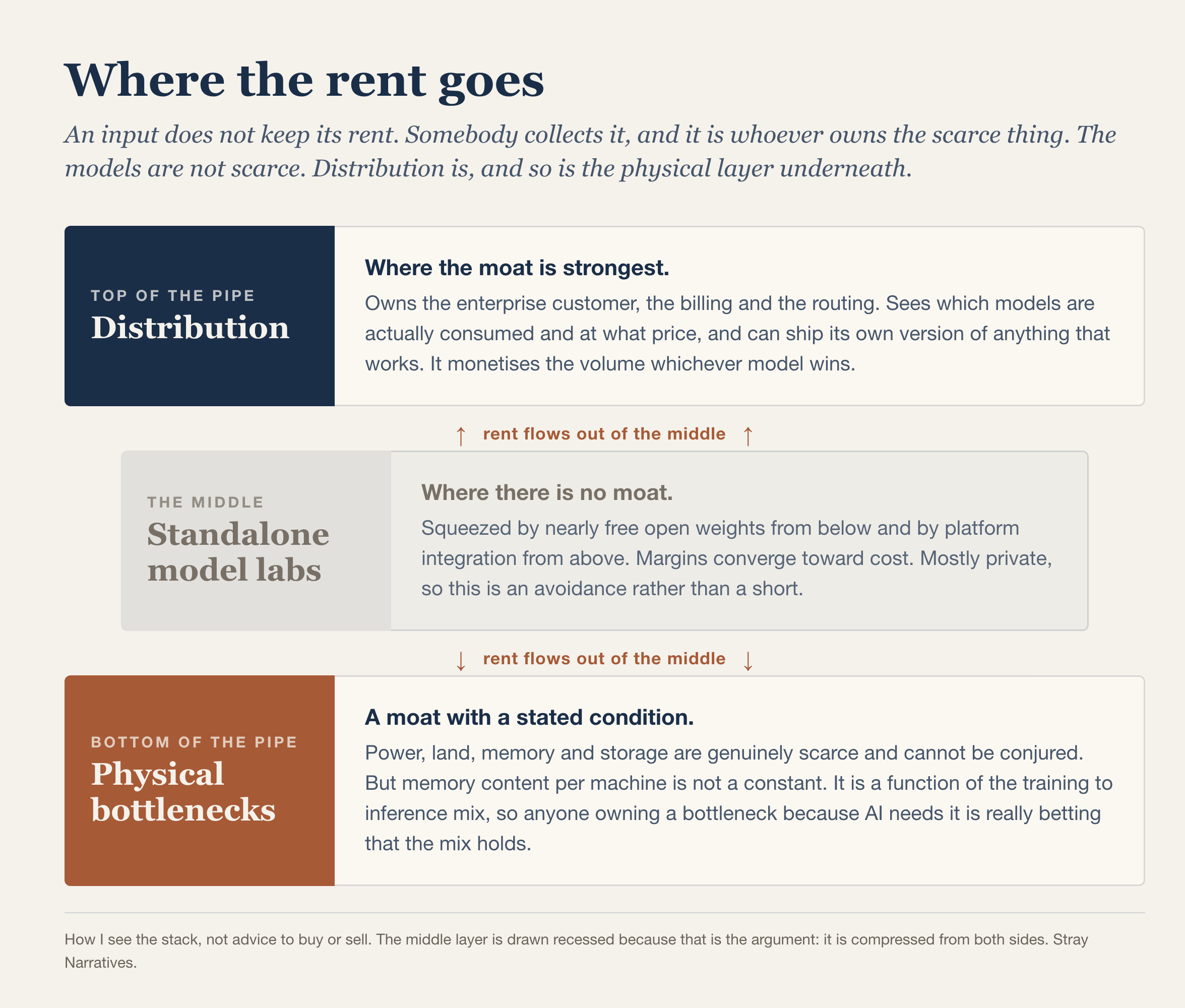
So that is where this Substack will spend its time. When I try to understand an AI related investment opportunity in the issues ahead, the work will sit at the two ends of the pipe: the platforms that own customer distribution at the top, and the physical bottlenecks that own power, land and memory at the bottom. The middle is what I will seek to avoid.
Core takeaways
The moat is at the distribution layer. The platforms hold their position regardless of which model wins, because they own the customer relationship and the billing, they can see which models are actually consumed and at what price, and they can ship their own version of anything that works. That is not a forecast about technology. It is where the defences in this stack actually sit. One boundary belongs in the same breath: the rent is real, and the committed capacity is the cost of defending it, signed years ahead of the revenue it serves. The moat and the bill come together.
The second moat is physical, and narrower than it looks. Power, land, memory and storage are genuinely scarce and cannot be conjured. But memory content per machine is not a constant; it is a function of the training-to-inference mix. Anyone holding a bottleneck because “AI needs it” is really betting that the mix holds.
Be sceptical of the middle. Most of it is unlistable, be sceptical of anything priced as though it will one day charge a platform’s toll. Its margins will likely converge toward cost as open-weight models improve.
And note where the exposure actually sits. When a laboratory cannot raise its next round, today’s cloud usage does not stop. What moves is the forward book, and that is concentrated in a way current revenue is not. It arrives as marks and leases on platform balance sheets. It is a credit exposure, not a demand collapse. That is a different risk from the one most people are watching for, and it is the one already being acted on.
So here is the position and what would change my mind. The bubble sits in the model layer, not the infrastructure layer: model economics converge toward zero profit while the platforms above them and the bottlenecks below them keep the rent.
Two things would tell me I have this wrong. The first is a proprietary frontier model rebuilding real pricing power. I would see it in the same price capture behind [5], re-pulled each quarter: the top flagship’s premium over the cheapest capable tier widening again, and holding for some time. The second is a platform’s cloud growth stalling on ordinary enterprise demand rather than on laboratory commitments. Microsoft discloses that itself every quarter: the non-frontier share of Microsoft Cloud, and commercial remaining performance obligations excluding OpenAI. I am keeping a close eye on that.
Neither is happening yet and the price of intelligence has split rather than fallen. The floor has been flat since mid-2024 while the frontier costs around nine times what it did three years ago on a like-for-like blend. And the reported gap between OpenAI’s cheap tier and DeepSeek’s has collapsed from twenty-one times to 1.4. Remember that open source models are free in the sense that they are free to own, but the expenses to run them remain. Open-weight models lead at least one public capability board. Cloud revenue is growing above forty per cent, with nearly ninety per cent of Microsoft Cloud sold to non-frontier customers. The committed backlog is growing eighty-four per cent, or twenty-five excluding a single frontier customer.
Knowing that AI is in a late-cycle input bubble won’t tell you the exact date of the top. But knowing which layer the bubble sits in tells you exactly what to hold while you wait.
References
[1] Carlota Perez, Technological Revolutions and Financial Capital: The Dynamics of Bubbles and Golden Ages (Edward Elgar, 2002). The frenzy and maturity phases are Perez’s framework; reading the two as leaving a usable commons versus stranded capital is Singh’s extension of it (see [2]).
[2] Sameer Singh, “AI: The Wrong Kind of Bubble,” Breadcrumb, 2026. The microprocessor reference class and the input-not-platform reframe draw on this essay. This piece departs from it on where the stranding lands.
[3] Nicolas Colin, “Late-Cycle Investment Theory” (Drift Signal, 2025) and “The Beginning of the End for Big AI” (Drift Signal, 2026), for the tell that a paradigm has matured.
[4] Arena.ai Frontend Code leaderboard, July 2026, and Moonshot AI release materials for Kimi K3. Standings re-verified at publication.
[5] Model pricing from a full capture of a public model marketplace listing, 19 August 2026. Blended price defined as 30% input plus 70% output per million tokens; batch and free tiers excluded. The 2023 comparison is on the same blend: the then flagship, at $30 input and $60 output per million tokens, blends to $51. Prices move weekly; the capture is re-verified at publication and re-pulled quarterly thereafter to score the falsifier.
[6] Microsoft fiscal 2026 fourth-quarter results and earnings call, 29 July 2026, for Azure and Microsoft Cloud revenue, the share of cloud revenue from customers outside frontier model companies, and commercial remaining performance obligations. Alphabet, Amazon and Meta second-quarter 2026 results and calls for cloud margins, capital-spending commentary and free cash flow; free-cash-flow figures are the companies’ own reported definitions for the June quarter.
[7] FactSet Earnings Insight, August 2026, for blended S&P 500 second-quarter earnings growth of 50.4% and 32.0% excluding Alphabet and Amazon.
[8] S&P Global Ratings, “Oracle Corp. Downgraded To ‘BBB-/A-3’ From ‘BBB/A-2’ On Rising Business Risk And Weaker Cash Flow; Outlook Stable”, 9 July 2026, including the estimate that OpenAI makes up roughly half of Oracle’s $638 billion in remaining performance obligations. Moody’s Investors Service, affirmation of Oracle at Baa2 with negative outlook, February 2026, citing counterparty risk associated with its largest AI infrastructure customer.
[9] Purchase-commitment, lease and power-agreement disclosures in the largest AI spenders’ most recent annual and quarterly filings, at SEC EDGAR. The roughly $3 trillion contracted and roughly $2.3 trillion binding aggregates are my own reading of those notes; a later piece in this series shows the work.
[10] National Bureau of Economic Research, Business Cycle Dating Committee chronology; the NBER-based recession indicator is FRED series USREC. The February to April 2020 contraction is the only recession in the fifteen-year window.