

A brief word of warning before proceeding. The subject of AI's impact on employment is one of those topics that attracts, in roughly equal measure, genuine analytical rigour and confident nonsense, often from the same author within the same paragraph. I have done my best to stay on the right side of that line, though I am aware that this is precisely what someone on the wrong side would also say. What follows is necessarily compressed. For readers who would like the argument laid out with rather less prose and rather more arrows, there is a diagram at the end of this piece that attempts to map the causal structure in a format that does not require thirty years of professional stamina to navigate. I am told it is considerably clearer than what follows. I choose to regard this as a comment on the diagram rather than on the writing.
There is a concept in portfolio risk management that every investor understands in principle and almost no one internalises until it is too late. In normal market conditions, the volatility of a portfolio is a function of the individual volatilities of its constituent assets, modulated by the correlations between them. A diversified portfolio carries less risk than a concentrated one precisely because assets do not move together. Their independence is the protection.
Under stress, that independence disappears. In a genuine market dislocation, correlations move toward one. Assets that behaved as distinct risks in normal conditions begin to move as a single risk. The portfolio that looked well-constructed by every standard measure of diversification turns out to be far more concentrated than the model suggested, not because the individual asset analyses were wrong, but because the assumption of independence was wrong. The model failed not at the level of the components. It failed at the level of the system.
This is, of course, obvious in retrospect and invisible beforehand, which is a reasonably accurate description of most errors in financial analysis and several of my own investment decisions over the years.
The consensus analysis of AI’s economic impact is making the same error.
The standard framework examines sectors individually. It asks what AI does to insurance, to legal services, to financial intermediaries, to professional services firms. It finds, correctly, that the dynamics differ by sector, by regulatory environment, by the degree of verifiability in the value proposition, by the pace at which institutional adoption can proceed. In isolation, each sector analysis is reasonable. The aggregate picture they produce, when assembled sector by sector, looks manageable. Disruption is real, the framework concludes, but uneven, sector-specific, and subject to the institutional frictions that slow adoption. The portfolio is diversified. The correlations are assumed to be low.
They are not. And when they move toward one, the aggregate effect is something the sector-by-sector framework is not designed to see.
There are two distinct correlation structures operating simultaneously, and they work through entirely different mechanisms. Understanding each separately is necessary before understanding what they produce in combination.
The first is timing-driven. In the previous issues of this series, I described the demand-side sorting machine: AI placed in the hands of every private consumer as a tireless, cost-free optimisation engine that collapses information asymmetry in every market where quality can be objectively measured. The consumer who once satisficed, who bought a good-enough insurance policy because finding the optimal one was prohibitively costly, now has an agent that reads every policy document, identifies the exclusion buried in clause 14(b), cross-references claims satisfaction data with pricing, and switches automatically at renewal. The search cost drops to approximately zero.
The critical word in that description is not “cost.” It is “every.” The same consumer is applying this tool across every verifiable sector simultaneously. Not sequentially, not sector by sector on a rolling schedule that allows incumbents to adapt and industries to adjust, but simultaneously, at the speed of consumer adoption, which faces none of the institutional barriers that slow corporate response.
This is not contagion in the traditional sense. It is not a shock that propagates from one sector to the next through financial linkages or supply chains. It is common factor exposure. The consumer is the common factor. The sorting machine is the tool. And the tool is sector-agnostic. The same agent that optimises the insurance renewal optimises the mortgage, the utility contract, the savings product, the telecommunications package, and the travel booking. The verifiable economy does not experience sequential disruption. It experiences simultaneous pressure from a single cause that is indifferent to sector boundaries.
The sector-by-sector analysis is not wrong about any individual sector. It is wrong about the assumption that the sectors are being disrupted independently.
There is a second mechanism reinforcing the first, and it runs in the opposite direction to concentration. When prices and service terms become transparent and comparable across an entire sector simultaneously, the competitive response is not passive. Firms do not merely lose volume to the best provider. They are forced to compete more aggressively for the volume that remains, compressing prices to retain customers who now have perfect information about the alternatives. The margin is attacked from both sides at once: volume falling as the sorting machine concentrates demand toward best-in-class providers, and price falling as incumbents compete more fiercely for what is left. AI does not merely accelerate concentration. It accelerates competition. The two effects compound rather than offset, and they do so simultaneously across every verifiable sector, because the transparency that drives both is delivered by the same tool to the same consumer at the same time.
It is worth being precise about where this consumer-side dynamic currently sits. The first wave, AI as information tool collapsing search costs and enabling systematic comparison, is already operating across most verifiable sectors. The second wave, AI as transacting agent switching providers automatically without the consumer's active involvement beyond an initial authorisation, is in accelerating deployment rather than fully arrived. The direction is not in dispute. The residual question is timing, and experience with the first wave suggests that timing estimates made by incumbents tend, with impressive consistency, toward optimism.
The second correlation structure is behavioral, and it operates through an entirely different mechanism. Where the first runs through the consumer, the second runs through the corporate response to the stress the first creates.
Return to the Adoption Asymmetry introduced in the second issue of this series[1]. Revenue compresses at consumer speed. Costs adjust at institutional speed. The margin collapses in between. Every business in every verifiable consumer-facing sector is experiencing a version of this scissors simultaneously, because the cause, the AI-empowered consumer, is universal and simultaneous.
Now observe what businesses under margin pressure do. Not what they say they do, not what the restructuring consultant recommends, but what they actually do, in sequence, reliably, across every industry and every cycle. Hiring freezes arrive first, before any public acknowledgment of difficulty. Bonus pools are the next to compress, quietly, framed as a response to performance rather than margin pressure. Salary increases are deferred, then cancelled, then replaced by real-terms cuts dressed as flat nominal pay. The headcount reduction that eventually follows is the last step in a sequence that began considerably earlier and operated considerably more broadly. Every firm runs this sequence as though it has invented it, with the quiet confidence of management teams who have not read the last several decades of corporate restructuring history. The sequence is, in fact, entirely predictable and has been since at least the 1980s. What is new is not the playbook. It is the number of firms running it simultaneously.
There is a further reason the supply-side adjustment is even slower than institutional friction alone would predict, and it has received almost no attention in the investment commentary. In the first phase of generative AI adoption, a substantial proportion of employees who used AI tools at work did so without management awareness, capturing the productivity gain as quietly recovered time rather than delivering it as measurable output improvement. The corporate efficiency gain that was supposed to compress the cost base never reached the bottom line. It was absorbed, entirely rationally, by the workforce. The scissors is consequently wider than the institutional inertia argument alone suggests: the revenue line is compressing at consumer speed, the cost base is adjusting at institutional speed, and a meaningful share of the productivity gain that should have narrowed the gap between them has instead disappeared into the space between what employees do and what their managers believe they do. That space, in my experience of thirty years managing people who were considerably more resourceful than I gave them credit for, is reliably larger than the organisational chart suggests.
This sequence is not unique to AI disruption. It is the standard corporate response to sustained margin pressure regardless of cause. What makes the current situation structurally different is that the same sequence is being triggered across every verifiable sector simultaneously, because the margin pressure is arriving from the same source at the same time. The behavioral correlation does not require firms in different sectors to be connected. It requires only that they are all subject to the same demand-side pressure simultaneously, and that they all respond to that pressure using the same operational playbook. Which they do, because it is the only playbook available.
Recent academic work analysing AI agent development across the full spectrum of United States occupations found that the overwhelming majority of AI benchmarking and deployment activity is concentrated in computer and mathematical work, a category representing roughly seven percent of the employed workforce [2]. The domains where the largest headcounts actually sit, management, office and administrative support, sales, are barely touched by systematic AI agent development. This is not an argument against the thesis. It is the empirical confirmation of the Adoption Asymmetry: corporate AI deployment is nowhere near uniform across the economy, which is precisely what institutional speed predicts. But the behavioral response to margin pressure does not wait for AI deployment. It responds to the threat of it. The hiring freeze at the mid-tier insurer is not triggered by the AI system that has already been installed. It is triggered by the revenue line that is already moving in the wrong direction, driven by a consumer who has already adopted the sorting machine. The correlation is behavioral, not technological, and it operates across the entire corporate sector regardless of how much AI any individual firm has actually deployed.
There is a further dimension to this corporate correlation that the sector analysis does not capture, and it requires a moment’s attention before the mechanism becomes clear.
Every professional services firm in the economy is built on a pyramid: junior staff performing proceduralized work at the base, senior judgment and client relationships at the top. The business model depends on billing junior hours at senior rates while training the junior staff for eventual promotion. The pyramid is not merely an organisational convenience. It is the mechanism by which the profession reproduces itself, the channel through which proceduralized experience is converted into senior judgment over time.
The exposure of this layer is not, it should be said, a reflection of the people within it. A junior lawyer reviewing contracts against a checklist, an analyst building a discounted cash flow model from a template, an audit associate working through a sampling framework, these are not roles held by people of limited ability. They are roles that organisations have spent decades deliberately engineering toward proceduralized execution, because proceduralization is what made professional services scalable. The industrialisation of knowledge work converted judgment into process, template, and rule-driven workflow as a feature, not a defect. I am not immune to this observation: thirty years in private banking involved rather more template and rather less judgment than I would have cared to admit at the time, a realisation that AI has delivered with rather less diplomacy than I might have preferred. What made white collar professional services a growth industry for three decades is precisely what makes its junior architecture AI-compatible now. The credential obscures the exposure. The job architecture reveals it.
AI compresses the pyramid from the base. The mechanical work, the contract review, the financial model, the audit sampling, the due diligence checklist, is precisely the proceduralized layer that AI handles most readily. This is not a gradual erosion. It is a structural compression that operates at the same level of the hierarchy across every professional services firm simultaneously. Hiring at the entry level collapses before any visible disruption at senior level. The employment data shows the effect years before the broader narrative catches up. The firms are all running the same playbook, on the same layer, at the same time, because the technology is compressing the same layer of every pyramid regardless of sector.
The individual firm responses look rational and contained. The aggregate does not.
There is a third compressing force, independent of the two correlation structures above and operating simultaneously with them, that the sector analysis does not see because it acts not on the revenue line or the cost base but on the tools the businesses are using to adapt.
The software infrastructure that professional services firms, financial institutions, and corporate enterprises depend on, the workflow platforms, the analytical tools, the data management systems, is itself subject to a deflationary dynamic of considerable speed and severity. The cost of a standardised unit of AI-generated output has fallen by seventy to ninety percent annually as model providers compete aggressively for market share, as open-source alternatives set a reference price of near-zero for the intelligence layer itself, and as each successive generation of model delivers comparable capability at lower compute cost. When the intelligence layer is available to any developer at negligible marginal cost, the engineering effort required to build a competitive software product collapses from years to weeks. The barrier to entry that protected the established software provider was never primarily the software. It was the cost of replicating it. That cost is now approaching zero.
The consequence for the businesses caught in the Adoption Asymmetry is a compounding one. They are being squeezed on the revenue side by a consumer armed with perfect information. They are responding with the standard cost compression playbook. And the software infrastructure they are deploying as part of that response is simultaneously being commoditised beneath them, inviting new competition from entrants who can now build in weeks what previously required years. The life raft, in other words, is also deflating. The full consequences of this for the infrastructure layer that carries it, the hardware economics, the capital expenditure paradox, the question of who is paying for what on what assumptions, are a subject for the next issue. But the compressing effect on the software layer belongs here, because it is part of what the three forces produce in combination when they arrive simultaneously.
To understand what the combined effect of these forces produces when it runs its course, Andrea Pignataro’s analysis of the cascade mechanism is worth deploying in full [3]. I have held it until this point in the series because it requires both correlation structures, and the software layer dynamic, to be properly understood before it reads as a sequence rather than a list.
The first phase is the most familiar. AI handles routine tasks directly for end clients. Professional services firms lose the commodity revenue that was, in most cases, a larger share of their income than the billing structure acknowledged. The first wave of firm closures follows, concentrated among those whose revenue was most dependent on verifiable, proceduralized work. This phase is already underway in identifiable form.
The second phase is where the cascade begins to exceed what the sector-by-sector framework anticipates. AI begins to encroach on work requiring deeper contextual understanding. Fewer humans are required per client engagement. The second-order effects emerge: commercial real estate demand from professional services firms contracts, business travel compresses, the adjacent service economy that has grown around the concentration of knowledge workers in major cities begins to feel the withdrawal of that demand. These are not AI-exposed sectors in the direct sense. They are exposed through the contraction of the sector that was their primary customer. The correlation structure has already extended beyond the verifiable economy.
The third phase is where the financial system encounters the cascade. Venture capital and growth equity portfolios carrying professional services technology companies begin to see write-downs as the revenue assumptions underpinning their valuations prove inconsistent with the demand environment the cascade has created. The software layer deflation compounds this: the SaaS businesses that were supposed to be the solution to the disruption are themselves being repriced as barriers to entry collapse, a development that will surprise primarily those who did not read their own marketing materials with sufficient scepticism. Simultaneously, the hyperscaler capital expenditure programmes that were justified on the assumption of expanding AI revenue begin to attract scrutiny. The investment thesis faces pressure from both directions at once. This is not a financial crisis in the traditional sense. It is the moment at which the capital allocation decisions of the preceding years are tested against a reality that the models, which examined sectors in isolation and assumed low correlations, did not predict.
The fourth phase is the one that the investment analysis most consistently omits because it operates on a longer clock than the portfolio. The loss of professional services employment at scale affects communities, institutions, and tax bases in ways that are slow to emerge and difficult to reverse. The cities that have organised their economic geography around the concentration of knowledge work, and there are several whose names will occur immediately to the reader, face a structural demand problem that is different in kind from a cyclical downturn. A recession ends. A structural compression of the employment base that defined a city’s economic identity for three decades does not resolve on the same timeline.
Running beneath all four phases is the wage suppression mechanism that the second issue of this series introduced as the first and quietest labour market effect of the Adoption Asymmetry. In the context of the simultaneity argument, its significance is considerably larger than the sector-by-sector analysis suggests.
The sequence within each affected firm is by now familiar: hiring freezes, bonus compression, real-terms cuts dressed as flat nominal pay. But the propagation of this sequence beyond the directly affected sectors is the element that the individual sector analysis cannot see. A mid-level professional in an adjacent industry who might otherwise have negotiated a meaningful salary increase is aware, because the information is not difficult to obtain, that comparable roles in the sectors under direct pressure are experiencing wage suppression. The threat of displacement, even before actual displacement occurs, shifts bargaining power toward the employer across a far broader range of the labour market than the directly affected sectors would suggest. The wage effect is not contained by sector boundaries. It propagates through the awareness that the bargaining environment has changed.
This is the same mechanism that operated during the offshoring wave of the 1990s and 2000s. The mere possibility of relocation suppressed wages in jobs that were never actually moved. The workers who bore the cost of that suppression were not the ones whose jobs were offshored. They were the ones whose employers understood that the threat of offshoring was sufficient to alter the outcome of a wage negotiation. AI operates the same mechanism with greater breadth and greater speed, because it is not a threat that applies to specific industries or specific skill profiles. It applies to every sector where AI’s capability is advancing and the employer can credibly suggest that the ratio of humans to output is subject to revision.
The aggregate result is wage suppression operating simultaneously across the entire professional economy, driven not by actual displacement, which institutional inertia genuinely slows, but by the shift in bargaining power that the displacement threat creates. The individual negotiations look unconnected. The aggregate effect is a single, broad suppression of real wages across the economy's largest employment cohort.
I want to close this piece with two observations that the sector-by-sector framework is structurally unable to produce, because it treats each sector’s dynamics as self-contained. They are related, and together they explain why the cascade is not merely severe but self-reinforcing.
The first is economic. Wage suppression of the scale and breadth the simultaneity argument implies is not, in the aggregate, a neutral redistribution. It is an erosion of the demand base on which the consumer economy runs. In developed economies where household consumption represents sixty to seventy percent of output, the purchasing power of the professional middle class is not a peripheral concern. It is the primary engine of aggregate demand. The Kill Zone concentrates the spending that remains toward best-in-class providers in every verifiable category. But the pool of spending it is concentrating is shrinking. The consumers becoming more efficient allocators of their income are simultaneously experiencing real-terms compression of that income. The two effects compound rather than offset. Compress the incomes of the cohort that drives consumer spending, and you compress the revenue base of the businesses that employ them, which intensifies the margin pressure that drove the suppression in the first place. The scissors, once open, applies pressure to both blades simultaneously.
The second consequence operates on a longer clock but is, if anything, more structurally significant. The pyramid compression running simultaneously across every professional services firm is not merely an employment event. It is producing a specific social configuration with a precise historical signature. Peter Turchin's analysis of political instability across pre-revolutionary societies identifies two conditions that, when they converge, reliably precede structural political disruption: popular immiseration, real wages declining for the broad workforce, and elite overproduction, the supply of credentialed individuals trained for elite positions exceeding the number of such positions available to absorb them [4]. Both conditions are being produced simultaneously, at speed, and across every professional economy at once. The graduate who discovers that the credential no longer delivers what it promised is not merely disappointed. He is, in Turchin's framework, a member of the most politically destabilising cohort a society can generate: educated, organised, carrying legitimate grievance, and with the analytical capacity to identify, correctly, who bears responsibility for his situation. History suggests he will eventually do something about it, and that what he does will not be orderly. The wage suppression mechanism described in this piece produces the popular immiseration condition. The pyramid compression mechanism produces the elite overproduction condition. The historical precedents for what follows when both arrive together are not, on reflection, entirely reassuring for those planning to be present.
What both consequences together imply for the distribution of output between capital and labour, for the long-run structure of employment, and for the investment consequences that flow from political disruption at this scale, requires more analytical infrastructure than this piece can responsibly carry. That is the next conversation, and it is one the series will not avoid.
There is, however, a more immediate question that presses for attention first. The cascade described in this piece is being carried on a physical layer, data centres, electrical grids, specialised chips, fibre, all being built at extraordinary speed and at a cost that the economics of digital distribution alone struggle to justify. Someone is paying for that infrastructure. The question of who, on what assumptions, and what happens when those assumptions are tested against the physical constraints of the real world, is not a peripheral concern. It is, I shall argue, the most consequential miscalculation embedded in the current AI investment cycle.
That is where we are going next.
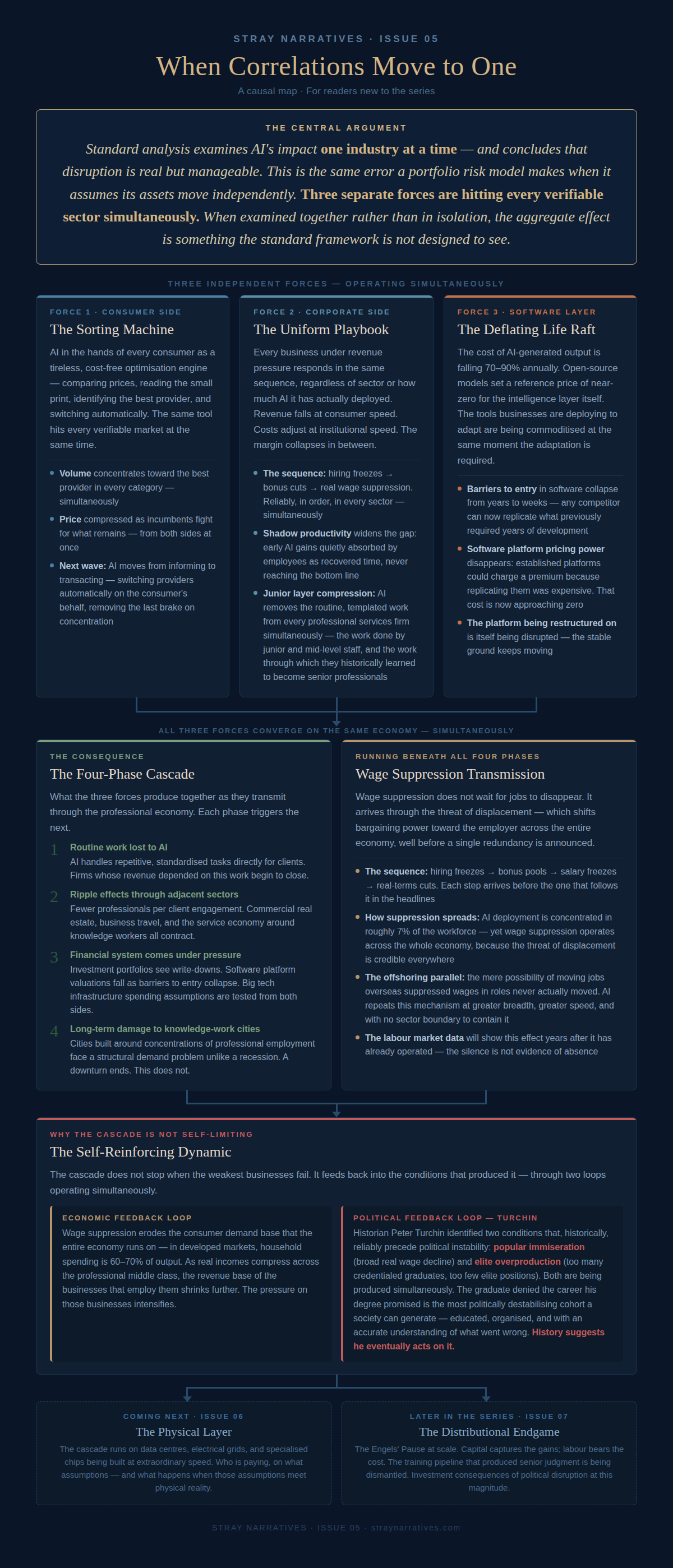
When Correlations Move to One: A Quick Reference
The independence assumption: Standard sector-by-sector analysis of AI’s economic impact assumes that disruption operates independently across industries. This assumption fails for the same reason that a portfolio risk model built on normal-conditions correlations fails under stress. The model is not wrong about the components. It is wrong about the assumption of independence, a distinction that tends to become clear at the least convenient moment.
The first correlation structure, timing-driven: The same AI-empowered consumer applies the sorting machine across every verifiable sector simultaneously. Common factor exposure, not contagion. Reinforced by a second mechanism: price transparency across sectors simultaneously intensifies competitive pressure, compressing margins from both the volume and the price side at once. The first wave, AI as information tool, is already operating. The second wave, AI as transacting agent, is in accelerating deployment.
The second correlation structure, behavioral: Every corporation under demand-side margin pressure responds in the same sequence regardless of sector: hiring freezes, bonus compression, real-terms wage suppression. The timing of AI adoption varies considerably by sector. The behavioral response to margin stress does not. Corporate AI deployment is concentrated in a narrow slice of the workforce; the behavioral response operates across the entire economy. A meaningful share of near-term productivity gains has been absorbed by employees rather than delivered to corporate bottom lines, widening the scissors further. Pyramid compression operates simultaneously across every professional services firm. The credential obscures the exposure. The job architecture reveals it.
The software layer: Token deflation running at seventy to ninety percent annually collapses barriers to entry across enterprise software, commoditising the tools businesses are deploying to adapt at the same moment the adaptation is required. The life raft is also deflating.
The Pignataro cascade: Four phases running in sequence as the correlation structures work through the economy: commodity revenue loss and first-wave firm closures; engagement compression and second-order demand contraction in adjacent sectors; financial system exposure via portfolio write-downs and hyperscaler capex scrutiny, compounded by software layer repricing; structural demand compression in the cities and institutions organised around knowledge work concentration.
The wage suppression transmission: Simultaneous real-wage suppression across the professional economy, propagating beyond directly affected sectors through bargaining power shift. The threat of displacement suppresses wages in jobs not yet displaced, as it did during the offshoring wave, but with greater breadth and speed.
The self-reinforcing dynamic: Wage suppression at this scale erodes the consumer demand base that the Kill Zone is concentrating spending within. The pool being optimised is shrinking. Pyramid compression simultaneously produces the social configuration, popular immiseration converging with elite overproduction, that Turchin’s historical analysis identifies as the precursor to structural political disruption. The cascade is not self-limiting economically or socially. It applies pressure to both blades of the scissors simultaneously.
References
[1] Stray Narratives, Issues 01, 02, and 04: “The Sorting Machine,” “The Adoption Asymmetry,” and “The Channel Controllers.” The Verification-Substitution Matrix, the Adoption Asymmetry, and the distribution argument are developed in full in those issues. The present piece assumes familiarity with those frameworks.
[2] Wang et al., “How Well Does Agent Development Reflect Real-World Work?”, 2026. The distribution of AI agent development across United States occupations, and the concentration of benchmarking activity in computer and mathematical work relative to the domains of largest employment, are drawn from this paper.
[3] Andrea Pignataro, “The Wrong Apocalypse,” February 15, 2026. The four-phase cascade is drawn from this essay.
[4] Peter Turchin, End Times: Elites, Counter-Elites, and the Path of Political Disintegration, Penguin Press, 2023. The framework of elite overproduction and popular immiseration as converging preconditions for political instability, and the historical evidence base across pre-revolutionary societies, are drawn from this book.