

A note for readers new since the last piece: this Substack mixes long-form thematic work like this one with market and investment analysis like the previous note. Both will continue, in rough alternation.
Key Takeaways
AI generates four observable mechanisms across the cognitive economy: recursive output proliferation, constant experimentation as time-sink, verification burden, and attention fragmentation. Each carries its own bimodal logic and its own compressed middle.
The audit profession ran one of these mechanisms first. Between 2002 and 2026, audit work commodified entirely; the signature on Page 1 kept 100% of the pricing power. The cognitive economy is now running all four at once.
The slice of the workforce this hits is roughly 13% of the US labour force, the proceduralised cognitive roles Issue 06 named [11]. The other 77% (food service, retail, construction, healthcare support, transport) is not running this trade.
The unemployment question is a sequencing question, not a directional one. AI eliminates roles at machine speed; new economic categories crystallise at institutional speed. The gap is where the shock lives.
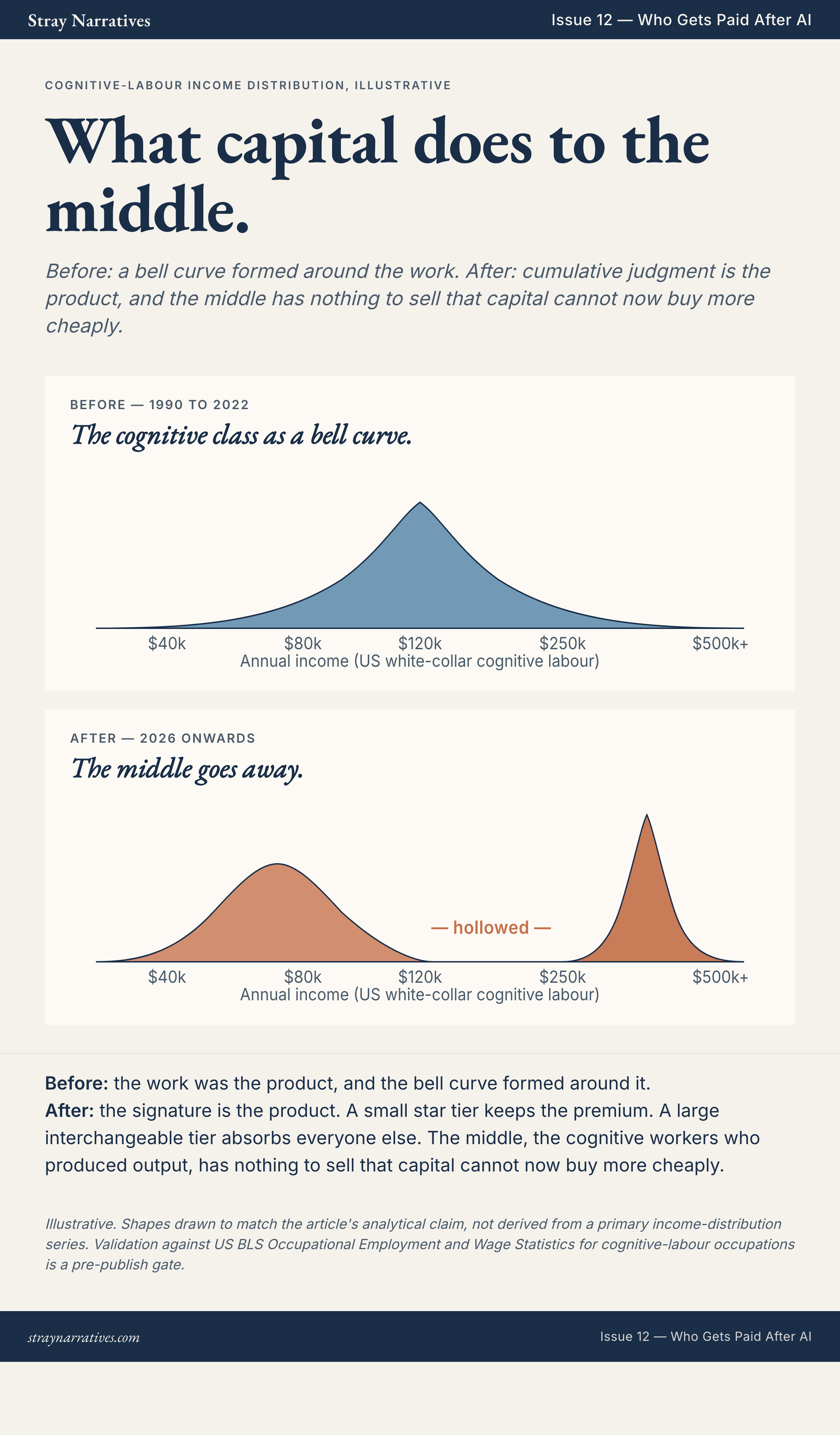
The equilibrium across each mechanism is bimodal: a small top tier of cumulative-judgment-holders retains pricing power, a large bottom tier becomes interchangeable, the middle goes away.
Here below is the podcast version of this article produced with NotebookLM:
What an auditor sells, in 2002 and in 2026
In 2001, an auditor sold thoroughness. The audit itself was the product, the partner’s signature at the end was a procedural formality, and selling thoroughness is what you do when you have nothing else to sell.
Enron collapsed in late 2001. Arthur Andersen, the audit firm that had blessed its accounts, collapsed with it. A market eighty-nine years in the building evaporated in nine months because the signature had not done what the signature was supposed to do.
Sarbanes-Oxley followed in 2002. Buried inside the thousand pages of other reforms was the change that mattered: the audit partner whose name appeared on the opinion was now personally responsible for it. The signature became the unit of liability; the workpapers, which for ninety years had been the product the audit firm sold, stopped being the product. Signed accountability did.
Twenty-four years later, the audit field work is largely automated. AI handles anomaly detection, transaction sampling, reconciliation, control testing, journal-entry analysis. The audit teams of 2026 are smaller, more senior, supervisory. What they sell is the same thing they sold in 2003: the partner’s name on Page 1. The room got smaller. The signatures got more expensive.
If you have ever signed an audit letter, or sat across a table from someone who has, this is the transition you have already lived through. The audit profession ran the cleanest of four mechanisms first, because verification was the dominant binding constraint and Sarbanes-Oxley named it in legislation rather than letting the market discover it slowly. The cognitive economy is not so lucky. It is running all four at once, with no Sarbanes-Oxley to clarify any of them.
The slice of the cognitive economy this transition will run through is roughly 13% of the US workforce but that 13% is going to create havoc and the market is still in denial.
As Ken Griffin of Citadel appears to have just noticed, finance will be hit hard. Financial and macro research, probably does not even need the audited signature approval on the content created. Its forecasting ability has always been poor not from lack of work or effort, but simply because forecasting complex adaptive systems is more art than science. However plentiful the hallucinations of the AI model, they will likely be no less error prone than the approximations and assumptions of the analysts. As he said, “there is no theoretical position to retreat to”, especially in finance.
The data is starting to show up where the framework predicts it should. The unemployment rate for workers under thirty-five holding a Master's degree has reached its highest level in nearly twenty years. Business-school applications are dropping fast enough that specialised degrees are now openly discounted; the higher-education credential factory boom that defined the 1990-to-2020 period is ending in real time.
None of this is the AI shock arriving. It is the AI shock that has already arrived, showing up in census-class data and the market remains in denial, sleepwalking into a drastically changing economic environment.
The four mechanisms
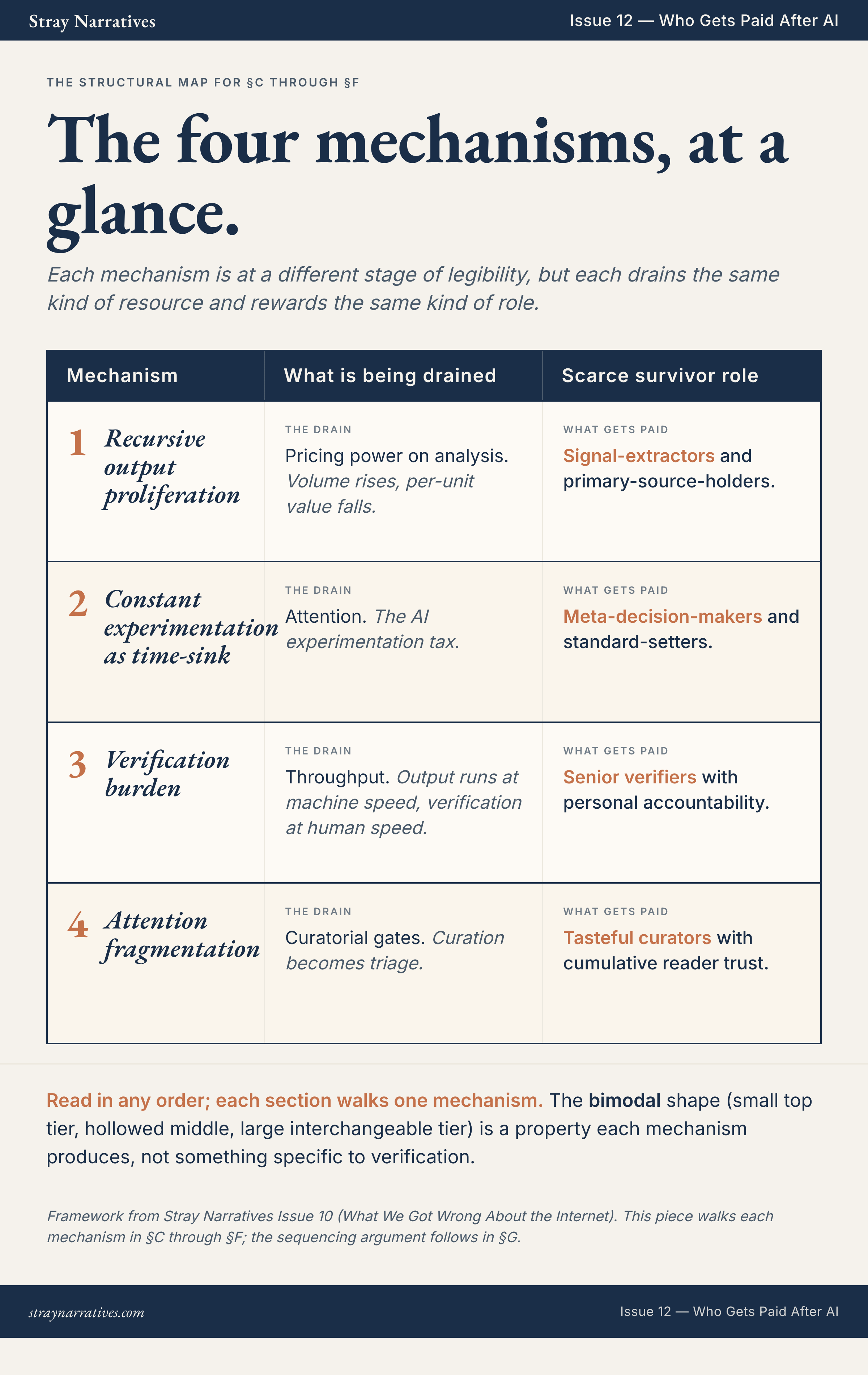
A previous piece [10] named the four mechanisms AI produces in cognitive labour markets. Each runs in parallel; each creates its own bimodal compression; each carries its own scarce role; each is at a different stage of legibility.
Recursive output proliferation. AI outputs become inputs become outputs. The half-life of any specific knowledge advantage collapses, because what one analyst learns this quarter is in everybody’s training set the next.
Constant experimentation as time-sink. Every team running parallel trials on tools, workflows, agents, and models. Time spent evaluating what to use displaces time spent on the work itself.
Verification burden. When an AI can produce anything, verifying becomes the bottleneck. Citations may be hallucinated, code may compile and still be wrong, drafts may pass spell-check and still be incoherent on a re-read.
Attention fragmentation. The bottleneck is no longer capability but choice: what to attend to, in a stream that has lost most of the curatorial gates that used to do that work for us.
Four mechanisms, one underlying physics: capital pushes work toward commodification; accountability and irreproducibility push the surviving slice toward irreducibility. The middle, across all four, hollows out. What follows walks each in turn, with the audit profession as the running reference for what the late stage looks like.
Recursive output proliferation
The premium on having access to a piece of analysis falls because the cost of producing equivalent analysis falls. Each output becomes training data for the next model release, and each release lowers the floor under what a generic AI summary can produce on the same topic. Volume rises; average per-unit value falls, perhaps a long way.
Sell-side equity research is the cleanest live case. The morning notes that used to anchor a buy-side institution’s intraday positioning are now, within a quarter, ingested, paraphrased, and surfaced as AI-summarised feeds to subscribers who never paid the issuing firm [15]. The note still exists; the informational asymmetry it used to carry does not. The half-life of an analyst insight has compressed from quarters to days.
Academic working papers run the same loop. A preprint posted on arXiv on Tuesday is summarised, cross-referenced, and embedded in literature-review queries by Thursday. Authorship is preserved; what has changed is the duration over which the paper functions as the reader’s first encounter with its argument.
Inside the cognitive workplace the loop runs faster. An internal research memo, once written, is fed into the firm’s AI tooling within a week and surfaced as context to every junior analyst’s queries thereafter. The analyst who wrote it has handed her firm a permanent productivity asset and lost the ability to be paid for being the only person who could have written it. Two quarters later, she is competing with a tool trained on her own outputs.
What remains scarce is what the training set cannot reproduce. A radiologist with a million scans has calibration the model cannot have until it is trained on a comparable distribution, and the distribution itself is the constraint. A senior credit analyst with thirty years of cycle memory holds judgement compressed from outcomes the model has no access to. A primary-source researcher with cultivated relationships at central banks, regulators, or operating-company management produces information the model has never seen because it was never written down [1][3]. The conference-room conversation that never makes it to email, the off-record deal-room exchange, the boardroom briefing that exists only in the partner’s memory, the dinner with a CFO whose remarks are not minuted: these are the channels that stay scarce by structurally avoiding the recursive loop. The professional whose value sits in those channels remains paid for being trusted; the professional whose value is fully digitised has handed it to the next model release.
The bimodal: signal-extractors and primary-source-holders keep their pricing power; output-producers compress; the middle, the analyst whose work the next model release will absorb at no cost to the customer, goes away.
Constant experimentation as time-sink
There is a tax on attention, the AI experimentation tax, and it takes the form of keeping up with platform churn. The tax compounds quietly because the comparison to the prior tooling regime fades from memory. People remember being busy; they do not always remember whether the busyness was productive.
An engineering organisation ran on a stable IDE in 2022. In 2023, GitHub Copilot was the new shared assumption. In 2024, Cursor displaced Copilot for many teams. In 2025, Claude Code displaced Cursor for several of those same teams. Each marginal model release shifts the relative ranking enough to justify a re-evaluation. Each evaluation costs a team a week of attention; each team runs roughly four per year. The aggregate looks like a tax of one month per engineer per year, paid in deferred work, before any productivity benefit from the chosen tool is counted.
The same dynamic runs one layer up. Agentic frameworks, MCP servers, orchestration layers, retrieval-augmented stacks: each is now under live evaluation at most cognitively intensive firms, and the cost of the evaluation is the senior engineer-week that is not spent on the work itself. The output of these meetings is rarely a new tool; it is usually the firm’s collective decision to keep using roughly the same tool, slightly upgraded. The tax was paid for an answer the firm already had.
What remains scarce is the meta-decision-maker. The senior practitioner who can credibly say “we are not re-running this comparison; the gain is below the cost of evaluating it” removes the tax from the teams underneath. Standard-setters who pick a stack and force the firm to live with it for two years rather than two months recover the attention the experimentation tax was draining. These are not popular roles. They are paid because the alternative is the entire firm in a permanent state of evaluation.
The bimodal: meta-decision-makers and standard-setters win. The busy-but-not-deciders, running the comparison for the fifth time, lose the attention that used to do the work itself. The middle, the team-lead who keeps comparing because no one more senior will stop the comparison, is the one whose week vanishes into the tax.
Verification burden
When an AI can produce anything, verifying becomes the bottleneck. Citations may be hallucinated, code may compile and still be wrong, drafts may pass spell-check and still be incoherent on a re-read. This is the mechanism the audit profession lived through first, and the one Issue 01 named as the Trust Economy quadrant of the Verification-Substitution Matrix [7]. It is now running across the rest of the proceduralised cognitive economy with no Sarbanes-Oxley to organise it.
If you have ever spent a week waiting on a single senior signature while the underlying work was done in an hour, you have already met this bottleneck.
Legal. Bottleneck: a senior partner has to verify the AI-drafted brief before it can be filed. Lawyers in Texas, New York, and California have been sanctioned for filing briefs with AI-fabricated citations [4]. A senior partner described the new workflow as “a whole second associate-level workforce we did not have to hire two years ago, doing nothing but verifying what the first one produced.” A second associate-level workforce, except non-billable, and somehow this is filed under productivity gains.
Medical. Bottleneck: the AI cannot be the named clinician of record on the diagnosis. Diagnostic AI has reached or passed expert-level accuracy on benchmark datasets in radiology, dermatology, and pathology. The radiologist who signs off is still the named accountable clinician; the signature is the unit the legal and insurance systems can act on. AI produces more candidate findings per patient that must be ruled in or out, and the rate at which a radiologist can rule findings in or out has not changed. The AI is faster, the radiologist is the same speed, and the patient queue gets longer.
Software. Bottleneck: a senior engineer has to credibly approve the pull request. Code volume is up; the engineer count is down; senior time in code review is up sharply. Engineering leaders describe the new bottleneck as “the rate at which a senior engineer can credibly approve a pull request,” and that rate is the same as it was in 2022. The career path that produced senior engineers now runs through the tier the AI is eating, which is the sort of thing the strategy memo never quite gets to.
The 2025 macro numbers fit. US GDP grew 2.7% with 181,000 net jobs added, the worst non-recession year for net employment since 2003 [5].
The bimodal: senior verifiers retain pricing power; junior producers compress, because the bottom rung of the cumulative-judgment ladder is now performed by the model.
Attention fragmentation
Email becomes agent-to-agent. Search becomes AI-mediated. Content becomes infinite. The bottleneck is no longer capability but choice: what to attend to, in a stream that has lost most of the curatorial gates that used to do that work for us.
Google’s AI Overviews now displace a meaningful fraction of the organic-search referral that used to send users to underlying publishers [14]. The user gets an answer; the publisher gets nothing. The previous bargain (the publisher writes, search indexes, the user clicks through, the publisher monetises the click) has been quietly rewritten so that the click is no longer needed. The gate (the search-results page with its ten organic links) has been replaced by a single curated answer in which no publisher’s URL needs to appear. This is the channel-controller dynamic Issue 04 named [9], one layer further down the stack.
Inbox email is running the same compression. Agent-to-agent message flow (the AI assistant that triages, summarises, and replies on behalf of its user) reduces the inbox from a stream of human signals to a stream of pre-processed summaries. The pre-processing removes senders the user no longer needs to hear from, which sounds like an upgrade; it also removes the curation-by-attention that used to make the inbox a signal of who was paying attention to whom. The signal degrades; the time saved feels real; the relationships do not survive.
Long-form content is the most obviously infinite. Every newsletter, podcast, and video channel the user might subscribe to now produces at the rate the user used to consume across all of them combined. The cost-of-production constraint has fallen; consumption has not expanded to meet the new floor. What used to be a curation problem is now a triage problem.
The scarce role is the tasteful curator operating at scale. The Substack writer whose subscribers trust their selection enough to read what is recommended and skip what is not, the podcast host whose guest selection is itself the product, the editor whose name on a piece of content is the reason it was opened: these roles function as the new choice-architecture. The user delegates attention to them because the alternative is to drown in the unfiltered stream [2].
The dynamic mirrors music after the phonograph: a small star tier whose names were the asset, a great middle buried. Network effects in content distribution concentrate attention on a handful of writers, podcasters, and curators whose distribution is near-universal; the majority is statistically invisible not because the work is worse but because the volume of competing output makes any individual title disappear against the average.
The bimodal: tasteful curators with cumulative reader trust retain pricing power; generic distributors lose. The middle, the title whose curation is now indistinguishable from any other generic gate, goes away. The Google homepage of 2012 is the cognitive economy’s church-choir-and-dance-hall of 2026: the middle distribution layer, eaten by the platforms above and the algorithmic curation below.
Pieces like this one are fighting the same fight, against the same deluge. The fact that the reader has made it this far means the curatorial gate worked at least once today, which writer and reader (?) can perhaps both notice with some relief.
The gap between elimination and emergence
The unemployment question is a sequencing question, not a directional one. AI eliminates roles at machine speed across all four mechanisms. New economic categories crystallise at institutional speed, which is slow, and in forms nobody currently knows how to describe.
The audit profession is the reminder that the gap can be long. The transition from Sarbanes-Oxley in 2002 to the senior-and-supervisory 2026 audit firm took twenty-four years, with workforce contraction front-loaded and the new equilibrium back-loaded. Junior auditors absorbed the loss; senior partners absorbed the rebalanced rent; the audit-manager tier in between, whose function had been to verify juniors who were no longer being hired, was the slowest-resolving casualty.
The four mechanisms now run in parallel without the legislative cue Sarbanes-Oxley supplied. There is no act of Congress arriving to clarify that the AI summary is not the named author of record; no statute defining the verification ratio at which an AI-generated brief becomes a sanctionable filing; no licensing body declaring the meta-decision-maker the new partner-track role. Institutions form around the gap slowly, and the gap is the shock.
I do not try to predict the length of the gap. I am naming the mechanism by which the unemployment outcome is determined: elimination runs faster than emergence; the unemployed are the working-age population in the gap; the gap is set by the slower of the four institutional clocks. Whichever mechanism resolves slowest sets the duration of the dislocation.
Bottom Line
Two forces, opposite directions. Capital pushes work toward commodification, the way the phonograph pushed singing: the singing stayed, the leverage dissolved, the great middle of working singers in church choirs and dance halls mostly went away [8]. Accountability pushes the surviving slice toward irreducibility, the way Sarbanes-Oxley pushed the audit partner’s signature toward irreducibility. AI accelerates the first and sharpens the asymmetry; the mechanism is the same in each of the four domains, the costume different.
The equilibrium is bimodal. A small top tier (cumulative-judgment-holders, primary-source-holders, meta-decision-makers, verifiers, tasteful curators) keeps its pricing power. A large bottom tier (the analyst the next model release absorbs, the team-lead running the fifth comparison, the junior producer whose verification ladder has been kicked away, the generic distributor) becomes interchangeable. The middle hollows out across all four. What would falsify this is a stable verification ratio across firms over time, or a regulatory shift commodifying accountability the way limited liability commodified ownership in the nineteenth century. Neither has happened yet.
Blue-collar work went through the same compression in the second half of the twentieth century; the work was not destroyed, it stratified. Skilled trades held their wages; interchangeable manufacturing was commodified, offshored, gone. The cognitive class is entering its turn.
The luxury sector of cognitive labour compresses into a single tier of Hermès at the top and a long tail of interchangeable at the bottom [12]. The middle goes away.
If you are reading this from inside the affected 13%, the question I keep returning to is which fields defend themselves and which do not. No checklist gets this fully right (too many variables, too long a horizon), but three tests do most of the work for me, and I think they are the right starting point:
Does the field reward judgment that takes decades and cannot be compressed?
Is the junior-to-senior ladder still being funded? No juniors means no future seniors.
Does credentialing intensity or regulatory accountability prevent the AI shortcut at the entry tier?
The defensible fields by all three: medicine and surgery, senior engineering disciplines where firms still invest in junior training, specialty research, track-record-based investment management, skilled trades outside the AI-cognitive frontier. The cautious fields are the ones the shock is hitting hardest at the junior end: financial compliance, legal junior-associate work, junior software engineering, content production, white-collar BPO. The ladder breaks at the bottom rung; the field shrinks even where the senior tier remains scarce.
Paul Kedrosky is right that “unprecedented in human history” is a small-sample argument; the compression dynamic does not need precedent to operate. This is the elite-overproduction half of Peter Turchin’s framework [13]: a credentialed professional class larger than the elite positions available to absorb it, alongside popular immiseration. A cognitive class compressed into a star tier and an interchangeable tier across four mechanisms at once is what elite overproduction looks like in real time. Turchin’s evidence base does not predict revolution; it predicts volatility, delegitimisation, and a search for scapegoats. A generation of credentialed professionals is walking into that configuration without the vocabulary to recognise it. Some of them are reading this. I am one of them, having run the three filters above on my own field and chosen not to elaborate on which is missing.
The signature is what is being bought. The draft is now cheap. The audit profession ran one of the four mechanisms first, between 2002 and 2026; three more are running through the cognitive economy in parallel, in different costume, without the legislative cue that organised the first. When verification and cumulative judgement are the scarce inputs across all four, a new economic class forms around their certification, and a market emerges priced around it. Each of these four mechanisms warrants its own deep treatment, and future notes will take them on individually, starting with recursive output proliferation. I named the four mechanisms I observe today; further mechanisms may surface as the AI impact on the economy continues to take shape, and my framework will be extended as they do.
References
[1] Sangeet Paul Choudary, Reshuffle, platformthinkinglabs.com, 2024-2026. The coordination-layer thesis.
[2] Alex Imas, “What Will Be Scarce?”, Ghosts of Electricity, 2026. The relational-sector reframe of post-commodity scarcity.
[3] Arvind Narayanan and Sayash Kapoor, AI as Normal Technology, Knight First Amendment Institute at Columbia, 15 April 2025. The three speed limits of invention, application, and diffusion.
[4] Mata v. Avianca, Inc., 22-cv-1461 (S.D.N.Y. 2023). Canonical first sanctions case; subsequent sanctions through 2024-2026 in jurisdictions including Texas, New York, and California are documented in legal trade press and federal court orders.
[5] “Unprecedented ‘Jobless Boom’ Tests Limits of US GDP Expansion”, Bloomberg, 18 February 2026. 2025 GDP growth and the 181,000 jobs added per BLS Employment Situation and BEA NIPA tables.
[6] Anthropic ARR of ~$30bn and headcount ~3,500 per Reuters / Bloomberg, April 2026. Salesforce fiscal-2024 revenue $34.86bn / 72,682 employees per Salesforce 10-K, February 2024.
[7] Stray Narratives, Issue 01: “The Verification-Substitution Matrix”, February 2026. The Trust Economy quadrant.
[8] Stray Narratives, Issue 02: “Adoption Asymmetry”, March 2026. The bargaining-power-shift mechanism: wage suppression arrives first through eroded leverage, not direct displacement. The phonograph case study is set out in the body.
[9] Stray Narratives, Issue 04: “The Channel Controllers”, March 2026. AI capability absorbed by channel controllers as toll collectors and platform operators.
[10] Stray Narratives, Issue 10: “What We Got Wrong About the Internet (and May Get Wrong Again)”, May 2026. The four-mechanism passage on which this piece’s framework is anchored.
[11] Stray Narratives, Issue 06: “The Noise Economy”, April 2026. The 13% / 77% workforce split.
[12] Alex Imas and Kristóf Madarász, Mimetic Dominance and the Economics of Exclusion, Quarterly Journal of Economics, 2024. Willingness-to-pay doubles with exclusion.
[13] Peter Turchin, End Times: Elites, Counter-Elites, and the Path of Political Disintegration, Penguin Press, 2023. The two-precondition framework (popular immiseration plus elite overproduction) is developed across the book; the empirical base across 20+ societies and 5 centuries is set out in the introductory chapters.
[14] Search referrer trend data for AI Overviews displacement of organic traffic to news and reference publishers, 2024-2026, as reported by Similarweb, Press Gazette, and publisher-side disclosures (BBC, Mail Online, News Corp earnings calls).
[15] Salesforce / Bloomberg / consumer AI-search ingestion of third-party sell-side research: industry trade reporting in Institutional Investor and Risk.net, 2025-2026, documenting analyst-research summary surfacing in chatbot products and the resulting compression of research half-life.