

As always, if you enjoy this article, please Like & Share, it means the world to me, really! Click here for : Part1 - Part 2 - Part 3 - Part 4 - This is part 5!

Companies that sell chips do not usually guarantee their customers’ rent.
In August, Nvidia agreed to guarantee up to $105 billion on leases for data centres being built for an affiliate of OpenAI. [1] If OpenAI defaults and the space cannot be re-let or sold for enough, Nvidia pays the shortfall. In return, the site will run only Nvidia’s systems. The seller has agreed to guarantee part of its own customer’s rent, and it is not the only seller doing something like this.
Why would a seller do that? My answer is that the money to pay for all of this has not arrived yet. This year, six companies will spend about $785 billion building data centres and filling them with machines, according to press reports of Moody’s forecast. Next year, it will be close to $1 trillion. [2] For all that spending, customers currently pay at most $250 billion a year for AI. [3]
The whole issue, summarised in one word, is sequencing.
Basically, I think the bill for this build-out will arrive before the money that pays for it, and that the realisation of this ends in a bust that builds in stages.
The best guide to why is electricity. It changed everything, and it still took decades to pay off. In 1899, electric motors supplied less than 5% of the mechanical power in American factories. Only in the early 1920s, four decades after the first power station opened, was slightly more than half of it electric. Factories first bolted motors onto their old steam-era layouts. The gains came only when they rebuilt the factory floor around the new power. [4]
Nor did the money stay with the companies selling the power. They ended up as regulated utilities, and from the late 1910s their rates fell sharply against other prices. [4] Electricity made companies more efficient, not more profitable: once everyone had it, nobody had an edge.
AI looks set to repeat both lessons, on price and on speed.
Start with price: Most sellers lose customers when they charge more. A few do not. A luxury handbag sells scarcity. Cigarettes sell a habit. And the spreadsheet your whole office runs on sells the pain of leaving it.
AI has none of that, at least not yet. Everyone is building the same thing at the same time, so it will not stay scarce. Most consumer AI is given away, so paying for it is not yet a habit. And models only a few months behind the best are free to download, so leaving is easy. So the price keeps falling, far faster than electricity’s ever did. Household electricity got about 5% cheaper a year for eight decades. The same level of AI performance has become about 13 times cheaper every year since 2023. [5]
Then there is speed: The buyers with the most money and the best reason to pay are employers, because a machine that does a job replaces a wage. But to get the gains, companies have to rebuild how they work, as factories did around the electric motor, and that takes years. Even OpenAI’s chief executive, Sam Altman, says so. Asked on a podcast published in August whether 2026 would be the year every business is “up for grabs”, he said he disagreed on the timeline. “The economy just has so much inertia,” he said, and “we’ve all been too ambitious on timelines.” [6]
That matters to you even if you have never used a chatbot. If you own an S&P 500 index fund, about $30 of every $100 in it sits in seven companies that are building AI, or selling to the companies that are. They are Nvidia, Microsoft, Amazon, Alphabet, Meta, Broadcom and Micron. [7]
This is part one of two. Here I do the arithmetic: how big the bill is, and why the money cannot arrive in time. Part two, “The Companies Selling AI Are Paying for It. For Now.”, follows the money: who is paying for all of this today, and the order in which I expect it to break.
Nobody Has Sent the Bill Yet
If this much capital has been committed, why does everything still look fine?
Because the real test comes later. It did in the late 1990s too, when telecom companies laid fibre-optic cable across America to carry the internet. One of the boom’s mantras was that internet use doubled every three to four months. Between 1996 and 1999 the amount of fibre laid each year more than quadrupled. [8]
The demand was real. Internet traffic kept growing, roughly doubling every year. [8] But it grew far more slowly than the forecasts, and two other things went wrong. Everyone built the same thing at the same time, and the technology kept improving. A strand of fibre that carried 2.5 gigabits a second in 1996 could carry 100 by 2000, forty times as much from cable already in the ground. [8] Capacity became plentiful, and of course, its price fell. [8]
The Nasdaq’s telecom index peaked in March 2000 and had fallen 62% by the end of that year. [8] Global Crossing, which owned a fibre network reaching 27 countries, filed for bankruptcy in January 2002. [9] The network kept running. A new owner put in $250 million and took control, creditors got part of the new company, and under the bankruptcy plan the shareholders got nothing. [9]
AI has some of the same ingredients. The demand is real and everyone is building the same capacity at the same time. And as the technology improves and providers compete, the price of a given level of performance keeps falling. [5] So far that has not hurt: cheaper AI is being used more, and revenue is still growing fast. But when a price falls that fast, usage has to grow almost as fast just to keep revenue where it is. The fibre lesson is what can come next. Once capacity outgrows use, prices can fall faster than use grows. The risk is not that customers stop coming. It is that nobody keeps enough pricing power to charge what the machines cost. Computing has been here before. Between 1994 and 1998, IBM shipped 30% to 60% more mainframe computing power every year, and its mainframe revenue fell in four of those five years, because the price of each unit fell faster. And this time the equipment has a short life. The companies' own accounts write servers off in five to six years, [10] so they have to earn their keep now, not in some later decade.
CoreWeave, which sells AI computing, makes almost all its revenue on what the industry calls “take-or-pay” contracts. [11] The customer books a slice of computing capacity for years and owes the money whether it uses it or not. Other companies’ contracts are private, so I cannot see how strict they are. I assume most work the same way, and that they are strict. Only a small part of the money is paid upfront: across CoreWeave’s contracts, the deposit has averaged 15% to 25% of the contract’s value. [11] The big payments start only when the capacity is switched on, and a data-centre campus takes years to build, so most of the bill is still in the future.
Nvidia’s guarantee only takes effect when the first leases are ready for service, expected from 2028. [1] Oracle has $664 billion of contracted work and expects to turn only 13% of it into revenue in the next twelve months. [12] A machine’s cost only reaches reported profit once it is switched on. A large order book in 2026 says little about whether the money arrives in 2028.
Part of the reason everything looks fine is where the money comes from. Most of it is still the big cloud companies’ own cash, earned from search, advertising, software and online shopping. Some is borrowed or raised from outside investors. Some is backed by the sellers themselves, like Nvidia’s guarantee. But the balance is shifting fast. In the latest quarter the six companies spent about $200 billion, as much as their businesses brought in. [13] And much of the building never shows up in their spending at all. Microsoft, Meta, Amazon and Alphabet have signed about $830 billion of leases, mostly for data centres, that have not started yet. [13] Landlords build those sites with their own borrowed or raised money. That is the big difference from the fibre boom, much of which was built by new companies such as Qwest, Level 3 and IXC. [8] The closer precedent is the mainframe. IBM paid for its machines itself and rented them out, and its grip on big business computers lasted more than 25 years. When it broke, IBM's shares fell 77% in six years. I think this boom will also be slower to break, but not safer for shareholders. As long as that money keeps flowing, the orders keep coming, and the order books look like demand. Part two comes back to this.
The Trillion-Dollar Treadmill
What does a trillion dollars a year of machines have to earn? The answer takes three steps.
That $250 billion is the most generous estimate of what the AI industry earns from AI products and services. It comes from Aswath Damodaran, a professor of valuation at New York University. [3] It adds up the annualised revenue of the AI labs, OpenAI and Anthropic among them (recent revenue scaled up to a full year), plus what xAI, Microsoft and others earn from AI products. It leaves out the companies that sell the chips and equipment, because the question is what customers pay to use AI.
On the spending side, Moody’s expects close to $1 trillion a year by 2027. [2] Not all of it is AI. Some pays for ordinary cloud services and other buildings. My estimate is that about three quarters is AI, roughly $750 billion, but no company discloses the split. So I run the long-run bill twice. I show the working on the full $1 trillion, because the numbers are rounder, and give the three-quarters answer next to it. The year-by-year sums later on use three quarters, the kinder case. That is why the bill comes out as a range, $3.2 trillion to $4.3 trillion: the low end is the three-quarters case.
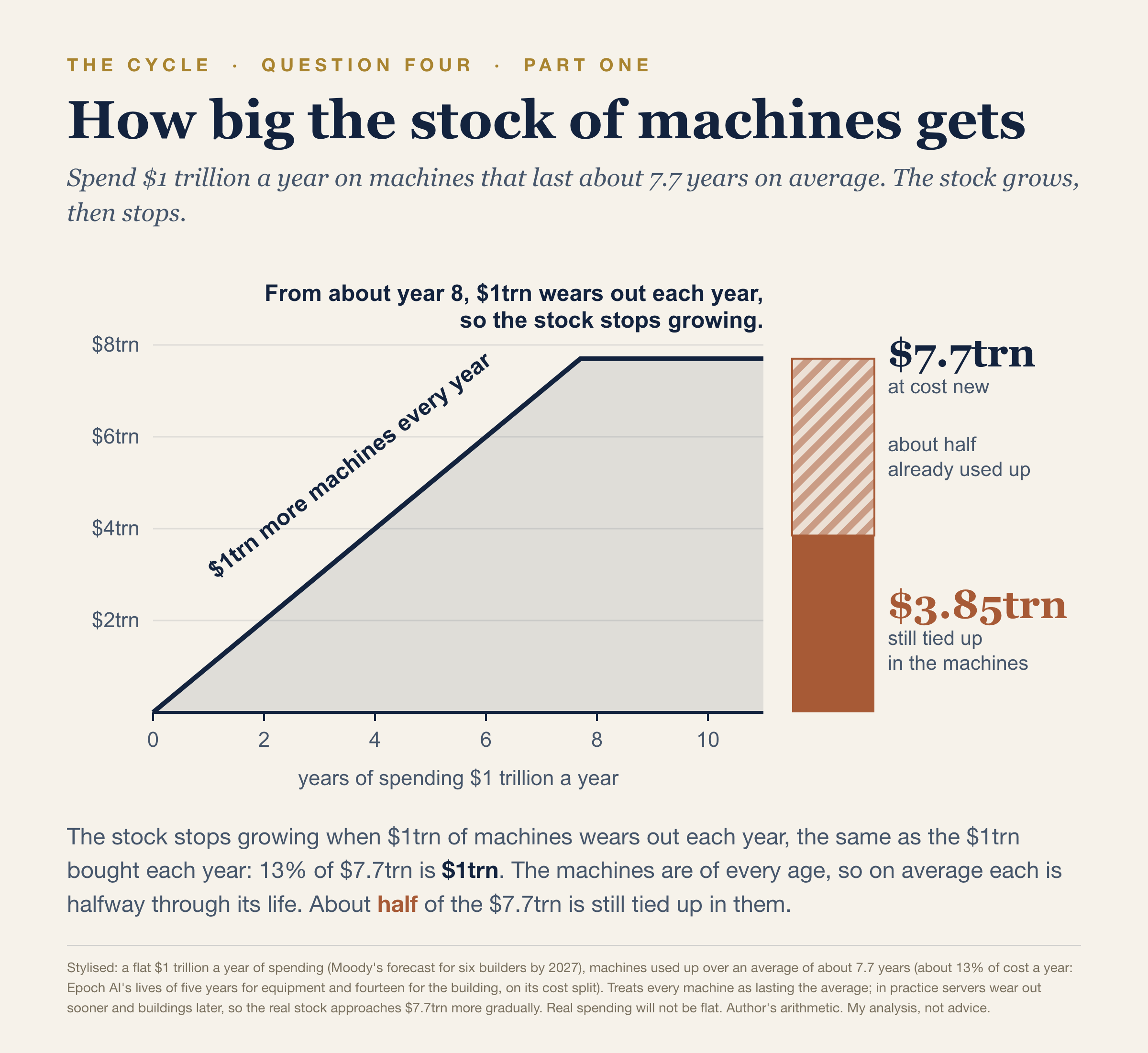
Step 1 - How big the stock of machines gets: The stock is all the servers, network equipment and buildings the companies own. Their own accounts treat servers and network equipment as used up over five to six years. [10] Buildings last longer. Epoch AI, which models what a data centre costs, assumes five years for the equipment, fourteen for the building, and about 70% of the cost in equipment. [14] On those lives, about 13% of the original cost of the whole stock is used up each year. That is an average life of about 7.7 years (100 divided by 13). Longer building lives would lower that rate. The stock would then grow bigger before it stops, and so would the bill.
Treat every machine as lasting that average. Spend $1 trillion a year. After one year you own $1 trillion of machines. After two, $2 trillion, and so on. The early machines start to wear out. After about eight years, $1 trillion of machines wears out every year, the same as the $1 trillion bought each year. From then on the stock stops growing. It has reached $7.7 trillion at what the machines cost new, and 13% of $7.7 trillion is $1 trillion.
You now own machines of every age, from brand new to nearly worn out. On average each is halfway through its life. Half of what was paid is already used up, and the replacement payments in step 2 cover it. The other half, $3.85 trillion, is still tied up in the machines, and that is the money that has to earn a return.
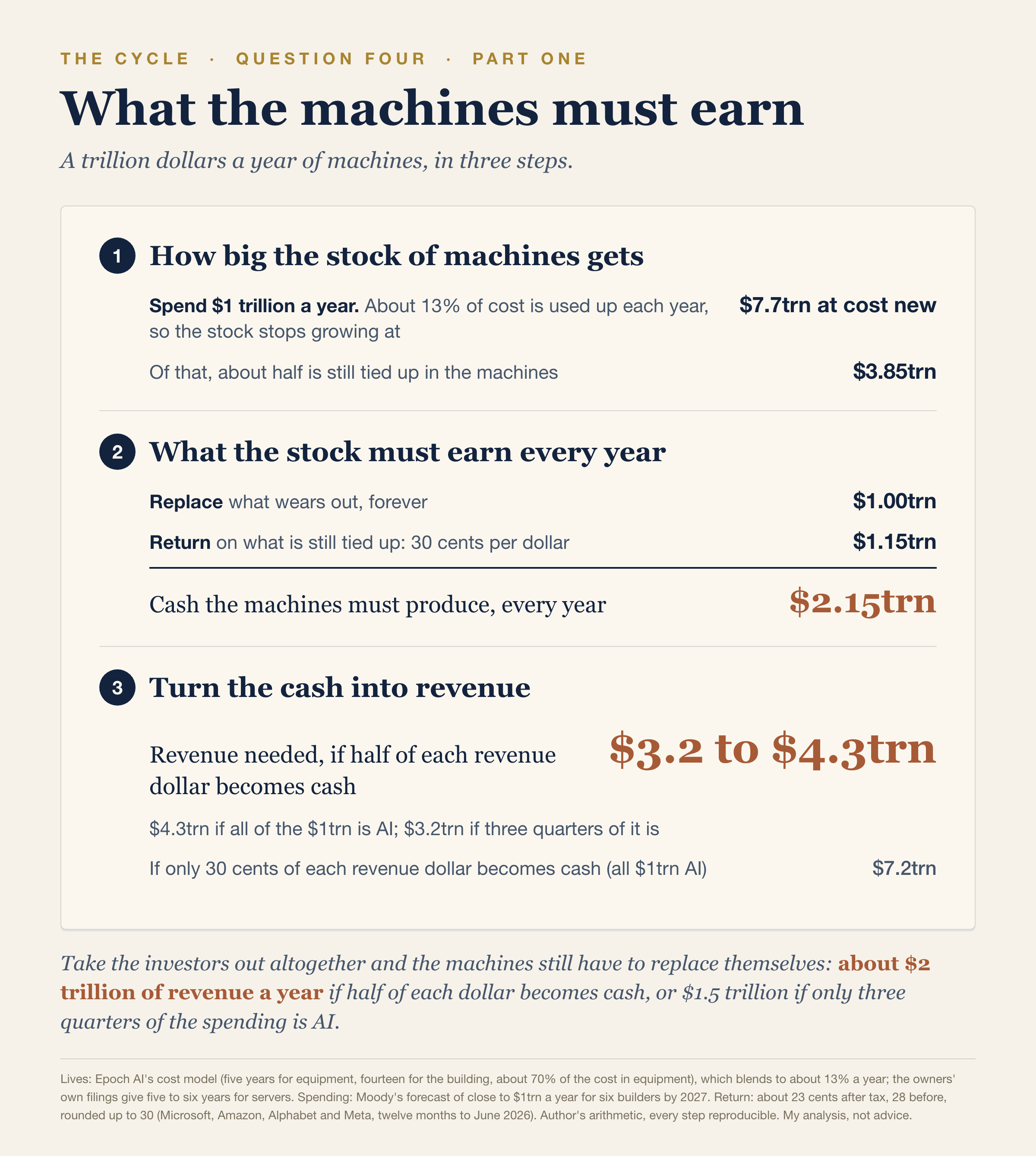
Step 2 - What that stock has to earn every year: The machines have to make two payments. The first is replacement: $1 trillion a year, every year, to replace what wears out. The second is a return for the people who put up the money. Over the twelve months to June 2026, Microsoft, Amazon, Alphabet and Meta earned about 23 cents a year after tax on each dollar of capital they put to work. That is about 28 cents before tax. [15] Capital here means the money that shareholders and lenders have tied up in the business. I assume the new machines must earn the same 28 cents, rounded up to 30 cents for simplicity. A 30% return on the $3.85 trillion still tied up in the machines is about $1.15 trillion.
Together the machines must produce $2.15 trillion of cash every year: $1.00 trillion to replace what wears out, plus $1.15 trillion of return.
Step 3 - Turning that cash into revenue: What customers pay is revenue. Staff, electricity, sales teams and overhead take their share. What is left is the cash the machines produce. I assume half of each revenue dollar is left as cash. If half is left, the machines need $4.3 trillion of revenue a year to produce the $2.15 trillion. If only three quarters of the spending is AI, the same sum gives $3.2 trillion. If instead only 30 cents of each revenue dollar is left as cash, and all of the spending is AI, they need $7.2 trillion.
Across those three cases the answer runs from about $3 trillion to $7 trillion. It never gets small. The 30 cents is what these companies already earn. Even if lenders and shareholders accepted 10 to 12 cents, a normal cost of capital before tax, the bill would still be $2.1 to $2.9 trillion, eight to twelve times what AI earns today. [15] Even with no return for investors at all, the machines still have to replace themselves. That is $1 trillion of cash a year. If half of each revenue dollar is left as cash, it takes $2 trillion of revenue. If only three quarters of the spending is AI, it takes $1.5 trillion.
The Size of It
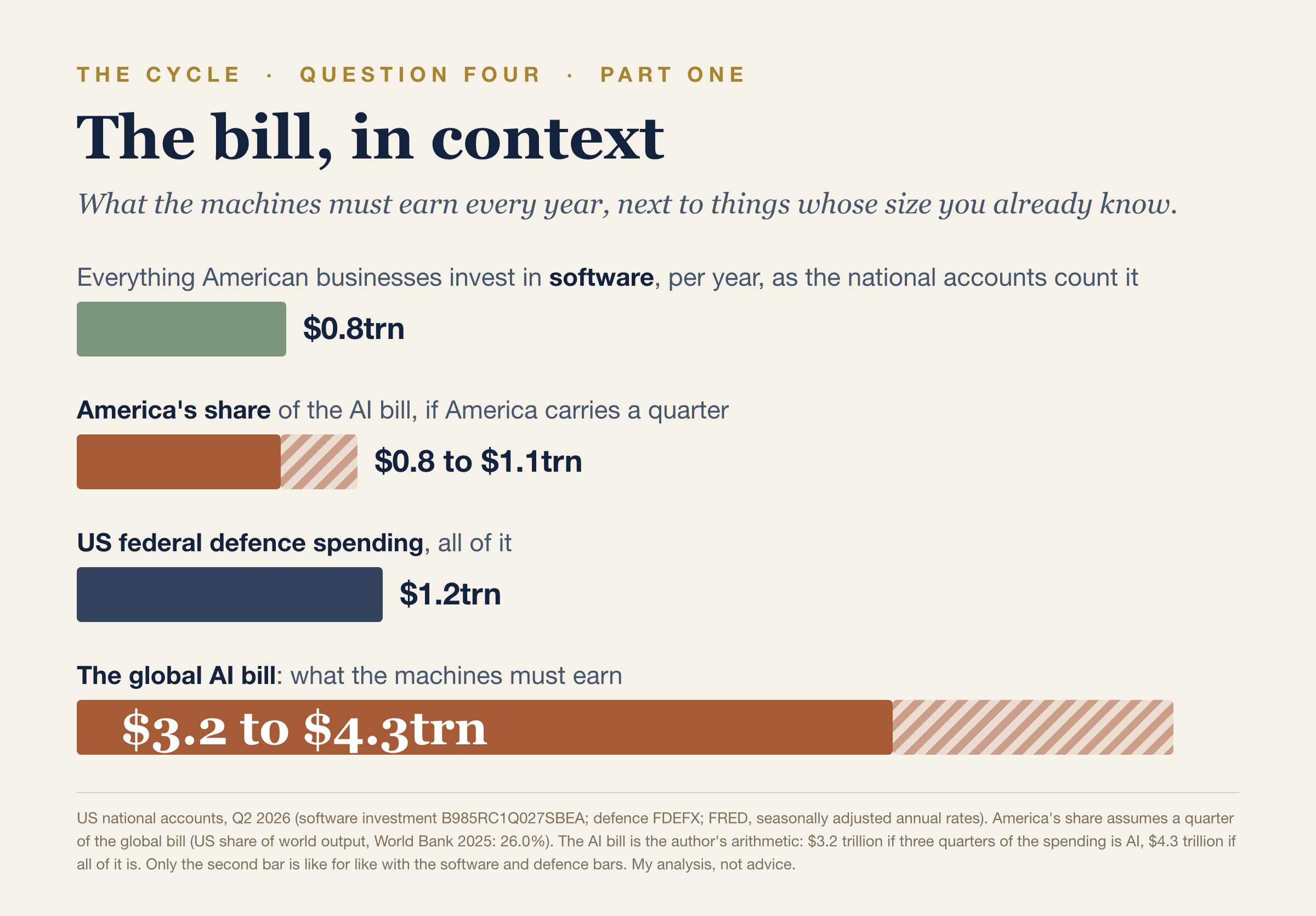
At $3.2 trillion to $4.3 trillion a year, the bill is about 2.7 to 3.6 times everything the US federal government spends on defence. [16] That compares a world total with one country’s spending.
America is about a quarter of world output. [17] If it carries a quarter of the bill, in line with its share of world output, America’s share is $0.8 trillion to $1.1 trillion a year. That is about as much as everything American businesses invest in software in a year, and up to a third more. [16]
That is every year, not once. I know of no industry that has grown from $250 billion a year to trillions in a few years. Money on this scale has to come out of some other giant pool of spending.
A Race Between the Bill and the Revenue
The $3.2 trillion to $4.3 trillion is where the bill ends up, in the 2030s. The race is about how fast it climbs on the way there. Every year the companies keep building, the revenue AI needs goes up, and revenue has to chase it.
Start with what is already bought. By my count from company spending to the end of June, taking three quarters of it as AI, the industry has built or is building roughly 24 gigawatts of AI computing capacity since 2023. [18] A gigawatt is the output of a large nuclear reactor, and the industry counts capacity in gigawatts because power is the physical ceiling on growth. Epoch AI’s own estimate is about 30 gigawatts, but it measures total facility power including cooling, so it is not directly comparable. [19]
Epoch AI puts the cost of owning and running one gigawatt at about $8.5 billion a year. That spreads the up-front cost of servers, network and buildings over their lives, with a charge for the money tied up in them, and adds about $0.9 billion of operating costs, electricity included. [14] The charge for the money is the return the computer services industry requires, much lower than the 30 cents in step 2. So the machines already built or being built cost roughly $204 billion a year to own and run.
Of each dollar customers spend on AI, the owners of the computers can expect to keep roughly 30 to 40 cents, as payment for running the models and training the next ones. Software companies spend 20 to 33 cents of each revenue dollar on all their costs of delivering the service, hosting and support staff included. [20] So my 30 to 40 cents does not overstate what the machines need. The labs hand over more today: Anthropic projected in May that its computing cost would fall from 71 cents of each revenue dollar to 56 cents. [21] I do not think a business that lasts can keep handing over that much.
So the machines already paid for need $510 billion to $680 billion of revenue a year. Today the industry brings in at most $250 billion, so the owners of the computers receive $75 billion to $100 billion, against $204 billion of cost.
Machines do not stop working when the accounts say they are used up, and older chips can keep earning on lighter jobs. If servers last seven years instead of five, Epoch’s figures [14] cut the yearly cost by about 18%. The revenue needed for the machines already paid for then falls to roughly $420 billion to $560 billion. That is still 1.7 to 2.2 times what the industry earns today. It shrinks the gap but does not close it.
And the building has not stopped!
On Moody’s forecast, the six companies still have about $440 billion to spend in the second half of this year, and close to $1 trillion next year. [2] [18] Each $1 trillion buys nearly 20 gigawatts and needs another $420 billion to $560 billion of revenue a year. Some of it is already sold on the long take-or-pay contracts I described above, so the cost is locked in. The revenue that has to pay for it is not.
This is a Red Queen’s race: you have to run as fast as you can just to stay in the same place. The bill climbs like a staircase. If the building goes on at next year’s pace, the revenue AI needs reaches about $0.7 trillion to $0.9 trillion by the end of this year. It reaches $1.1 trillion to $1.5 trillion by the end of 2027, and $2.0 trillion to $2.6 trillion by the end of 2029.
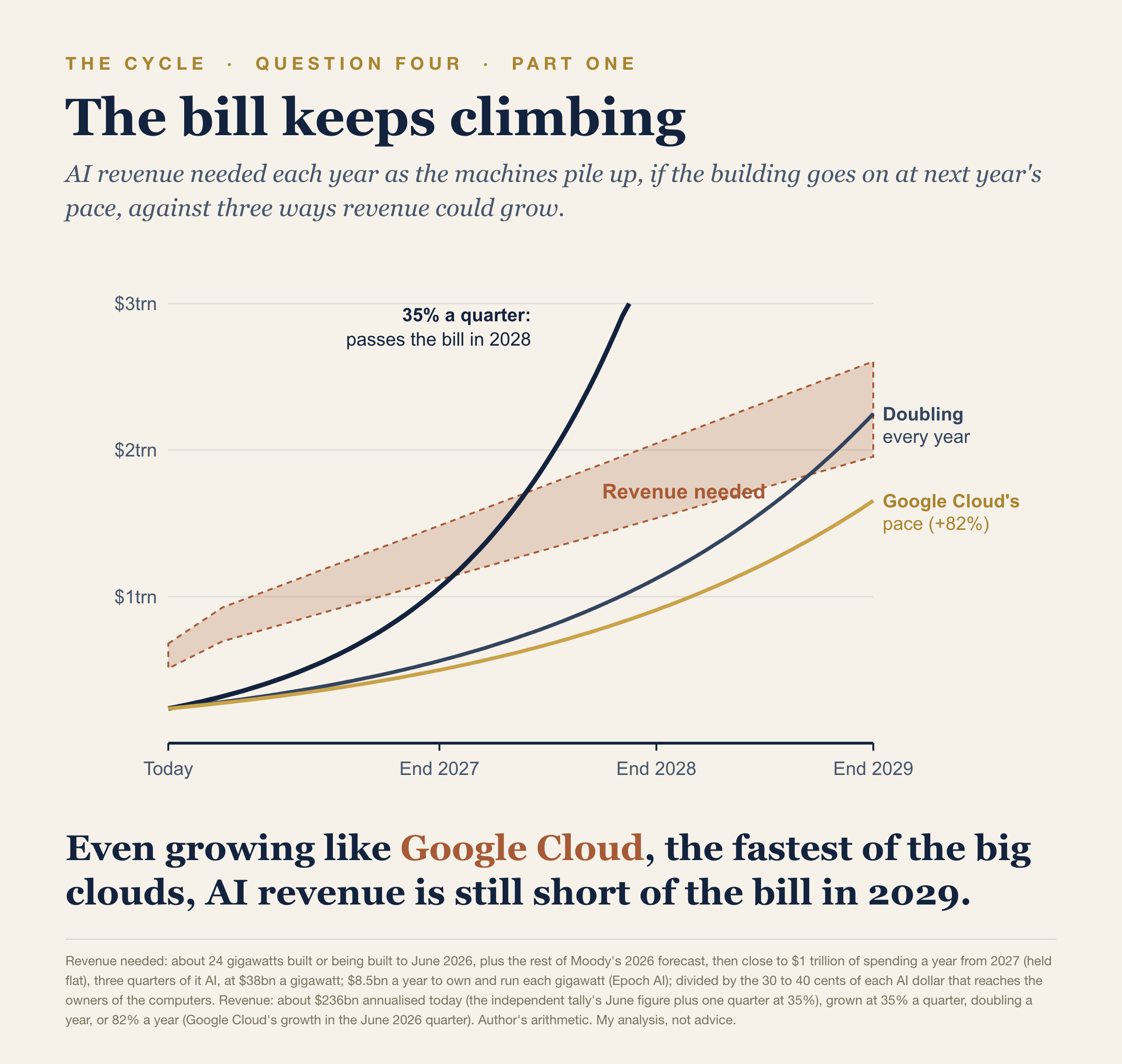
Now set revenue against it. An independent tally, global excluding China, puts annualised AI revenue at $175 billion in June, after four quarters of growth of 35% or more. [22] Add one more quarter at that pace and it is about $236 billion today.
Even if revenue keeps growing 35% a quarter, it is still short of the bill at the end of 2027. It only overtakes in 2028, after growing six to eight times. If it doubles every year, which is faster than any of the three big cloud businesses is growing today, it reaches the low end of the bill only in the second half of 2029, and still not its top end. If it grows as fast as Google Cloud, the fastest of the three at 82% a year, it is still short in 2029. [23]
And growth would have to stay extraordinary after that. The full bill arrives in the 2030s. Revenue of $4 trillion would be about fourteen times all US digital advertising, which was $294.6 billion in 2025, [24] though that sets a world figure against one country’s market. It would also be more than 3% of everything the world produced in 2025. [17]
Each year of building adds $420 billion to $560 billion to the revenue needed. In the last year, AI revenue added about $170 billion. [22] So the new money customers add each year has to roughly triple, and then stay that high for as long as the building goes on. I think that is very unlikely.
Three Wallets, None Can Pay in Time
Revenue is price times volume. The fibre story is why I think the price will not hold. The wallets show who could pay, and why the money cannot arrive in time.
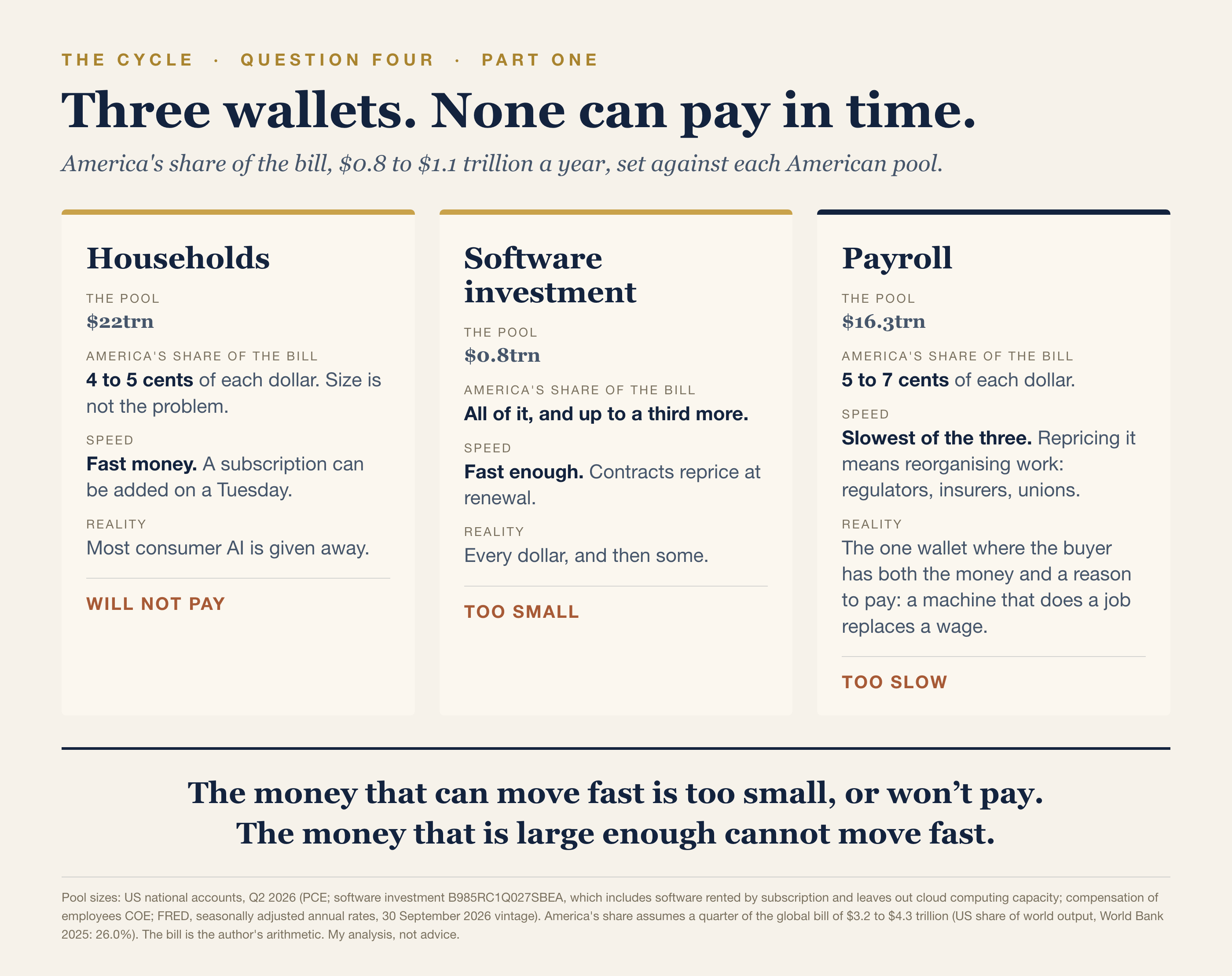
Where would $0.8 trillion to $1.1 trillion a year of American money come from, and fast enough? To keep pace, worldwide AI revenue has to add roughly $0.4 trillion to $0.6 trillion every year while the build-out continues. Three wallets are big enough to discuss: households, software investment and payroll. I also size two smaller pools, advertising and governments.
Households. American consumers spend about $22 trillion a year. [16] If households alone paid America’s share of the bill, $0.8 trillion to $1.1 trillion a year, they would have to spend four to five cents of every dollar they spend on AI. The problem is pricing power. Household money moves fast: you can add a $20 subscription on a Tuesday. Paid plans exist at about that price. Meta’s Premium plan costs $19.99 a month. [25] But even 100 million people paying $20 a month is $24 billion a year, small next to a bill in the trillions. And most consumer AI is given away. Google’s Gemini has a free plan and 950 million monthly users. [26] Meta puts its assistant in WhatsApp for free. The paid plans it announced on 15 September add extras such as more media generation. Meta says the core experience stays free. [25] Apple includes its own at no extra cost, but it limits daily use of its server-based features and has said expanded access will be available for a fee. [27] DeepSeek and Alibaba release leading models that anyone can download for nothing. [28] A provider that charges a premium risks losing the household to a free alternative.
Advertising and governments. Two other pools could pay. Both are smaller than they sound. American digital advertising was $294.6 billion in 2025, and search alone is 38.8% of it. [24] Even if every dollar moved into AI, it would cover only a quarter to a little over a third of America’s share of the bill. And the whole market grew by about $36 billion in 2025. If AI is paying for itself through better advertising, it is doing so in tens of billions, not trillions. Published federal IT budgets, civilian and defence, add up to about $134 billion for fiscal 2026, and AI is only part of that. The Pentagon’s figure is its request. [29] I have not sized state and local government. Part two comes back to both.
Software investment. American businesses invest about $810 billion a year in software, as the national accounts count it: software bought, including software rented by subscription, and software built in-house. It leaves out what businesses pay for cloud computing capacity. [16] America’s share of the bill is all of it, and up to a third more. Software contracts reset when they renew, so this money moves fast. It is too small on its own. I have not sized what businesses pay for cloud computing capacity, or for IT services and outsourcing beyond custom software.
Payroll. American employers pay $16.3 trillion a year in wages and benefits. [16] If employers alone paid America’s share of the bill, it would take five to seven cents of every dollar they spend on wages and benefits. This is the one wallet where a buyer has both the money and a reason to pay: a machine that does a job replaces a wage. It is also where AI could finally build the lock-in that gives a seller pricing power. Once a company rebuilds its work around a model, leaving could become hard.
But payroll moves slowest. Taking a share of it is not a software purchase. It is a reorganisation: rewriting job descriptions, rebuilding workflows, retraining staff and accepting legal responsibility for what the machine gets wrong. A tool that is right 95 times out of 100 is a productivity aid, not an employee, because the company answers for the other five. Regulators, insurers, auditors and unions set the pace, and they work in years. Altman called it inertia. It is not in his models. It is in his customers.
And then there is the elephant in the room. Five to seven cents of every payroll dollar is roughly the pay of 8 million to 11 million American jobs, about one job in every fifteen to twenty. [30] If AI really takes that share of payroll, it does so by replacing work that people are paid to do today, through layoffs or through jobs that are never filled. I do not think any government will watch that happen quietly. The better AI gets at the one thing that would pay its bill, the more it invites the politics that slow it down: rules, taxes and limits on what companies may automate.
The money that can move fast is too small, or won’t pay. The money that is large enough cannot move fast enough, and moving it has dire social consequences.
Why I Think This Ends Badly
Even at 35% a quarter, revenue does not catch the bill until 2028. After that, revenue has to add $420 billion to $560 billion a year for as long as the building goes on. Of the wallets I could size, only payroll can feed growth like that, and payroll moves slowly. So growth slows. It has a second reason to slow. Much of today’s growth comes from programmers, as the investor Paul Kedrosky points out. [31] Code is unusual: a short request explodes into thousands of lines that get rewritten again and again. Most office work goes the other way, turning a long inbox into a short summary. And much of the coding boom is a one-off clean-up of old code. Growth led by programmers is a poor guide to the rest of the economy. But the builders do not slow down when growth does. Each of these companies believes the next platform decides who survives, and nobody concedes a platform to protect a margin.
The bill wins the race if growth slows before the machines are paid for. I think it will. So the most likely outcome is that the technology works and the machines get used, but the money that built them does not come back in time to pay the bills.
The contracts run longer than the servers do. OpenAI expanded its commitment to Amazon by $100 billion over eight years, and Anthropic by more than $100 billion over ten. [32] Amazon treats its servers as used up in five to six years. [10] By my reading, not the filing’s, the servers that serve the early years are likely to need replacing before those contracts end. Even a take-or-pay contract protects the owner only while the customer can pay. If the customers’ revenue is late, the owner faces the cost of replacing the servers, and the shortfall lands on whoever lent or invested against that revenue.
And it does not stay inside AI. The seven companies named at the top of this piece are about 30% of the S&P 500. If the money arrives late, their profits take the hit, and every fund that tracks the S&P 500 takes it with them. [7]
I expect it to end in stages rather than in one crash. Sequencing, remember? Part two sets out the stages.
What Would Change My Mind
I am wrong if customers start spending the money, and paying a price that holds. What customers spend is the industry’s revenue, so I would see it at three levels: who is spending, the total, and the price.
The first test is payroll. If American employers are spending five cents of every payroll dollar on AI within two years, about $0.8 trillion a year, payroll is moving fast enough. That is the pay of about 8 million jobs, close to the 8.7 million jobs America lost between the end of 2007 and early 2010, in the slump around the financial crisis, moving to machines within two years. [30] It would be a revolution, in the workplace and in politics, and I think the politics would push back hard. Households, software buyers, advertisers and governments could also spend more than I expect. I would need to see it in disclosed figures, not forecasts. The best place to see it is the AI revenue that the large cloud and business-software companies report from business customers in their quarterly results.
The second test is the total. If AI revenue keeps growing 35% a quarter for the next seven quarters, it passes $1.9 trillion. That means growing about eight times in under two years, from a base that is already about $236 billion. It would take AI from smaller than all US digital advertising to more than six times its size, though that again sets a world figure against one country’s market. [24] I know of no industry of this size that has ever grown that fast. But if it happens, revenue is above what the machines already paid for and the 2027 build together need, even counting the spending since June. Then I am wrong about the race. I would check three sources. Microsoft, Alphabet and Amazon each report cloud revenue every quarter. The large cloud and business-software companies report AI revenue from business customers. Anthropic and OpenAI announce annualised revenue figures.
The third test is price. If AI providers can raise the price of a given level of performance without losing customers, or that price stops falling, the pricing-power problem is smaller than I think. The check is the prices the labs publish for their models, and independent trackers such as Epoch AI. [5] The hardest thing for this test to survive is China. Its labs give away models only a few months behind the best. [5] [28] Its companies have done this before: they make more than 80% of the world’s solar panels, at the lowest cost anywhere. [33] I expect them to do the same to AI and turn it into a commodity sold close to cost. If that happens, there is no pricing power left to find.
Where This Goes Next
That is part one. It leaves one question. If the sums are this hard, who is paying for all of this today?
Not mainly the customers. This year the six builders Moody’s tracks are spending about $785 billion on machines and buildings, on Moody’s forecast. [2] Customers pay at most $250 billion a year for AI. [3] The rest is coming from somewhere else, and some of it is coming from the sellers themselves.
Part two follows the money. It starts with the guarantee at the top of this piece. It shows who else is lending to the buyers. It sets out the best case for AI and why I think it fails. It gives the order in which I expect it to break, and what that does to the stock market.
Figures are from company filings, official statistics and the sources listed below. References marked press-reported or estimated have not been checked against a primary document. The $250 billion revenue ceiling is Aswath Damodaran’s. The rest of the arithmetic is my own.
Figures are from company filings, official statistics and the sources listed below. References marked press-reported or estimated have not been checked against a primary document. The $250 billion revenue ceiling is Aswath Damodaran’s. The rest of the arithmetic is my own.
References
[1] NVIDIA Corporation, Form 8-K filed 17 August 2026 (Item 1.01, residual value guaranties; accession 0001045810-26-000069); Form 10-Q, quarter ended 26 July 2026 (Note 10; accession 0001045810-26-000075)
[2] Moody’s Ratings, hyperscaler capital-expenditure forecast, press-reported (Moody’s report not independently obtained): CNBC, “Moody’s says ‘unprecedented’ AI spending threatens credit quality of Amazon, Meta, Alphabet and others,” 24 July 2026; DataCenterDynamics, “Moody’s: Hyperscaler capex forecasts marked up by $85bn, to close in on $1trn by 2027,” 24 July 2026. Capital expenditure across Microsoft, Amazon, Meta, Alphabet, Oracle and CoreWeave forecast at $785 billion in 2026 and close to $1 trillion in 2027 (Moody’s treats AWS capex as an estimate)
[3] Aswath Damodaran, “AI’s Bar Mitzvah Moment: From Hype & Hope to Business Questions!”, Musings on Markets, first posted 20 August 2026, updated 21 August (current AI revenue “caps out at about $250 billion” on the most upbeat estimates, built from the labs’ annualised run rates plus what xAI, Microsoft and others earn)
[4] Paul A. David, “The Dynamo and the Computer: An Historical Perspective on the Modern Productivity Paradox,” American Economic Review 80(2), Papers and Proceedings, May 1990, pp. 355 to 361: in 1899 electric motors were less than 5% of factory mechanical drive and electric lighting reached 3% of US homes; slightly more than half of factory drive was electrified in the early 1920s, four decades after the first central power station; regulated regional utility rates were lowered substantially relative to the general price level after 1914 to 1917; early retrofits added motors to belt-and-shaft layouts, and the productivity gains came with redesigned factories
[5] Epoch AI, Luke Emberson and David Roodman, “The plunging price of thought,” epoch.ai/publications/the-plunging-price-of-thought, 22 September 2026 (updated 23 September): the cost of achieving a given level of AI performance has fallen about 47% per quarter since 2023, or 13 times a year; 7 to 10 times a year on game puzzles, 16 to 19 times on maths; fastest when a level is first reached (75 times a year), slowing to 4.7 times a year two years later; the most intense price competition near the state of the art has been between closed-weight models. Epoch AI, Luke Emberson, “Open-weight models lag state-of-the-art by around 3 months on average,” 30 October 2025. An earlier Epoch data insight (Cottier, Snodin, Owen and Adamczewski, 12 March 2025) found per-token price declines of 9 to 900 times a year. The same report: the average US residential price of electricity fell by a compounded 1.05 times a year between 1892 and 1973
[6] David Senra, “Sam Altman, OpenAI,” episode of the David Senra podcast, page dated 23 August 2026 (davidsenra.com/episode/sam-altman); the transcript is machine-generated and the audio was not reviewed
[7] State Street Global Advisors, SPDR S&P 500 ETF Trust daily holdings, as of 29 September 2026 (downloaded 1 October 2026): Nvidia 8.3%, Microsoft 5.7%, Amazon 3.7%, Alphabet 5.5% (two share classes), Meta 2.5%, Broadcom 2.6%, Micron 1.8%, together about 30%. The author’s selection of companies that are building AI or selling to those who do
[8] Elise A. Couper, John P. Hejkal and Alexander L. Wolman, “Boom and Bust in Telecommunications,” Federal Reserve Bank of Richmond Economic Quarterly, Fall 2003: the mantra that internet use doubles every three to four months; traffic roughly doubling every year since 1996 (Coffman and Odlyzko); annual fibre deployment more than four-fold, 1996 to 1999; fibre capacity of about 2.5 gigabits a second in 1996 and 100 by 2000; demand for long-haul capacity grew more slowly than forecast; ‘capacity prices are dropping’ (America’s Network, February 2001); Nasdaq telecom index peaked on 10 March 2000 and fell 62% by the end of 2000
[9] Federal Communications Commission, Order and Authorization DA 03-3121, In the Matter of Global Crossing Ltd. (Debtor-in-Possession), adopted 8 October 2003: network in 27 countries; Chapter 11 petitions filed on 28 January 2002; under the reorganisation, Singapore Technologies Telemedia invests $250 million in New GX, Global Crossing relinquishes all of its equity and voting interest in New GX, and its creditors receive New GX shares. Global Crossing Ltd., Form 10-K for fiscal 2002 (filed 8 December 2003), Item 1: holders of common and preferred shares “will not receive any distribution under the plan”
[10] Alphabet Inc., Form 10-K for fiscal 2025 (servers and network equipment generally six years); Amazon five to six years; Meta five to five and a half; Microsoft two to six; Oracle and CoreWeave six (each company’s Form 10-K, Note 1 or equivalent). The filings give lives for servers and network equipment as a class, not for AI accelerators specifically
[11] CoreWeave, Inc., Form 10-K for fiscal 2025: customers purchase a specified amount of capacity on a take-or-pay basis over the contract term, payment due regardless of the level of utilisation; contracts typically include a prepayment, and the weighted-average prepayment across all active contracts was 15% to 25% of total contract value at the end of each of 2023, 2024 and 2025; over 98% of 2025 revenue came from committed contracts
[12] Oracle Corporation, Form 10-Q, quarter ended 31 August 2026, filed 11 September 2026 (remaining performance obligations $664 billion; about 13% expected to be recognised as revenue in the next twelve months, 37% in months 13 to 36, 34% in months 37 to 60)
[13] Stray Narratives calculations on EODHD cash-flow data, spot-checked against Microsoft’s and Amazon’s filings: Microsoft, Amazon, Alphabet, Meta, Oracle and CoreWeave together, four quarters to June 2026: operating cash flow $714bn, capital expenditure $607bn, net borrowing $237bn, new shares $30bn; quarter to June 2026: capital expenditure about $200bn against operating cash flow about $196bn. Leases signed but not yet commenced, mostly for data centres: Microsoft $329.1bn (Form 10-K, fiscal 2026), Meta $279.0bn, Amazon $137.2bn and Alphabet $85.2bn of future payments (Forms 10-Q, second quarter of 2026), about $830bn in all
[14] Epoch AI, Amelia Michael and Ben Cottier, data insight on data-centre costs, epoch.ai/data-insights/ai-datacenter-cost-breakdown, 14 May 2026: about $38 billion up front and $0.9 billion a year to operate per gigawatt of IT capacity; about 69% of the up-front cost is servers and network equipment and about 30% the facility; lives of five years for IT equipment and fourteen for the facility; annualised to about $8.5 billion a year at the industry’s cost of capital (Epoch’s own sensitivity: $12 billion at a three-year server life, $7 billion at seven years). The author’s calculation on Epoch’s split and lives: the whole stock is used up at about 12.8% of its cost a year, an average life of about 7.8 years (rounded in the text to 13% and 7.7 years). With server lives of 5.5 to 6 years the same split gives 11.8% to 12.3%; with building lives of 25 to 40 years it gives 6.0% to 8.9%, which would raise the stock and the bill
[15] Stray Narratives calculations on EODHD data tied to the companies’ Forms 10-Q: Microsoft, Amazon, Alphabet and Meta, return on capital = after-tax operating profit ÷ (equity + long-term debt − cash and short-term investments); twelve months to June 2026 about 28.4 cents before tax and 22.7 cents after tax (effective tax rate about 20%). Amazon’s long-term debt of $128.9 billion is taken from its Form 10-Q because the data feed omits it. Cost of capital before tax: Aswath Damodaran, Cost of Capital by Sector (US), January 2026, after-tax cost of capital 7.8% for computer services and 9.3% for software (system and application), grossed up at the 20% effective tax rate to about 10% to 12%
[16] US Bureau of Economic Analysis via FRED, second quarter 2026, seasonally adjusted annual rates, vintage of 30 September 2026: federal national defense consumption expenditures and gross investment FDEFX, about $1.19 trillion; private fixed investment in software B985RC1Q027SBEA, about $810 billion (software bought, including hosted software rented by subscription, and software built in-house; fees for cloud computing capacity are outside it; BEA, NIPA Handbook chapter 6, and Rassier, Kornfeld and Strassner, “Treatment of Data in National Accounts,” May 2019); compensation of employees COE, about $16.3 trillion; personal consumption expenditures PCE, about $22 trillion (average of the three months)
[17] World Bank, GDP (current US$), NY.GDP.MKTP.CD, 2025: United States $30.77 trillion of a world total of $118.35 trillion, 26.0%
[18] Stray Narratives calculations on EODHD data: quarterly capital expenditure, Microsoft, Amazon, Alphabet, Meta, Oracle, CoreWeave and Nebius, Q1 2023 to Q2 2026 (Oracle’s fiscal quarters mapped to the nearest calendar quarter), about $1.18 trillion; three quarters of the total assumed AI infrastructure; $38 billion a gigawatt of IT capacity per Epoch AI; the result is about 23.4 gigawatts to the end of June 2026, shown as roughly 24 (spending since June adds more). Capital expenditure counts spending including construction in progress, so the capacity is built or being built. First half of 2026 at the six companies Moody’s covers: about $344 billion, leaving about $440 billion of Moody’s $785 billion 2026 forecast for the second half (author’s calculation from the companies’ filings)
[19] Epoch AI, “Global AI power capacity is now comparable to peak power usage of New York State,” epoch.ai/data-insights/ai-datacenter-power (read 1 October 2026): about 30 gigawatts of total facility power in the fourth quarter of 2025, calculated by multiplying chip power by 2.5 to include cooling and other overhead; not directly comparable with a count of IT capacity
[20] Cost of revenue as a share of revenue, latest fiscal year, from annual reports: total cost of revenue over total revenue: Datadog (2025) 20%; Salesforce (year to 31 January 2026) 22%; ServiceNow (2025) 22%; Snowflake (year to 31 January 2026) 33%; each from the company’s Form 10-K. These lines include hosting and support staff, not only cloud bills. Datadog and Snowflake run mainly on the large public clouds; ServiceNow and Salesforce also operate some of their own infrastructure
[21] Anthropic’s computing cost per revenue dollar, press-reported (Anthropic does not file accounts): internal projection shared with investors, Wall Street Journal, 20 May 2026, via PYMNTS, 21 May 2026, and PitchBook News, 10 June 2026 (71 cents in the first quarter, projected 56 cents in the second). A confidential draft registration reported on 29 September 2026 repeats the 71 cents; I have not seen a second-quarter ratio
[22] Exponential View (Azeem Azhar), “The State of the AI Economy,” 25 June 2026 (slide 7: $175bn annualised run rate, $110bn banked over the trailing twelve months, global excluding China, built from public disclosures and Exponential View’s own models; slide 11: quarter-on-quarter readings of 35%, 41%, 35% and 35%, “equivalent to 3.2x annually”). The four readings compound to 3.5 times, so annualised revenue was about $50 billion in June 2025. Taking the readings as listed, oldest first, it was about $68 billion in September 2025, against about $236 billion today (June’s $175 billion plus one more quarter at 35%): an increase of about $170 billion over the year (author’s calculation)
[23] Cloud revenue growth year over year, quarters ended June 2026 against June 2025: Microsoft, Azure and other cloud services +43% (earnings release); Amazon, AWS net sales +37% (Form 10-Q); Alphabet, Google Cloud revenue +82% (Form 10-Q). Total cloud revenue, not AI-only; Google Cloud’s growth includes sales of TPU systems recognised from the second quarter of 2026
[24] IAB and PwC, Internet Advertising Revenue Report: Full Year 2025, April 2026 (US internet advertising revenue $294.6 billion, up 13.9% on 2024; search 38.8% of the total)
[25] Meta, “Meet Your New Assistant: Meta AI, Built With Llama 3,” 18 April 2024 (free in its apps); Meta, “Introducing Meta One,” 15 September 2026 (about.fb.com/news/2026/09/introducing-meta-one-subscription-service-more-features-ai/): paid plans from $2.99 to $499 a month, Premium $19.99, and “the core experience across our apps and Meta AI has always been free, and that’s not changing”
[26] Google, Gemini subscription plans page (read 26 September 2026); Alphabet Q2 2026 earnings, CEO remarks, 22 July 2026 (Gemini app, 950 million monthly active users)
[27] Apple Newsroom, “Siri AI, a profoundly more capable and personal assistant, is here,” 14 September 2026 (daily usage limits on server-model features; “Expanded access to such features will be available for a fee in the future”); Apple Newsroom, “Apple Intelligence is available today on iPhone, iPad, and Mac,” 28 October 2024 (introduced as a free software update)
[28] Model cards and licences on Hugging Face (read 26 September 2026): DeepSeek (MIT License); Alibaba Qwen (Apache 2.0 for mid-size models; the flagship Qwen3.8-2.4T-A95B under the Qwen3.8-Max License, free of charge, with a separate licence for large hosted-service businesses); Moonshot AI Kimi K3 (Kimi K3 License, “free of charge”)
[29] Office of Management and Budget, Analytical Perspectives, Budget of the US Government, Fiscal Year 2027 (April 2026), chapter 5 (civilian federal IT spending $67.9 billion in fiscal 2026, Chart 5-2; excludes the Department of War); US Department of Defense, Information Technology and Cyberspace Activities, FY 2026 President’s Budget Request overview, August 2025 (request $66.1 billion). Together about $134 billion; intelligence-community IT outside the Department of Defense is not included
[30] US Bureau of Labor Statistics via FRED, total nonfarm payroll employment PAYEMS, September 2026: 159.0 million jobs. Average compensation per job about $103,000 (compensation of employees, about $16.35 trillion, divided by payroll jobs); $0.8 trillion to $1.1 trillion is the pay of about 7.8 million to 10.7 million jobs (author’s calculation). The same series fell from 138.4 million in December 2007 to 129.7 million in February 2010, a loss of about 8.7 million jobs
[31] Paul Kedrosky (SK Ventures), interview on Between Two COOs with Michael Koenig, “The AI Bubble Has a Due Date. It’s 2029,” 22 September 2026 (transcript machine-generated): early AI demand is dominated by coders, whose token use is expansive, while most office use is compressive; much coding work is a one-time refactoring of old code
[32] Amazon.com, Inc., Form 10-Q, quarter ended 30 June 2026 (Note 1): OpenAI’s commitment to AWS expanded by $100.0 billion over 8.0 years, Anthropic’s by more than $100.0 billion over 10.0 years
[33] International Energy Agency, Special Report on Solar PV Global Supply Chains, July 2022, executive summary: China’s share in all the manufacturing stages of solar panels (polysilicon, ingots, wafers, cells and modules) exceeds 80%; China is the most cost-competitive location for every part of the supply chain, with costs 10% lower than India, 20% lower than the United States and 35% lower than Europe